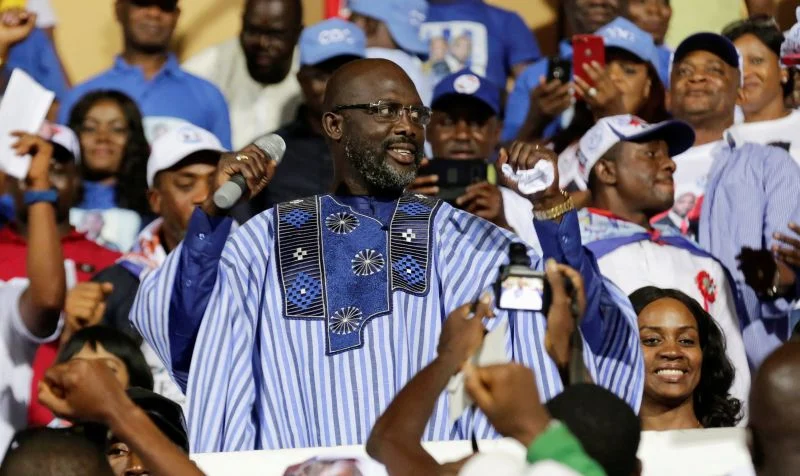
The remarkable journey of George Tawlon Manneh Oppong Ousman Weah, a name synonymous with footballing excellence and now with political leadership, reached a momentous peak in December 2017 when he was officially elected President of Liberia. This transition from the global football arena, where he was once crowned the World’s Best Player, to the highest office in his native land, marks one of the most compelling narratives of modern times. Weah, affectionately known as George Weah, carved his name in football history through stellar performances for iconic clubs such as AC Milan, Manchester City, and Chelsea, before dedicating himself to public service following his retirement from the sport.
Born on October 1, 1966, in Monrovia, Liberia, Weah’s innate talent for football was evident from his formative years. His early days were spent honing his skills on the sandy pitches of his hometown, a humble beginning that belied the global superstardom that awaited him. His initial foray into organized football saw him play for local clubs including Invincible Eleven, Mighty Barolle, Bongrange Bonguine, and Young Survivors of Claretown. Even in his youth, his leadership qualities and exceptional abilities shone through. He was instrumental in guiding Young Survivors, a team that reportedly operated without a coach, to promotion into the top division, showcasing an early aptitude for overcoming challenges and inspiring success.
At the age of 19, Weah’s prodigious talent caught the eye of Tonnerre of Yaoundé, a prominent club in Cameroon. He signed a three-year contract in 1987, and his impact was immediate. In his debut season, he contributed significantly to Tonnerre’s triumph in the top-tier league championship, marking his first major career title and signaling his arrival on the continental football stage. This success served as a springboard for further opportunities, and it wasn’t long before his name was being discussed in European football circles.
The burgeoning talent of George Weah did not go unnoticed by the scouts of AS Monaco, a club then competing in France’s top flight, Division 1. At the age of 22, he made the move to France, embarking on a five-season tenure from 1987 to 1992. During his time with Monaco, Weah established himself as a formidable force, netting an impressive 57 goals across all competitions. His contributions extended beyond individual scoring; he was a key player in Monaco’s victory in the French Cup in 1991, adding another significant trophy to his burgeoning collection and demonstrating his ability to perform on the biggest stages.
Weah’s electrifying pace, his remarkable ball control, and his pinpoint accuracy in front of goal quickly endeared him to fans and garnered widespread admiration. His relentless work ethic, coupled with an uncompromising technical prowess, made him a highly sought-after player. These attributes ultimately led to a lucrative contract offer from Paris Saint-Germain (PSG), another powerhouse in French football.
At PSG, Weah’s reputation as a world-class footballer solidified. He played a pivotal role in the club’s success, helping them secure the French Cup, clinch the league title, and reach the semi-finals of the prestigious UEFA Champions League in the 1994-95 season. His goal-scoring exploits in Ligue 1 were exceptional, accumulating 37 goals and 3 assists in 123 appearances, further cementing his status as one of Europe’s most prolific strikers. His performances in the Champions League, in particular, brought him to the attention of a global audience, showcasing his ability to compete and excel against the continent’s elite clubs.
In 1995, a significant transfer occurred that saw George Weah move to Serie A, Italy’s top football league, joining the illustrious AC Milan. The transfer fee was substantial, reflecting his immense value and proven track record. His impact at AC Milan was immediate and profound. He was instrumental in leading the club to two Serie A titles, in 1996 and 1999, solidifying AC Milan’s dominance during that era. His spell in Italy represented the zenith of his footballing career. Over 114 appearances for AC Milan, he scored 51 goals and provided 1 assist, a testament to his consistent goal-scoring threat.
The year 1995 marked a personal pinnacle for George Weah as he was awarded the prestigious FIFA World Player of the Year award, a recognition of his unparalleled talent and impact on the sport. This was followed by the Ballon d’Or in 1996, further cementing his status as the greatest footballer of his generation. These accolades are not merely individual honors; they represent a period where Weah not only excelled individually but also elevated the profile of African football on the global stage. He became the first and only African player to win these prestigious awards, breaking barriers and inspiring millions across the continent.
The Transition to Politics
Following his illustrious football career, George Weah transitioned from the roar of the crowds to the complexities of the political arena. His decision to enter politics was not a sudden whim but a deliberate choice driven by a desire to serve his country and address the challenges Liberia faced. He recognized that his platform and influence could be leveraged for the greater good of his nation.
Weah’s political journey began in the early 2000s. In 2005, he made his first bid for the presidency, running as the candidate for the Congress for Democratic Change (CDC) party. While he garnered significant support, he ultimately lost to Ellen Johnson Sirleaf, Africa’s first elected female head of state. Despite the defeat, this initial foray into politics demonstrated his commitment and the trust many Liberians placed in him. He continued to engage with the Liberian people, advocating for development and improved governance.
His political aspirations did not wane, and he ran for the Senate representing Montserrado County in 2014, winning the election and serving as a Senator. This period provided him with valuable experience in legislative processes and a deeper understanding of the country’s governance structures. It was during this time that he continued to build his political base and refine his vision for Liberia.
The Road to the Presidency
The 2017 presidential election presented George Weah with another opportunity to lead Liberia. He ran again for the presidency, this time as the candidate for the Coalition for Democratic Change (CDC). The campaign was intense, characterized by rallies, public debates, and extensive grassroots mobilization. Weah’s message resonated with a populace yearning for change and economic improvement. His past as a national hero, coupled with his promises of tackling corruption, creating jobs, and improving education and healthcare, struck a chord with voters.
The election results, announced in December 2017, declared George Weah the winner, marking a historic moment for Liberia. He secured a decisive victory, with the National Elections Commission reporting that he had won over 61% of the vote in the runoff election. This victory was not just a personal triumph but a reflection of the widespread desire for a new direction in Liberian leadership.
Broader Impact and Implications
George Weah’s ascension to the presidency has had profound implications, both domestically and internationally.
Domestic Impact:
- Symbol of Hope and Change: For many Liberians, Weah’s election represented a significant shift from the traditional political establishment. His background as a self-made man from humble beginnings offered a powerful symbol of hope and possibility for a generation that had endured decades of civil war and economic hardship. His supporters saw him as an outsider who could bring fresh perspectives and break the cycle of corruption that had plagued the nation.
- Economic Development and Job Creation: A key promise of Weah’s campaign was to revitalize Liberia’s economy, which has struggled with high unemployment and poverty. His administration has faced the immense challenge of creating sustainable economic growth, attracting foreign investment, and improving the living standards of its citizens. The success of his economic policies will be crucial in determining the long-term impact of his presidency.
- Governance and Anti-Corruption Efforts: Weah pledged to combat corruption, a persistent issue that has hindered Liberia’s progress. Implementing effective anti-corruption measures, promoting transparency, and ensuring accountability within government institutions are vital for rebuilding public trust and fostering good governance.
- Youth Engagement: As a former youth icon, Weah’s presidency has the potential to inspire and engage Liberia’s large youth population. Empowering young people through education, skills training, and access to opportunities is critical for the nation’s future.
International Impact:
- African Leadership Narrative: Weah’s journey from football superstar to head of state contributes to a growing narrative of African leaders emerging from diverse backgrounds and bringing new energy to governance. It highlights the potential for individuals with global recognition and strong public appeal to transition into impactful political roles.
- Diplomatic Relations: As president, Weah has been tasked with navigating Liberia’s international relations, fostering partnerships, and advocating for the nation’s interests on the global stage. His background as a globally recognized figure can be an asset in building bridges and attracting international support for Liberia’s development agenda.
- Inspiration for Developing Nations: Weah’s story serves as an inspiration for other developing nations, demonstrating that individuals from outside traditional political structures can achieve the highest office through popular support and a commitment to public service. It underscores the importance of grassroots movements and the power of charismatic leadership in driving political change.
Conclusion
George Weah’s trajectory from the football pitch to the presidential palace is an extraordinary testament to his ambition, talent, and the profound impact he has had on both the sporting and political landscapes. His election as President of Liberia in December 2017 was a watershed moment, marking a new chapter for the nation. While the challenges ahead are considerable, Weah’s unique background and his commitment to his country offer a beacon of hope. His legacy will ultimately be defined by his ability to translate his vision into tangible progress, improve the lives of Liberians, and steer the nation towards a more prosperous and equitable future. The world watches with keen interest as this former footballing icon embarks on his most challenging and potentially most rewarding match yet: the presidency of Liberia.