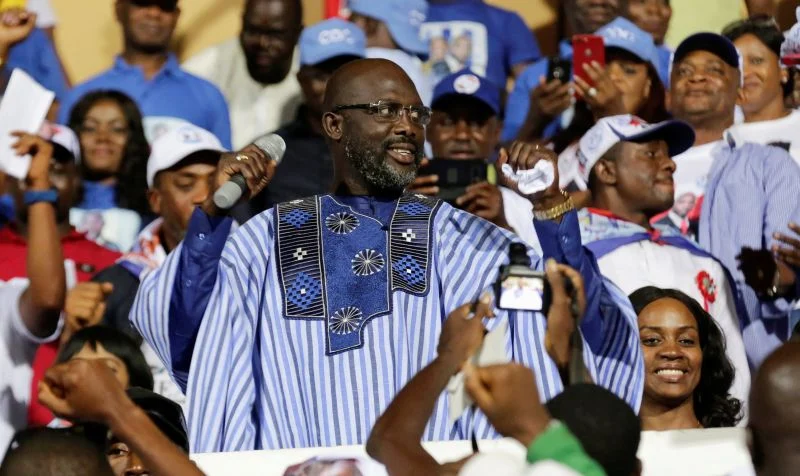
The remarkable journey of George Tawlon Manneh Oppong Ousman Weah, a figure who transcended the world of football to ascend to the highest political office in his native Liberia, is a narrative of extraordinary achievement and unwavering dedication. In December 2017, less than two decades after being crowned the world’s best footballer, Weah was officially elected President of Liberia, marking an unprecedented transition from the sporting arena to the presidential palace. His illustrious football career saw him grace some of Europe’s most prestigious clubs, including AC Milan, Manchester City, and Chelsea, before he ultimately pivoted his focus to public service and the political landscape of his homeland.
Born on October 1, 1966, in Monrovia, Liberia, Weah’s prodigious talent for the beautiful game was evident from a young age. His early years were spent honing his skills on the dusty pitches of his hometown, a humble beginning that belied the global stardom that awaited him. He began his amateur career playing for local Liberian clubs such as Invincible Eleven, Mighty Barolle, Bongrange Bonguine, and Young Survivors of Claretown. Even in his teenage years, Weah demonstrated exceptional leadership and skill, famously captaining Young Survivors, a team reportedly operating without a formal coach, to promotion into the top division of Liberian football. This early success foreshadowed his ability to inspire and elevate those around him.
His burgeoning talent did not go unnoticed, and in 1987, at the age of 22, he was signed by Cameroonian club Tonnerre Yaoundé of the Elite One division. His impact was immediate, contributing significantly to the team’s league championship victory in his inaugural season. This move marked his first foray into professional football outside of Liberia, exposing him to a higher level of competition and further refining his already impressive skillset.
The following year, his performances attracted the attention of AS Monaco, a prominent club in the French top flight, Ligue 1. Weah’s transfer to Monaco in 1988 proved to be a pivotal moment in his career. Over five seasons with the club, from 1988 to 1992, he netted an impressive 57 goals. His time at Monaco was not only personally successful but also saw the club achieve silverware, notably winning the Coupe de France (French Cup) in 1991. His electrifying pace, exceptional dribbling ability, and pinpoint accuracy in front of goal made him a fan favorite and a formidable opponent.
Weah’s relentless work ethic and uncompromising technical prowess continued to capture the attention of Europe’s elite clubs. In 1992, he made a high-profile move to Paris Saint-Germain (PSG). Under the bright lights of the French capital, Weah solidified his reputation as one of the world’s most exciting forwards. His tenure at PSG was marked by significant team success and individual brilliance. He was instrumental in leading the club to a Coupe de France title, a Ligue 1 championship, and a historic run to the semi-finals of the UEFA Champions League in 1995. His scoring record for PSG in Ligue 1 was outstanding, with 37 goals and 3 assists in 123 appearances, underscoring his consistent goal-scoring threat.
The next chapter of his career saw Weah embark on what would become arguably the most celebrated period of his footballing life. In 1995, Italian giants AC Milan acquired his services from PSG for a substantial transfer fee, a testament to his established status as a world-class player. His move to Serie A, renowned for its defensive solidity, did not deter Weah. Instead, he adapted seamlessly, helping AC Milan secure two Serie A titles in 1996 and 1999. During his five-year spell with the Rossoneri, from 1995 to 2000, he scored 51 goals in 114 appearances, cementing his legacy as a prolific and influential striker.
It was during his time at AC Milan that George Weah reached the pinnacle of individual achievement in the football world. In 1995, he was awarded the prestigious FIFA World Player of the Year award, a monumental accomplishment that recognized him as the greatest footballer on the planet. This was followed by the Ballon d’Or in 1996, further solidifying his status as a global icon. These accolades were not merely symbolic; they represented the culmination of years of dedication, talent, and perseverance, making him the first and, to date, only African player to have won these coveted individual awards.
The Transition to Politics: A New Arena for Leadership
Following his retirement from professional football, George Weah turned his attention to his homeland, Liberia, a nation that had endured years of civil war and struggled with economic development. His decision to enter politics was not a sudden one but a gradual evolution, driven by a desire to contribute to his country’s reconstruction and upliftment. He recognized the immense challenges facing Liberia and believed his platform and influence could be leveraged for positive change.
Weah’s political journey began with his announcement to run for the Liberian presidency. His initial presidential bid in 2005, shortly after his retirement from football, saw him face Ellen Johnson Sirleaf. While he did not win that election, his participation signaled his serious commitment to public service. He continued to engage in humanitarian work and advocacy, building a grassroots support base and articulating his vision for Liberia.
Key Milestones in Weah’s Political Career:
- 2005: First presidential bid, losing to Ellen Johnson Sirleaf.
- 2014: Elected as a Senator representing Montserrado County in the Liberian Senate. This marked his first successful foray into elected office, providing him with invaluable experience in legislative processes and governance. His senatorial tenure saw him champion various initiatives aimed at improving the lives of his constituents and advocating for national development.
- 2017: Second presidential bid. This campaign was characterized by a more robust and organized political movement, drawing on his widespread popularity and a platform focused on anti-corruption, job creation, and improved social services.
The 2017 Presidential Election: A Mandate for Change
The 2017 presidential election in Liberia was a highly anticipated event, with Weah emerging as the leading contender against the incumbent Vice President, Joseph Boakai. The campaign was closely watched, both domestically and internationally, as Liberia sought to consolidate its democratic gains and chart a new course for its future. Weah’s campaign resonated with a large segment of the Liberian population, particularly the youth, who saw him as a symbol of hope and a departure from the established political elite. His slogan, "Change for Hope," encapsulated the aspirations of many Liberians yearning for a better future.
The election process was marked by its initial complexities. The first round of voting, held in October 2017, did not produce a clear winner, necessitating a run-off election between Weah and Boakai. The run-off, scheduled for November 2017, was subsequently postponed due to legal challenges. These delays created a period of uncertainty, but ultimately, the Supreme Court of Liberia paved the way for the election to proceed.
On December 26, 2017, George Weah was declared the winner of the presidential run-off election, securing approximately 61.5% of the vote. His victory was met with widespread jubilation across Liberia, signifying a historic moment for the nation. It marked the first peaceful transfer of power from one democratically elected president to another in over seven decades, a significant milestone for Liberian democracy.
Inauguration and the Presidency: Challenges and Aspirations
George Weah was inaugurated as the 25th President of Liberia on January 22, 2018, at the Samuel Kanyon Doe Sports Complex in Monrovia. His inauguration speech outlined his vision for the country, emphasizing unity, development, and the fight against poverty and corruption. He pledged to serve the Liberian people with integrity and to work tirelessly to build a prosperous nation.
The presidency of George Weah has been characterized by a set of ambitious goals and significant challenges. Liberia, a nation with a rich but often turbulent history, continues to grapple with the lingering effects of civil war, economic underdevelopment, and infrastructure deficits. Weah’s administration has focused on several key areas:
Key Policy Initiatives and Challenges:
- Economic Development: A primary focus has been on attracting foreign investment, creating jobs, and diversifying the Liberian economy, which is heavily reliant on natural resources and foreign aid. Challenges include a lack of robust infrastructure, limited access to capital for local businesses, and global economic fluctuations.
- Anti-Corruption: Weah has made combating corruption a cornerstone of his presidency, recognizing it as a major impediment to national progress. His administration has implemented measures to enhance transparency and accountability in government, though the deep-rooted nature of corruption presents a persistent challenge.
- Social Services: Improving access to quality education and healthcare remains a critical priority. The government has sought to expand school enrollment, improve teacher training, and strengthen the healthcare system, which was severely tested by the Ebola epidemic and continues to face resource constraints.
- Infrastructure Development: Significant investment is needed to upgrade Liberia’s roads, power grids, and communication networks to facilitate economic growth and improve the quality of life for citizens.
- Regional and International Relations: Weah has maintained Liberia’s commitment to regional integration and international cooperation, working with neighboring countries and international organizations to address shared challenges.
The Legacy of a Legend: Footballer to Statesman
George Weah’s transition from a global football superstar to the president of his nation is a story that continues to inspire. His journey is a testament to the power of ambition, dedication, and the potential for individuals to effect profound change in their communities and countries. As president, he carries the hopes and aspirations of a nation eager for progress and stability. His leadership, forged on the football pitch and tested in the political arena, is closely watched as he navigates the complex realities of governing Liberia. The world continues to observe his efforts to build a brighter future for a country he has served with distinction both as a player and now as its leader. His legacy is not solely defined by the trophies he won or the goals he scored, but by the enduring impact he has had on the lives of millions and his unwavering commitment to the betterment of Liberia.