
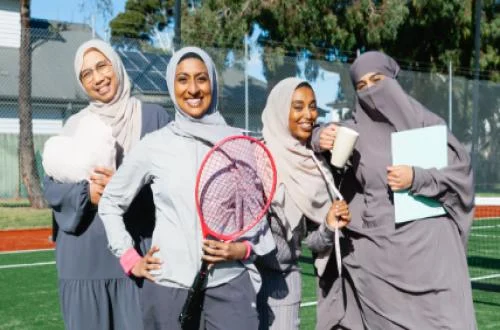
The comedic television series "Salma’s Season" has premiered, offering audiences a nuanced and relatable portrayal of the lives of Muslims residing in Australia. Directed and written by Kauthar Abdulalim, the series aims to delve into the multifaceted experiences of the Muslim community, exploring everyday conflicts and triumphs against the backdrop of Australian society. The premiere and subsequent discussion, held at the Teater Komunitas Utan Kayu in Jakarta on Monday, February 13, 2023, provided a platform for Abdulalim to elaborate on his creative vision and the motivations behind the series.
Abdulalim articulated his intention to capture the humor inherent in shared human experiences, even within the context of cultural and religious identity. He highlighted instances of domestic comedy, such as a husband struggling to find salt in the kitchen, as examples of relatable scenarios designed to resonate with viewers. "For example, a scene where the husband is in the kitchen and can’t find the salt. We laugh because we experience it, and that’s what I want to show," Abdulalim stated during the event. This focus on the mundane and the universally recognizable is a deliberate strategy to humanize and destigmatize the Muslim experience for a broader audience.
Beyond the lighthearted aspects, "Salma’s Season" also addresses the significant challenges faced by Muslims as a minority group in Western countries. Abdulalim specifically pointed to the character of Zoya, portrayed by Lyeba Khan, as an embodiment of these struggles. Zoya’s difficulty in securing employment due to her wearing of the niqab and her Islamic-sounding name serves as a poignant illustration of the discrimination that many Muslims and other ethnic minorities encounter in predominantly white societies. The series sheds light on the subtle yet pervasive barriers that can prevent qualified individuals from being hired, often based on preconceived notions triggered by their names or religious attire. "Sometimes, just seeing your name can lead them not to consider recruiting you," Abdulalim observed, underscoring the systemic nature of such biases.
Diversity Within the Muslim Diaspora in Australia
The premiere and discussion event also featured insights from Yanuardi Syukur, Chairman of the Australia Indonesia Muslim Exchange Program Alumni Forum. Syukur emphasized that "Salma’s Season" effectively showcases the rich diversity that exists within the Muslim community in Australia. He noted that Australia is home to a vast array of Muslim communities, with individuals originating from countries like Lebanon, various African nations, Pakistan, and many others. This multicultural fabric is a key element explored in the series, moving beyond monolithic representations of Muslim identity.
Syukur elaborated on the narrative of survival and adaptation depicted in the series. He explained that the characters, much like real-life immigrants, are striving to build lives and find their footing in a new environment. The show illustrates their strategies for navigating societal challenges, with Zoya’s name change being presented as a prime example of an "adaptive strategy." This signifies a proactive approach to overcoming obstacles, even if it involves compromising on certain aspects of personal identity to achieve professional goals.
Countering Western Media Narratives
A significant contribution of "Salma’s Season," according to Syukur, is its role in presenting an alternative to the often-negative portrayals of Islam prevalent in Western media. He lamented the tendency of some Western media outlets to conflate Islam with terrorism, a narrative that contributes to Islamophobia and misunderstanding. "In its various versions, Muslims are many. Some wear hijabs, some wear niqabs, some don’t wear hijabs. They are all Muslims in terms of religion," Syukur asserted, advocating for a more inclusive and accurate understanding of Islamic practice and identity. The series, by showcasing the everyday lives and diverse expressions of faith among Muslims, actively works to dismantle these harmful stereotypes.
The Core Narrative of "Salma’s Season"
At its heart, "Salma’s Season" tells the story of Salma, a 45-year-old Australian-Pakistani woman who harbors a lifelong dream of competing in the Australian Open tennis tournament. The series stars Faryaal Jabbar in the titular role. Her friends, Nur, Maryam, and Zoya, are portrayed by Seble Girma, Pudak Nayati, and Lyeba Khan, respectively. Bryan Hynes takes on the role of Salma’s tennis coach, Brod. The ensemble cast brings to life a narrative that intertwines personal aspirations with the broader realities of cultural integration and individual identity.
The series comprises six episodes, each running between six and nine minutes in length. This format allows for concise storytelling and accessible viewing. "Salma’s Season" is currently available for free viewing on the Vidly YouTube channel, making it accessible to a global audience eager to engage with its unique perspective.
Broader Context: Muslim Representation in Media
The emergence of "Salma’s Season" arrives at a time when discussions surrounding media representation of minority groups are gaining significant traction worldwide. Studies have consistently shown that underrepresentation or misrepresentation can have profound impacts on public perception and contribute to social marginalization. For instance, a 2017 report by the USC Annenberg School for Communication and Journalism found that Muslim characters were largely absent or depicted in stereotypical roles in mainstream films and television, often as perpetrators of violence.
The Australian context is particularly relevant. According to the 2021 Australian Census, approximately 3.2% of the Australian population identified as Muslim, representing a growing and diverse demographic. While Australia prides itself on multiculturalism, anecdotal evidence and research suggest that challenges related to religious discrimination persist in various sectors, including employment and education. A 2020 study by the Australian Human Rights Commission indicated that religious discrimination remains a significant concern for many Australians, with Muslims being disproportionately affected.
The Strategic Significance of "Salma’s Season"
The strategic decision to set a series about Muslim life in Australia is noteworthy. Australia, a nation built on immigration and a stated commitment to multiculturalism, offers a complex canvas for exploring issues of identity, belonging, and assimilation. The series can therefore serve as a microcosm for larger debates about integration, secularism, and religious freedom in Western democracies.
Abdulalim’s approach of embedding universal themes within a specific cultural context is a proven method for fostering empathy and understanding. By showcasing relatable human struggles – the pursuit of dreams, family dynamics, and the everyday frustrations of life – "Salma’s Season" aims to build bridges between different communities. The comedic element is crucial in this regard, as humor has the power to disarm and to open up conversations that might otherwise be fraught with tension.
The series’ exploration of Zoya’s challenges, for example, can be seen as a direct response to the persistent issue of Islamophobia, which is often fueled by a lack of direct exposure to the lived realities of Muslims. By presenting Zoya not as a victim but as an individual employing adaptive strategies, the series empowers her character and offers a more hopeful narrative of agency and resilience. This aligns with broader efforts by cultural producers to create content that challenges stereotypes and promotes positive social change.
The Role of YouTube as a Distribution Platform
The choice of YouTube as the primary distribution platform for "Salma’s Season" is also a strategic one. YouTube has become a powerful engine for independent filmmakers and content creators to reach global audiences without the traditional gatekeepers of broadcast television or major film studios. This democratizes content creation and allows for more diverse voices and perspectives to be heard. For a series aiming to offer a fresh perspective on a specific community, YouTube provides a direct channel to viewers who are actively seeking out such content. The free accessibility of the series further amplifies its potential reach and impact.
Future Implications and Audience Reception
The success of "Salma’s Season" will likely be measured not only by viewership numbers but also by its ability to spark dialogue and foster greater understanding. If the series resonates with audiences, it could pave the way for more productions that explore the complexities of Muslim life in Western societies. It also offers a valuable educational tool for those who have limited exposure to Muslim communities.
The reactions from attendees at the Jakarta premiere and discussion suggest a positive reception. The emphasis on relatable humor and the nuanced portrayal of challenges have been highlighted as key strengths. As the series gains wider viewership, it will be interesting to observe how it is received by different audiences, both within Australia and internationally, and whether it can contribute to a more informed and empathetic global conversation about Islam and Muslims. The series’ commitment to showcasing the everyday, the aspirational, and the adaptive strategies of its characters positions it as a potentially impactful piece of contemporary storytelling.
