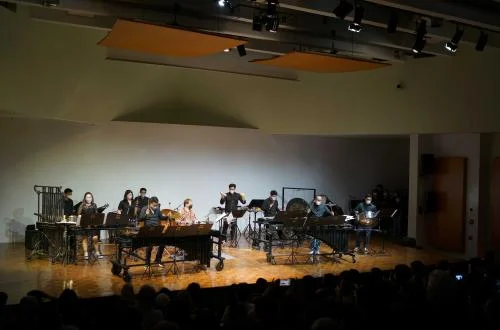
Indonesia’s rich tapestry of musical traditions is deeply interwoven with the percussive arts, a vibrant heritage that positions the archipelago as a potential beacon for percussion development not only in Asia but on a global scale. Despite this immense potential, the full scope of Indonesia’s percussion prowess remains largely untapped. In a significant move to address this gap and propel the genre forward, the Yayasan Musik Amadeus Indonesia (YMAI), a cornerstone of music education and promotion in the nation, has launched a comprehensive initiative culminating in "Kenopsia," its first-ever full percussion concert in its 30-year history.
The landmark event, held at the prestigious GoetheHaus in Jakarta on a recent weekend, featured the Amadeus Percussion Ensemble (Ampere) and showcased the talents of renowned Austrian percussionist Adi Schober. More than just a concert, "Kenopsia" served as the grand finale to a series of YMAI-backed events designed to foster innovation and international collaboration within the Indonesian percussion community. Prior to the concert, YMAI successfully organized the Indonesia Percussion Composition Competition (IPECC) and the Indonesia Percussion Meeting (IPM). These preceding events were instrumental in identifying and nurturing new compositional talent, providing a platform for dialogue and knowledge exchange among percussionists and educators.
A Symphony of New Compositions and Global Collaboration
The "Kenopsia" concert itself was a celebration of both established repertoire and groundbreaking new works. The program opened with James Swearingen’s "Novena," skillfully arranged by I Nyoman Trieswra Minartha, setting a tone of refined artistry. The heart of the first half was dedicated to the world premieres of winning compositions from the IPECC. These included "Dialektika, Dualitas, Kontradiksi" by Arya Pugala Kitti and Lucy Freia, "Restrained" by Andre, "March 16th" by Jeremia Saputra, and the titular "Kenopsia" by Regina Budiyanto Sutisno. The selection of these works underscores YMAI’s commitment to commissioning and premiering contemporary Indonesian percussion compositions, offering fresh perspectives and pushing the boundaries of the genre.
The second half of the concert transitioned into a diverse repertoire, featuring Murray Houllif’s energetic "Blue Samba," a captivating "Solo" piece performed by Adi Schober, and James Bocook’s iconic "The Music of James Bond," with a dynamic arrangement by I Nyoman Trieswara Minartha. The program continued with the infectious rhythms of Alice Gomez and Marily Rife’s "Mambo Africano." The evening reached its crescendo with David Mancini’s "Suite for Solo Drumset and Percussion Ensemble," featuring Adi Schober as the distinguished soloist, demonstrating a masterful interplay between individual virtuosity and ensemble precision. The inclusion of "Solo" and the "Suite" with a drumset soloist highlights the expanding role of the drumset within the concert percussion ensemble, reflecting contemporary trends in the field.
The Amadeus Legacy: Cultivating Musical Excellence for Three Decades
The Yayasan Musik Amadeus Indonesia, and its educational arm, the Sekolah Musik Amadeus (SMA), have been instrumental in shaping Indonesia’s musical landscape since their inception. Founded in 1992 by Grace Soedargo, SMA has cultivated a nurturing environment for musical learning, welcoming thousands of students of all ages, from as young as two years old. The institution’s comprehensive curriculum encompasses a wide range of instruments, including piano, strings, woodwinds, and percussion.
Currently, SMA boasts over 200 students actively engaged in their musical journeys, guided by a dedicated faculty of 25 instructors. The school’s mission extends beyond individual instrument instruction; it actively promotes classical music development in Indonesia through ensemble playing. Students participate in various student orchestras and ensembles, providing invaluable performance experience and fostering a collaborative spirit. A significant distinction for SMA is its affiliation with the Johann Sebastian Bach Musikschule (JSBM) in Vienna, Austria. This unique partnership, making SMA the only music school in Southeast Asia with such a connection, ensures that its students receive an education benchmarked against international standards of excellence, particularly in classical music pedagogy.
"Kenopsia" as a Catalyst for Growth
Grace Soedargo, the visionary founder of YMAI and SMA, articulated the foundation’s strategic intent behind the "Kenopsia" project. "By organizing IPECC, IPM, and the Kenopsia concert, Amadeus aims to make a breakthrough in percussion music in Indonesia," she stated. Her vision is rooted in inspiring Indonesian percussionists to elevate their craft and perform at a global standard. This initiative represents a significant investment in the future of percussion in Indonesia, aiming to create a ripple effect that inspires a new generation of musicians and composers. The synergy between the competition, the meeting, and the culminating concert provides a holistic approach to nurturing talent, fostering creativity, and promoting the art form.
The IPECC, in particular, has been a crucial element in this strategy. By soliciting original compositions, YMAI is actively contributing to the body of contemporary percussion literature in Indonesia. This not only provides performance opportunities for ensembles like Ampere but also encourages Indonesian composers to explore the unique sonic possibilities of percussion instruments. The IPM, on the other hand, serves as an intellectual hub, bringing together practitioners, educators, and enthusiasts to share knowledge, discuss challenges, and envision the future of percussion education and performance in the country.
Adi Schober: A Global Ambassador for Percussion
The involvement of Adi Schober, a distinguished percussionist from Austria, adds a significant international dimension to YMAI’s endeavors. Born in 1967 in Holabrunn, Austria, Schober’s musical journey began at a remarkably young age, starting his percussion studies at five, while also exploring piano, organ, and trumpet. His formal education at the Hochschule für Musik und darstellende Kunst Wien under the tutelage of Prof. Horst Berger laid a strong foundation in classical percussion. He further honed his skills in drumset and percussion with Prof. Fritz Ozmec and delved into jazz percussion at the Konservatorium der Stadt Wien under Prof. Walter Grassmann. His expertise in pedagogy was shaped by Prof. Kurt Prihoda.
Schober’s extensive career includes teaching across Austria, founding the "Adi Schober Quintett," performing with orchestras and big bands, and serving as a music director for various Austrian festivals. Beyond traditional performance, he has been a pioneer in rhythm therapy since 2009, collaborating with Dr. Kurt Sindermann and Dr. Barbara Schaffer to develop therapeutic applications of rhythm for individuals with mental health challenges. His personal recording studio is a testament to his creative output, where he records his improvisational works and also serves as a facility for international organizations like "Internationale Ignaz J Pleyel Gesellschaft" and record labels such as "Gramola" and "Apollon." Schober’s presence at "Kenopsia" served as a bridge between Indonesian and European percussion communities, offering invaluable insights and inspiration through his masterclasses and performance.
Ampere: The Ensemble Driving the Future
The Amadeus Percussion Ensemble (Ampere) itself is a relatively young but dynamic force, established in August 2017, coinciding with the silver jubilee celebrations of the Yayasan Musik Amadeus Indonesia and Sekolah Musik Amadeus. Its formation was a direct response to the establishment of the percussion department at SMA in the same year, with Ryan Saputro at its helm. The primary objective behind Ampere’s creation is to cultivate internationally competitive percussionists from Indonesia. The ensemble’s rigorous training and performance schedule are designed to equip its members with the technical proficiency, musicality, and artistic maturity required to excel on the global stage.
The success of "Kenopsia" and the accompanying initiatives by YMAI signals a promising trajectory for percussion music in Indonesia. By fostering new compositions, facilitating international exchange, and nurturing aspiring talent, YMAI is not merely organizing events; it is actively building an ecosystem that supports the growth and recognition of Indonesian percussionists. The implications of this sustained effort are far-reaching, potentially leading to increased international collaborations, greater representation of Indonesian percussionists in global ensembles and festivals, and the enrichment of Indonesia’s own cultural heritage through innovative musical expressions. The "Kenopsia" event stands as a testament to YMAI’s commitment to unlocking the full potential of Indonesia’s percussive legacy, transforming it from a rich tradition into a dynamic, globally recognized force.