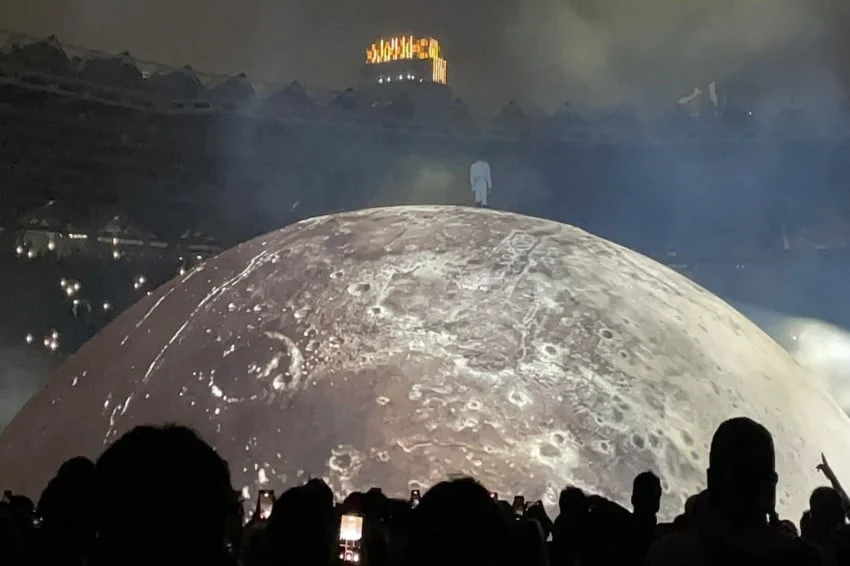
The atmosphere at the Gelora Bung Karno (GBK) Main Stadium in Jakarta reached a fever pitch on the evening of Saturday, October 24, 2026, as American music icon Kanye West, professionally known as Ye, delivered a performance that redefined the standards of live entertainment in Southeast Asia. The event, characterized by its avant-garde stage design and immersive visual storytelling, drew tens of thousands of spectators to the historic venue, marking one of the most significant musical milestones in Indonesia’s recent history.
At the heart of the production was a massive, 360-degree dome structure that served as the focal point for the evening’s theatrical presentation. This architectural feat, positioned centrally on the stadium’s pitch, acted as both a performance platform and a canvas for high-resolution projection mapping, effectively transforming the traditional concert format into an ethereal, multi-sensory experience.
A Technical Marvel: The Engineering Behind the Dome
The scale of the production at GBK was unprecedented. According to event logistics reports, the 360-degree dome was constructed over the course of ten days, requiring a specialized team of structural engineers and visual designers flown in from international production hubs. The dome utilized state-of-the-art projection mapping technology, which synchronized light, shadow, and color to manipulate the viewer’s perception of space.
For the audience, the experience began with a high-definition representation of Earth, rendered with such granular detail that it showcased the shifting patterns of oceans and continents. As the performance progressed, the visual narrative transitioned into a stark, lunar landscape. The transition was seamless, utilizing deep grey tones and intricate crater textures that made the dome appear as a floating celestial body suspended in the dark Jakarta sky.
Ye’s positioning on the structure was equally calculated. Standing at the zenith of the dome—the highest point of the hemispherical structure—the artist appeared as a silhouette against the backdrop of the simulated lunar surface. Clad in his signature oversized, minimalist aesthetic, his presence was understated yet commanding, creating a deliberate contrast between the grandiose scale of the stage and the solitary nature of his performance.
Chronology of an Iconic Evening
The evening began with a meticulously timed sequence of events that signaled the start of a new era for international touring in Indonesia. Doors opened to the public at 4:00 PM, with security protocols and digital ticketing systems operating at high capacity to accommodate the massive turnout.
By 7:30 PM, the stadium was illuminated by a series of ambient soundscapes, setting a meditative tone before the official commencement. At 8:15 PM, the dome began its initial visual sequence, bathing the stadium in a soft, atmospheric light that signaled the beginning of the show.
The main performance commenced at 8:45 PM. Ye’s entry was marked by a sudden change in the stadium’s lighting rig, drawing all attention to the dome. Over the next two hours, the setlist navigated through a career-spanning collection of works, each song punctuated by shifting visual motifs on the dome’s exterior. The show concluded at approximately 10:45 PM, followed by a controlled exit process that was managed by a collaboration between local security firms and the GBK management authority.
Economic and Cultural Impact on Jakarta
The choice of Jakarta as a primary stop for such a technologically complex tour highlights the growing importance of the Indonesian market in the global music industry. GBK, with its capacity to host over 70,000 people, has increasingly become a destination for global artists looking to tap into the demographic dividend of the Southeast Asian region.
From an economic standpoint, the concert generated significant revenue for the local hospitality and tourism sectors. Hotels in the Senayan and Sudirman areas reported near-full occupancy rates throughout the weekend, and local transport authorities noted a sharp increase in public transit utilization as thousands of fans from across the country—and neighboring nations—descended upon the capital.
Beyond the immediate financial gains, the production sets a new benchmark for technical excellence in the region. Industry experts suggest that the successful deployment of the 360-degree dome at GBK will likely encourage future promoters to invest in higher-tier production values for shows in Jakarta, potentially solidifying the city’s status as a top-tier touring hub in Asia.
Official Responses and Security Coordination
The event was the result of months of coordination between local promoters, the Indonesian government, and international production teams. Security remained a top priority throughout the planning phase. The Jakarta Metropolitan Police, in collaboration with private security teams, deployed over 3,000 personnel to ensure the safety of the massive crowd.
In a statement released shortly after the event, a spokesperson for the Gelora Bung Karno Management Center noted the facility’s pride in hosting such a technically demanding production. "The successful execution of this event proves that the GBK stadium is equipped with the infrastructure and professional support systems to handle the most ambitious performances in the world today. We are pleased to have facilitated an event that brings global artistic innovation to the Indonesian public."
While Ye is known for his unconventional public persona, his team maintained a professional silence regarding the logistical nuances of the performance, allowing the art to serve as the primary communication. Observers close to the production noted that the artist was deeply involved in the visual curation, insisting on specific color palettes and projection timings to ensure the "lunar" effect was achieved with scientific accuracy.
Implications for Future Live Entertainment
The success of the "Dome Stage" concept carries significant implications for the future of stadium tours. Traditional concert staging often relies on flat, frontal projection screens that limit the audience’s engagement to a single viewing angle. By contrast, the 360-degree format effectively democratizes the viewing experience, ensuring that every seat in the stadium—regardless of its proximity to the stage—receives a coherent and immersive visual narrative.
This shift toward immersive, architectural-based performances marks a departure from traditional "pop star" concerts, signaling a trend where the performance environment becomes as integral as the music itself. For Indonesia, the ability to host such an event is a clear indicator of the nation’s technological readiness. The integration of high-resolution mapping on a massive scale requires a stable power grid, advanced fiber-optic communication, and a local workforce capable of handling specialized equipment—all of which were successfully managed during the Saturday event.
Critical Reception and Public Sentiment
Social media sentiment throughout the night and in the subsequent hours was overwhelmingly positive, with fans highlighting the visual coherence of the show. Critics and music journalists in attendance noted that while the production was heavily reliant on visual stimuli, it did not diminish the impact of the audio. The dome’s acoustics, despite its open-air nature, were tuned to reflect sound in a way that maintained clarity across the stadium floor and the upper tiers.
"It was less of a concert and more of a digital installation," remarked one industry analyst. "Ye has always pushed the boundaries of what a performance can be, but bringing this level of engineering to a stadium in Jakarta proves that the infrastructure is here to stay."
As the crowds dispersed from Senayan late Saturday night, the consensus among attendees was clear: the evening represented a watershed moment. For many young Indonesian fans, the spectacle was their first experience with a production of such international caliber, an event that will likely influence a new generation of local creatives in the fields of visual arts, engineering, and event production.
Conclusion
The Kanye West concert at Gelora Bung Karno will likely be remembered not just for the artist’s performance, but for the technological ambition that defined it. By transforming the historic stadium into a site of modern architectural and visual wonder, the event underscored the evolving relationship between global entertainment and the vibrant, growing market of Jakarta. As the dust settles at the GBK stadium, the legacy of the dome remains: a testament to the fact that when technology and artistry intersect, they have the power to turn a standard weekend in the city into a global cultural phenomenon. The bar for future performances in Indonesia has been set significantly higher, inviting a new era of innovation in the live music industry.