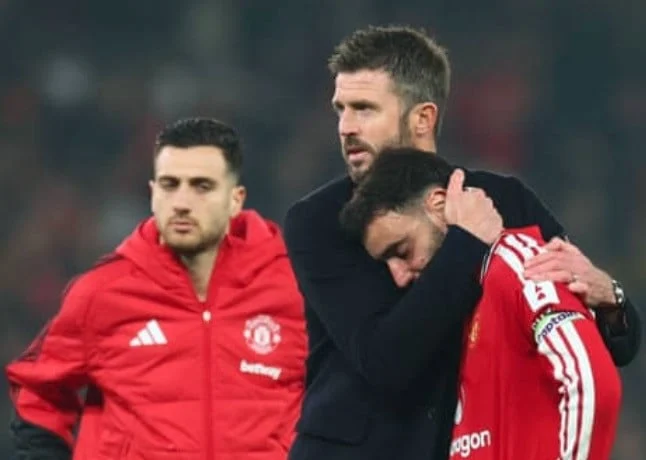
Manchester United has officially terminated the contract of head coach Michael Carrick, marking a significant turning point in a turbulent 2026/2027 season for the Premier League giants. The announcement, confirmed on Thursday, November 12, 2026, follows a comprehensive internal performance review conducted by the club’s executive leadership. The decision signals the end of a tenure that began with immense promise but ultimately succumbed to the persistent inconsistency that has plagued the club’s campaign.
The resolution was finalized at the Carrington training complex during a high-stakes meeting between Carrick and key club officials, including Technical Director Jason Wilcox and Chief Executive Officer Omar Berrada. The session, which lasted approximately 90 minutes, concluded with the mutual acknowledgment that a change in leadership was necessary to arrest the team’s downward trajectory.
The Rise and Fall of a Tactical Transition
To understand the weight of this dismissal, one must examine the context of Michael Carrick’s appointment. When Carrick stepped into the managerial role midway through the previous season to replace Ruben Amorim, expectations were tempered. However, the former United midfielder orchestrated a remarkable turnaround that surprised many critics.
During his initial interim period, Carrick stabilized a fragmented dressing room. His tactical adjustments—focusing on defensive solidity and high-transition efficiency—saw the team surge up the table. By the time the season concluded, Manchester United had secured a third-place finish, a result that earned Carrick widespread acclaim and eventually the permanent managerial position.
His statistical record during that initial period was, by all accounts, elite. Over 17 competitive matches, Carrick guided the team to 12 victories and three draws, suffering only two defeats. A win percentage of 71 percent suggested he had unlocked the potential of a squad that had previously appeared directionless. Yet, the transition from an interim figure to a permanent head coach often brings shifted expectations and intensified scrutiny, a challenge that proved insurmountable for the 45-year-old manager this season.
Chronology of the 2026/2027 Season Struggles
The current campaign has been defined by a stark contrast to the previous year’s late-season surge. While the board expressed confidence in Carrick’s vision during the summer transfer window, the team failed to translate that support into on-pitch consistency.
- August 2026: The season opened with cautious optimism. However, early draws against lower-table opposition signaled a lack of attacking fluidity.
- September 2026: The team suffered back-to-back defeats in the UEFA Champions League group stage, putting pressure on Carrick’s European tactical setup.
- October 2026: A series of disappointing results in the Premier League, including a high-profile loss in the Manchester Derby, prompted the club’s leadership to initiate a formal performance review.
- November 12, 2026: Following a winless streak that saw the team slip to ninth in the league standings, Wilcox and Berrada summoned Carrick to Carrington to finalize his departure.
The decline in output was not merely anecdotal. Advanced metrics revealed that the team’s expected goals (xG) were consistently lower than in the previous season, while their defensive structure allowed more shots on goal per 90 minutes. These figures provided the empirical basis for the club’s decision-making process.
Strategic Analysis: The Disconnect at Old Trafford
The departure of Carrick highlights the systemic challenges inherent in the post-Amorim era at Old Trafford. When an interim manager is elevated to a permanent role based on a short-term sample size, the club often risks conflating "new manager bounce" with sustainable long-term development.
Analysts point to several factors that hindered Carrick’s permanent tenure. Firstly, the lack of tactical evolution in the face of opponents who had successfully studied his methods proved costly. By the start of the 2026/2027 season, opposing managers had developed defensive blocks specifically designed to nullify the quick transitions that Carrick favored.
Furthermore, squad rotation became a point of contention. Frequent changes to the starting XI, intended to manage player fatigue, inadvertently eroded the cohesion that had been built during the previous spring. When the team failed to secure points, the resulting pressure led to increased tension within the training ground, according to sources close to the club.
Leadership and Official Responses
In a brief statement released shortly after the meeting, Manchester United expressed gratitude for Carrick’s service. "The club would like to thank Michael for his hard work, dedication, and the stability he brought during a critical period of transition," the statement read. "While the results of the current season have fallen short of our collective ambitions, Michael’s contribution to the club remains a respected part of our recent history."
While no public comments have been issued by Carrick as of this writing, sources suggest that he remains committed to his managerial career and is expected to take a period of reflection before pursuing new opportunities.
For Wilcox and Berrada, the focus now shifts to the immediate future. The club is reportedly already vetting potential candidates who can provide a more robust, long-term strategic identity. The goal is to identify a manager capable of integrating the club’s youth academy talent with high-level tactical sophistication, a mandate that proved elusive for the previous administration.
Broader Implications for the Club
The sacking of Michael Carrick serves as a sobering reminder of the volatility at the top tier of English football. Manchester United, a club with a history of long-term managerial dynasties, has struggled to find a successor who can replicate the stability of previous eras.
The financial implications of this move are also significant. With the loss of potential revenue from a deep run in the Champions League—now in jeopardy—and the necessity of paying out the remainder of Carrick’s contract, the club’s financial controllers will be under pressure to ensure that the next appointment is both cost-effective and structurally sound.
Furthermore, the morale of the playing squad will be a primary concern. Several key signings brought in during the summer were specifically recruited for Carrick’s tactical system. The transition to a new coach will inevitably cause uncertainty among players, some of whom may find themselves out of favor or in unfamiliar roles depending on the incoming manager’s philosophy.
Looking Ahead: The Search for a New Direction
As the club enters this period of transition, the focus will be on the search for a new head coach who can address the structural deficits in the squad. The criteria for the search are expected to emphasize experience in top-tier European leagues and a proven track record of developing a coherent team identity.
Industry experts suggest that Manchester United may look toward managers who prioritize high-pressing, possession-based football, as this aligns with the modern demands of the Premier League. However, the board is likely to exercise caution, ensuring that the next hire is not merely a short-term fix but a strategic partner in the club’s broader rebuilding project.
The next few weeks will be crucial. With the league season reaching its midpoint, the upcoming fixtures will provide a stern test for the interim coaching staff tasked with maintaining momentum until a permanent replacement is appointed. For the supporters, the hope remains that this decision will provide the necessary impetus to climb the table and regain the competitiveness that has been absent in recent months.
The departure of Michael Carrick is, in many ways, the end of an experiment. It serves as a case study in the difficulties of modern football management, where the gap between success and failure is often measured in narrow margins. As Manchester United turns the page, the challenge remains clear: to build a sustainable, winning culture that can withstand the immense pressures of the modern game.