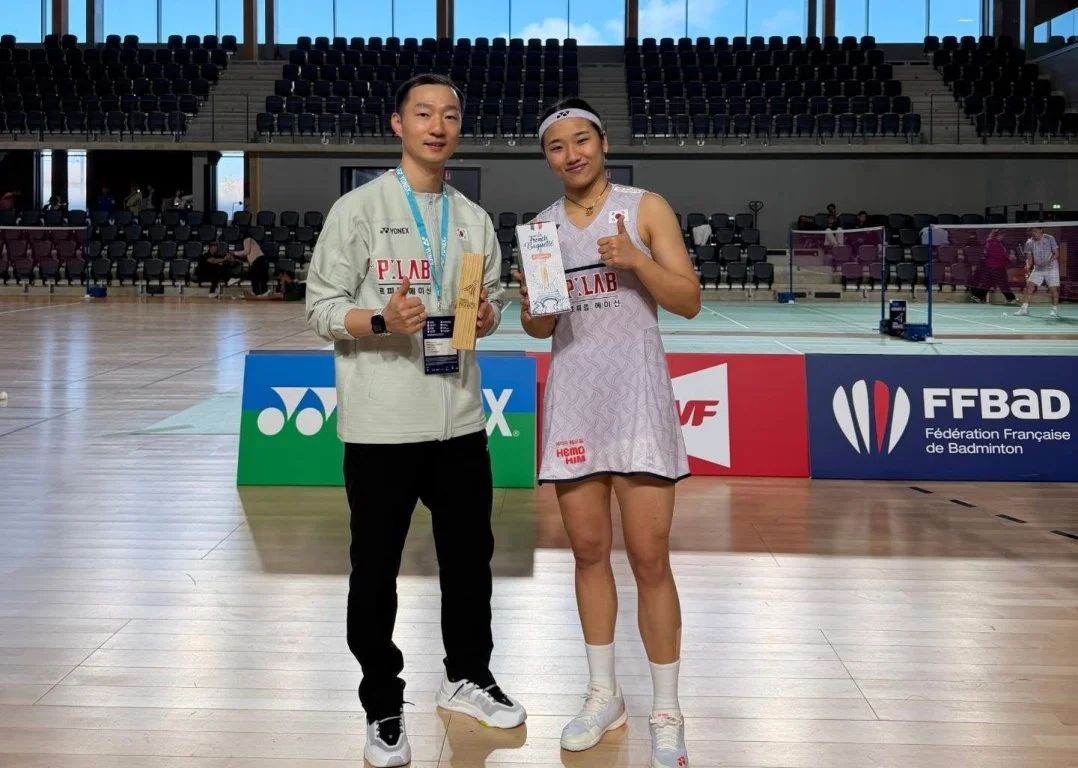
The world of international badminton has recently found itself gripped by a fascinating statistical anomaly at the very pinnacle of the sport. An Se-young, the indomitable women’s singles player from South Korea and the undisputed queen of the discipline, has captured the global spotlight once again through a dominant swing of victories on the European circuit. Yet, despite raising two prestigious trophies aloft in rapid succession, her official Badminton World Federation (BWF) ranking points have stubbornly remained frozen, baffling fans and statisticians alike.
This unexpected standstill has sparked intense discussions within the global badminton community regarding the complex mechanics of the BWF World Rankings system. To the casual observer, winning back-to-back Super 750 titles should instantly trigger a massive surge in ranking accumulation. However, a closer examination of the BWF’s rolling 52-week ranking structure reveals the intricate, and sometimes punitive, mathematical realities that govern elite-level sports rankings. As the sport continues to expand its global calendar, the case of An Se-young serves as a prime illustration of how defending previous triumphs can create a zero-sum game for athletes operating at the absolute zenith of their capabilities.
The European Triumph and the Mechanics of BWF Super 750 Tournaments
The 2026 badminton season has witnessed the continued consolidation of An Se-young’s dominance on the international stage. Continuing a multi-year run of extraordinary consistency, the South Korean phenom embarked on her annual European autumn campaign with surgical precision. Displaying the stamina, tactical acumen, and mental fortitude that have become her trademark, An navigated rigorous draws to claim consecutive titles at the Denmark Open and the French Open.
Both of these prestigious events hold a Super 750 classification on the BWF World Tour. According to the official BWF points distribution regulations, a victory in the singles category at a Super 750 tournament yields a maximum of 11,000 ranking points for the champion. Theoretically, by conquering both Odense and the French venue consecutively, An Se-young secured a massive haul of 22,000 potential ranking points. In a standard tournament progression, such a feat would firmly distance any competitor from their closest pursuers in the race for world supremacy.
However, the reality reflected in the official BWF rankings published on October 27, 2026, told an entirely different story. Despite her back-to-back triumphs in Europe, An’s total accumulated tally remained locked precisely at 122,287 points—the exact same figure she held weeks prior. In fact, a retrospective look at her ranking trajectory shows that her cumulative points total has experienced zero net movement since October 6, 2026, marking nearly a full month of statistical stagnation during a period of active, high-level competition.
The 52-Week Rolling System Explained
To understand why a double-champion can see her points remain completely static, one must examine the fundamental architecture of the BWF World Ranking system. The BWF calculates rankings based on a rolling 52-week window, aggregating a player’s highest-scoring performances from a maximum of ten tournaments within that timeframe. When a player competes in an event, the points earned from that specific tournament replace the points earned at the corresponding tournament from the previous year.
If a player wins a tournament this year, but won that exact same tournament during the previous season, their points tally does not experience a net increase. Instead, the old 11,000 points are simply swapped out for the new 11,000 points, resulting in a net gain of zero. This system is explicitly designed to reward sustained excellence rather than sheer volume of participation, ensuring that athletes must continually defend their past achievements to maintain their ranking status.
In the case of An Se-young, her dominant run through the European leg in 2026 directly mirrored her stellar performances in the corresponding events of the previous season. Because she had already maximum-scored at these exact tournaments a year prior, capturing the titles again merely served to defend her existing cache of points rather than generate fresh additions. This phenomenon highlights the unique burden placed on elite athletes who reach the absolute ceiling of the ranking system; once a player achieves maximum points across their ten countable tournaments, improving or even maintaining that score becomes a mathematical tightrope walk.

The Impact of the Asian Games 2026 and Point Substitution Anomalies
Adding another layer of complexity to An Se-young’s ranking puzzle is the integration of multi-sport games into the BWF structure. Earlier in the 2026 season, An triumphed at the Asian Games in the individual women’s singles category, a monumental achievement that traditionally rewards the gold medalist with a substantial influx of prestige and ranking incentives.
Ordinarily, a victory of that magnitude yields 12,000 ranking points. However, due to the unique calendar placement and the specific weight assigned to continental multi-sport games within the BWF framework, An’s recorded addition following the Asian Games was mysteriously modest, reflecting a net increase of just 1,000 points compared to her standing the previous week. This discrepancy occurs because multi-sport events often interact with the 10-tournament limit in non-standard ways, forcing the system to discard lower-tier tournament results to accommodate the new points, thereby diluting the visible net gain.
The convergence of the Asian Games defense and the successful retention of her European crowns created a saturation point in An Se-young’s ranking profile. With her ledger already packed to maximum capacity with 11,000 and 12,000-point tournament yields from the preceding 52 weeks, the system had no mathematical room to absorb additional numerical value. Every victory she secured was immediately offset by the expiration of an equally valuable result from the historical ledger.
Broader Implications for Elite Athletes and the BWF Tour
The stagnation of An Se-young’s ranking points, paradoxically caused by her own relentless winning streak, sheds light on broader structural debates within professional badminton. Sports analysts and coaching staffs frequently scrutinize the BWF ranking methodology for its lack of transparent dynamism when applied to generational talents who dominate the tour for extended periods.
For athletes and their federations, maintaining the World Number One ranking is not merely a matter of prestige; it carries significant commercial implications, seeding advantages in major international tournaments, and psychological leverage over opponents. When a player of An’s caliber wins two consecutive Super 750 events yet sees her points graph flatline for a month, it underscores the intense difficulty of breaking past historical personal bests once a player reaches the absolute threshold of the ranking algorithm.
From a competitive standpoint, this dynamic places an immense physical and mental burden on players. To improve their ranking buffer, athletes cannot simply rely on defending their titles; they must strategically target higher-tier events—such as BWF World Tour Super 1000 tournaments or the World Championships—where the points ceiling is higher, or they must optimize their ten-tournament schedule to purge lower-scoring finishes. For An Se-young, whose schedule is meticulously managed by her coaching team and medical staff to prevent burnout and injury, strategic withdrawal from minor events is often prioritized over point-chasing.
Conclusion and Future Outlook
As the 2026 badminton season progresses toward its dramatic conclusion, the case of An Se-young stands as a testament to both her supreme mastery of the sport and the rigid constraints of the BWF ranking architecture. While her fans may look at the official weekly updates with confusion as her points remain anchored at 122,287, the underlying reality is a badge of honor. Her numbers are not growing simply because they cannot grow any higher under the current mathematical constraints of defending a flawless past season.
As long as An Se-young continues to hoist trophies in Odense, Paris, and across the globe, her legacy in the sport will be defined by the gold around her neck rather than the fluctuating digits on a ranking spreadsheet. For the badminton world, the focus remains firmly on her extraordinary gameplay on the court, where statistics take a back seat to sheer athletic brilliance.