
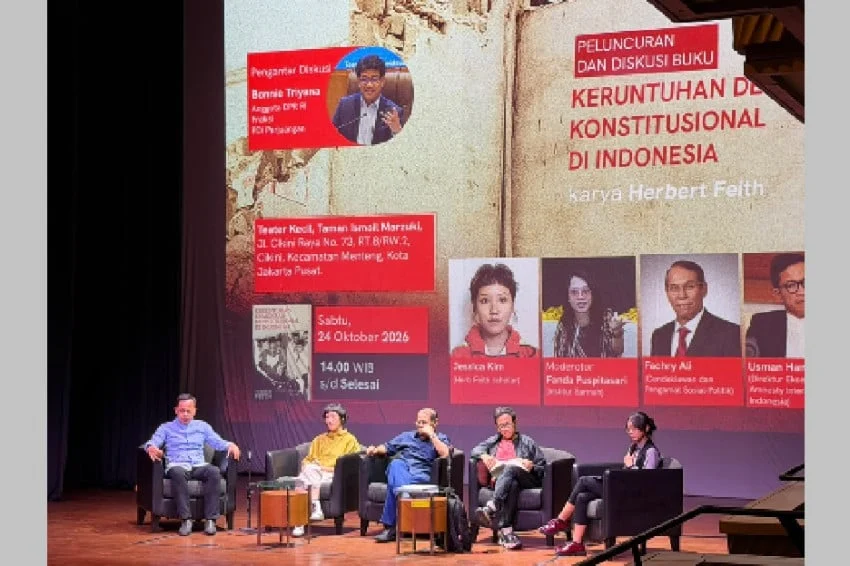
The debate surrounding the decline of constitutional democracy in Indonesia during the 1950s continues to serve as a vital analytical framework for understanding the nation’s current political landscape. This perspective was a central theme articulated by historian and House of Representatives (DPR) lawmaker Bonnie Triyana during the official book launch and scholarly discussion of Herbert Feith’s seminal work, The Decline of Constitutional Democracy in Indonesia. The high-profile literary and historical event took place at the Teater Kecil within the Taman Ismail Marzuki cultural complex in Central Jakarta.
Gathering historians, political scientists, and public policy observers, the event provided a platform to re-examine how Indonesia’s early post-independence experiments with governance continue to resonate decades later. By bridging the gap between mid-20th-century historiography and modern political realities, the discussion underscored the enduring fragility and evolution of democratic institutions in the world’s third-largest democracy.
Historical Context and the Feith-Benda Debate
At the core of Bonnie Triyana’s presentation was an intellectual clash that defined early Indonesian studies: the scholarly disagreement between Herbert Feith and fellow historian Harry J. Benda. Feith’s original thesis argued that the parliamentary democracy era of the 1950s represented a genuine, albeit ultimately unsuccessful, attempt to institutionalize constitutional governance. However, this interpretation faced rigorous criticism from Benda, who accused Feith of falling into the trap of Eurocentrism by treating Western liberal parliamentary democracy as the baseline norm for political development.
Benda contended that the parliamentary system experienced between 1950 and 1957 was merely a temporary interlude—a political arrangement imported from Western traditions that only maintained superficial roots among the broader Indonesian populace. According to Benda, this governance model failed to align organically with Indonesia’s indigenous socio-political structures, making its eventual collapse almost inevitable.
Despite the passage of more than six decades since these arguments were first exchanged, Bonnie emphasized that the core questions raised by Feith and Benda remain deeply provocative. The tension between institutional design based on Western liberal models and the realities of indigenous political culture is a dilemma that modern Indonesian policymakers and political scientists continue to navigate.
Elites, Administrators, and Solidarity Makers
Another crucial element of Feith’s analytical framework highlighted during the discussion was his dichotomy of Indonesian political elites: the "administrators" and the "solidarity makers."
Feith categorized administrators as pragmatic problem-solvers who focused on economic development, bureaucratic efficiency, and institutional governance. Conversely, solidarity makers operated primarily as symbol-wielders, leveraging nationalism, ideology, and mass mobilization to maintain political cohesion and emotional resonance among the public.
While Benda and other critics argued that this binary classification oversimplified a highly complex and fluid political reality, Bonnie suggested that the typology retains significant analytical value. In contemporary Indonesian politics, the tension between technocratic governance—focused on data-driven policies and fiscal management—and populist mobilization remains palpable. Leaders frequently oscillate between these two archetypes to secure electoral legitimacy and manage public expectations.
Geopolitical Origins of Indonesian Multiparty Democracy
To fully comprehend the trajectory of Indonesia’s democratic experiment, the discussion broadened to examine the geopolitical catalysts following the conclusion of World War II. Bonnie traced the institutional foundations of modern Indonesian democracy back to the crucial political shifts of late 1945.
A pivotal moment in this chronology was the issuance of Government Decree X (Maklumat X) on November 3, 1945. This decree formally opened the floodgates for a multiparty system, fundamentally reshaping the country’s political architecture. Behind this decision lay an urgent strategic imperative: the infant republic needed to demonstrate to the international community, particularly Western powers capable of recognizing its sovereignty, that Indonesia was a pluralistic, democratic nation rather than a fascist puppet state engineered by the Japanese occupation forces.
This historical origin reveals that Indonesia’s embrace of multi-party democracy was, from its inception, deeply intertwined with international diplomacy and the existential struggle for global legitimacy. The structural compromises made during those formative years laid both the groundwork for vibrant political participation and the seeds of political fragmentation that would plague the parliamentary decade.
Implications for Contemporary Indonesian Politics
The decision to revisit Herbert Feith’s analysis in the present day is far from an exercise in academic nostalgia. Modern political analysts have increasingly drawn parallels between the systemic challenges of the 1950s—such as coalition instability, ideological polarization, and the friction between central authority and regional aspirations—and contemporary political dynamics.
As Indonesia continues to consolidate its democratic system under the current administration, discussions regarding the resilience of constitutional checks and balances remain critical. The debate over whether democratic institutions are deeply internalized by society or remain vulnerable to elite manipulation echoes the historical warnings of scholars like Benda and Feith.
Furthermore, as the nation navigates complex socio-economic transformations and technological disruptions, the eternal balancing act between technocratic administration and populist solidarity-making continues to dictate the success or failure of public policies. By reflecting on the structural failures and systemic vulnerabilities of the constitutional democracy era, contemporary leaders and scholars can better diagnose the institutional safeguards required to prevent democratic regression.
The launch event at Taman Ismail Marzuki successfully reignited public discourse on the historical roots of the nation’s political identity. Through rigorous academic debate and historical reflection, participants and speakers alike reinforced the notion that understanding yesterday’s democratic struggles is an indispensable prerequisite for safeguarding tomorrow’s constitutional integrity.
