
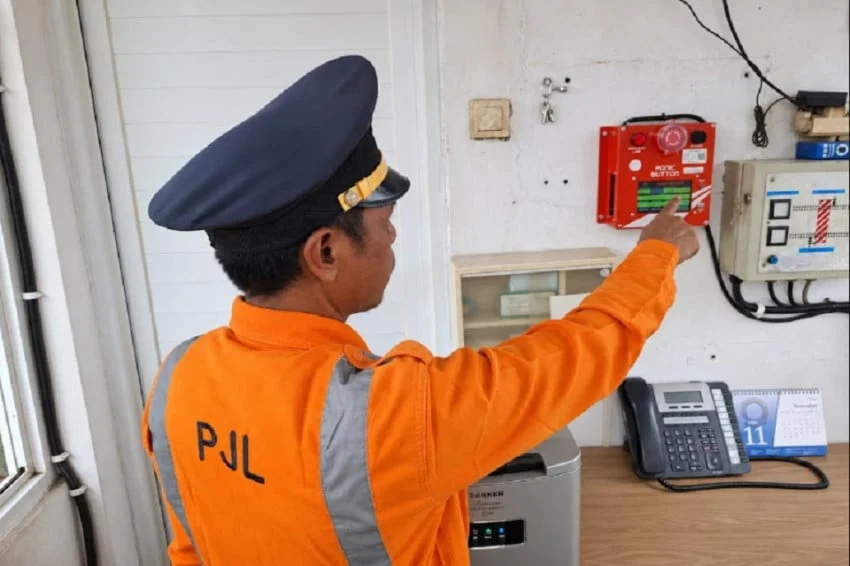
The safety infrastructure surrounding railway operations in the Greater Jakarta area has received a significant technological upgrade as PT Kereta Api Indonesia (Persero) Daerah Operasi 1 Jakarta completes the installation of 94 panic button units across critical level crossings. Finalized ahead of the late November 2026 benchmark, this comprehensive safety deployment is strategically designed to mitigate risks and prevent potential accidents along the bustling rail corridors managed by the state-owned enterprise. The initiative directly responds to the heightened operational demands and increased train frequencies anticipated during the upcoming Christmas 2026 and New Year 2027 (Nataru) holiday travel period, a time when vehicular and pedestrian traffic surge across urban and suburban transit networks.
Level crossings have historically represented one of the most vulnerable points within railway infrastructure, bridging the gap between high-speed rail transport and local roadway networks. By integrating rapid-response technological solutions directly into these crossing zones, KAI Daop 1 Jakarta aims to bridge the critical communication gap that frequently exists between field observations and train crew awareness during emergency scenarios. The deployment of these 94 units marks a proactive shift from purely reactive safety measures to advanced, interconnected early-warning systems capable of influencing emergency braking distances and minimizing collision impacts.
Understanding the Operational Mechanics of the Early-Warning System
At its core, the newly implemented emergency response infrastructure is engineered for maximum speed and reliability under high-stress conditions. Franoto Wibowo, Manager of Public Relations for KAI Daop 1 Jakarta, elaborated on the operational mechanics that govern the panic button network. According to Wibowo, the system was conceptualized specifically to accelerate the transmission of vital safety data from ground-level personnel directly to train engineers, known locally as masinis, in scenarios where foreign objects, stalled vehicles, or trapped pedestrians obstruct the tracks.
When an unexpected hazard materializes at a level crossing—such as a delivery truck suffering engine failure directly on the rails or a motorcycle skidding into the sleeper bed—every second dictates whether a catastrophic collision can be averted. Traditional communication channels, which often rely on verbal radio transmissions between crossing guards, dispatchers, and train crews, inherently carry a margin of latency. The newly installed panic button system circumvents traditional communication bottlenecks by instantly broadcasting alerts through an integrated digital architecture.
The technological ecosystem supporting the 94 panic button units relies on three interdependent components operating in real-time synchronization. The first component is the physical Panic Button device itself, ruggedized for outdoor resilience and strategically positioned at crossing gates where local guards or authorized personnel can access it instantly. The second component, designated as Loco Alert, functions as the dedicated receiver unit installed inside the locomotive cab. When a panic button is triggered in the field, the Loco Alert unit emits immediate audio-visual warnings to the engineer, alerting them to an imminent hazard ahead long before visual confirmation is possible. The third component consists of a centralized dashboard monitoring system located within the operational control center. This dashboard provides dispatchers with real-time telemetry regarding the exact timestamp, location, and activation status of any deployed panic button, ensuring seamless oversight and post-incident auditing capabilities.
Strategic Timing and the Nataru 2026-2027 Preparedness Framework
The completion of the panic button rollout aligns meticulously with KAI’s broader logistical timeline leading into the high-traffic Nataru season. Railway traffic across the Daop 1 Jakarta operational area experiences exponential growth annually between mid-December and early January, as millions of residents utilize rail networks for holiday travel, family visits, and seasonal tourism. During this peak mobility window, railway schedules are intensified, with dozens of additional long-distance, local, and commuter trains operating daily across congested urban corridors, including lines connecting Gambir and Pasar Senen stations to destinations throughout Java.
Historically, the confluence of heavy holiday traffic, saturated roadway intersections, and distracted motorists creates a spike in near-misses and level-crossing incidents. National transportation data frequently highlights unauthorized crossings and driver negligence as leading causes of rail-road accidents in Indonesia. Recognizing these recurring vulnerabilities, KAI Daop 1 Jakarta initiated the systematic placement of early-warning infrastructure months in advance, allowing engineering teams adequate time for field calibration, system stress-testing, and comprehensive training sessions for crossing guards and operational staff.
Beyond the installation of hardware, the deployment schedule reflects a multi-layered approach to holiday safety. KAI has concurrently ramped up routine infrastructure inspections, reinforced structural safety barriers, and collaborated closely with local municipal police forces and transportation agencies to crack down on illegal level crossings. The integration of the panic button network serves as the technological cornerstone of this year’s safety campaign, ensuring that even if physical deterrents fail to prevent a vehicle from stalling on the tracks, the human element in the field possesses an instantaneous mechanism to halt incoming trains.
Stakeholder Perspectives and Institutional Objectives
The rollout has garnered positive preliminary feedback from transportation observers, regional municipal authorities, and commuter advocacy groups who have long advocated for modernized safety interventions at high-risk intersections. Transport safety analysts emphasize that while grade separation—the construction of overpasses and underpasses—remains the ultimate structural solution to level-crossing hazards, the financial and spatial realities of densely populated urban environments make complete grade separation an incremental, long-term endeavor. In the interim, intelligent transport systems (ITS) and decentralized warning mechanisms such as KAI’s panic button network provide an economically viable and highly effective stopgap solution.
Internally, KAI management has emphasized that the implementation of the 94 panic button units reinforces the corporate commitment to zero-accident operations. Railway personnel operating within the Daop 1 region have undergone specialized briefings regarding standard operating procedures (SOPs) tied to the activation of the Loco Alert system. Engineers trained on the new hardware understand that an activation signal demands immediate reduction of throttle and application of emergency braking protocols, contingent upon visibility and train momentum. Furthermore, crossing guards stationed at vulnerable intersections have been drilled extensively on the precise threshold conditions required to trigger the alarm, ensuring that false triggers are minimized while genuine threats receive instantaneous responses.
The initiative also reflects broader institutional digitalization trends within PT Kereta Api Indonesia (Persero). Over recent years, the national carrier has systematically upgraded its signaling systems, passenger information displays, ticketing architectures, and centralized traffic control centers. By integrating Internet of Things (IoT) concepts into field-level safety infrastructure, KAI is progressively closing the technological divide between its modernized rolling stock and legacy wayside assets.
Broader Economic and Social Implications of Enhanced Rail Safety
The ramifications of improved level-crossing safety extend far beyond individual incident prevention, touching upon national economic efficiency, public confidence in mass transit, and regional mobility patterns. Indonesia’s railway network serves as the economic backbone for millions of daily commuters and freight transporters. Any major disruption along vital corridors—such as a collision resulting from a stalled vehicle at an unmonitored or semi-monitored crossing—can cause cascading delays across the entire network, stranding thousands of passengers and paralyzing logistics chains.
By mitigating the severity of potential crossing accidents through early-warning interventions, KAI Daop 1 Jakarta safeguards both human life and critical economic continuity. Minimizing emergency downtime preserves schedule integrity, protects expensive locomotive and rolling stock assets from catastrophic structural damage, and reduces the financial burdens associated with accident investigations, track repairs, and passenger compensation claims.
Moreover, public perception of safety plays a decisive role in modal choice during peak holiday periods. When families weigh the safety and reliability of long-distance rail travel against private automotive transport on congested toll roads, institutional investments in visible security and emergency response infrastructure reinforce consumer trust. The presence of advanced safety technology at level crossings reassures passengers that comprehensive preventative measures are actively operating behind the scenes.
As the operational countdown to the Nataru 2026-2027 holiday season proceeds, the 94 panic button units stand ready across the rail networks of Jakarta and its surrounding districts. While safety officials maintain that the ultimate objective remains the complete elimination of unauthorized crossings and a total adherence to traffic laws by motorists, this technological deployment provides a crucial safety net. By empowering ground personnel to communicate threats instantly to approaching engineers, KAI Daop 1 Jakarta has established a formidable precedent for proactive railway safety management in Southeast Asia’s rapidly modernizing transport sector.
