The political landscape in Indonesia is bracing for a series of high-profile strategic realignments as political parties gear up for the upcoming electoral cycles. In a decisive move signaling internal transformation and renewed vigor, the People’s Conscience Party, widely known as Partai Hanura, has announced plans to introduce a striking new official logo featuring a lion. This major rebranding initiative is scheduled to be officially unveiled during the grand commemoration of the party’s 20th anniversary on January 8, 2027, at the prestigious Hotel Sahid in Jakarta.
The unveiling of the lion emblem is not merely a cosmetic change; it is designed to serve as a profound psychological and strategic symbol for the party. According to the central leadership of Hanura, the lion represents core attributes such as formidable strength, operational agility, resilience under pressure, and an unyielding fighting spirit. These characteristics have been chosen to mirror the party’s overarching ambitions as it prepares to navigate the highly competitive political terrain leading up to the 2029 Indonesian general election. By shedding its older visual identity in favor of a bolder, more assertive motif, Hanura aims to project a revitalized image capable of capturing the imagination of a diverse and evolving Indonesian electorate.
The timing of the logo launch coincides with a critical juncture in the party’s institutional history. Having been founded in December 2006 in the wake of Indonesia’s democratic consolidation, Hanura has weathered two decades of fluctuating political fortunes. As it crosses the threshold into its third decade, the party leadership is seeking to solidify its grassroots foundations, enhance its national legislative presence, and reassert its relevance in the national parliament and regional councils alike.
Chronology of Events and Convention Schedule
The unveiling ceremony in January 2027 will not be an isolated event but rather the climax of a meticulously planned, multi-day political conclave. The comprehensive schedule for the anniversary celebrations and associated meetings reflects the party’s disciplined approach to organizational consolidation and policy formulation.
The sequence of events is set to commence several days prior to the main anniversary gala. On January 6 and 7, 2027, the party will host an intensive Bimbingan Teknis, or Technical Guidance workshop, tailored specifically for all elected members of the Regional House of Representatives (DPRD) representing Hanura from various provinces, regencies, and municipalities across the archipelago. This educational and strategic workshop is intended to align local legislative priorities with the broader national agenda of the party, ensuring that regional representatives are well-equipped to serve as effective advocates for their constituents.
Following the technical briefings, the official itinerary will reach its peak on January 8, 2027. On this single day, Hanura will simultaneously conduct its National Working Meeting, commonly known as Rakernas, alongside the formal celebration of its 20th anniversary. The dual-purpose gathering will serve as a platform for evaluating past electoral performance, ratifying strategic recommendations for the 2029 campaign, and formally introducing the new lion logo to the public and party faithful.
Preparations and Logistical Mobilization
Behind the scenes, the mechanics of this large-scale political gathering are already well underway. The Central Executive Board (DPP) of Hanura has initiated a series of intensive planning sessions to ensure flawless execution. Patrice Rio Capella, the Vice General Chairperson of the DPP Hanura, has been entrusted with the heavy responsibility of serving as the head of the organizing committee for this monumental event.
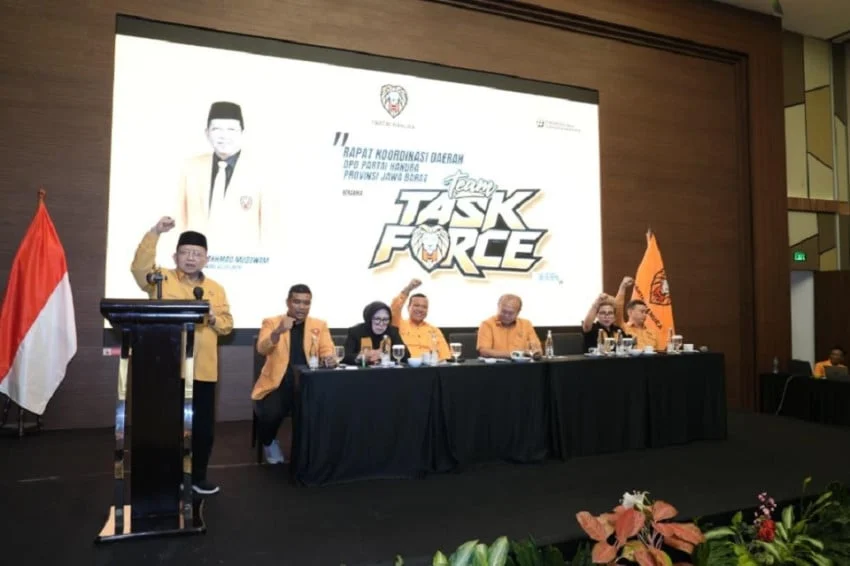
In statements made following a rigorous technical meeting and consolidation session of the DPP Hanura Task Force for West Java Province—held at the Holiday Inn in Bandung—Rio Capella outlined the expansive scale of the invitations being dispatched nationwide. The mobilization effort is designed to be fully inclusive of all structural tiers within the party organization, leaving no regional branch behind.
According to Rio Capella, the event will see an unprecedented gathering of internal stakeholders from every corner of the country. Invitations have been formally extended to all 514 Regency and Municipal Executive Boards (DPC) across Indonesia, alongside the leadership teams of all 38 Provincial Executive Boards (DPD). Furthermore, all functional units and departments within the central DPP structure are mandated to participate. This expansive mobilization underscores the leadership’s determination to foster a unified organizational culture and project collective strength ahead of the 2029 electoral contests.
External Invitations and High-Level Attendance
In addition to mobilizing its internal membership, Hanura is extending its reach outward to key figures within the broader Indonesian political ecosystem. The event is projected to draw a distinguished guest list comprising national leaders, government officials, diplomatic representatives, and leaders of rival political organizations.
Hanura has confirmed its intention to invite the President and Vice President of the Republic of Indonesia to grace the anniversary celebration and witness the unveiling of the new logo. The presence of the nation’s highest executive authorities would underscore Hanura’s positioning as a constructive political force aligned with national governance objectives.
Moreover, the organizing committee is reaching out across party lines. Invitations are being dispatched to the general chairpersons and senior leaders of other political parties, reflecting a spirit of inter-party diplomacy and democratic engagement. Recognizing Indonesia’s active role in international relations, the party also plans to invite resident ambassadors and diplomatic representatives of friendly foreign nations stationed in Jakarta. Cabinet ministers and senior government officials are likewise included in the comprehensive guest roster, signaling Hanura’s desire to maintain active channels of communication with the executive branch and policymaking institutions.
Background Context and Organizational Evolution
To fully appreciate the significance of Hanura’s upcoming rebranding in 2027, it is necessary to examine the historical trajectory of the party. Established in late 2006 by prominent figures within the Indonesian military and civil society—most notably General (Ret.) Wiranto—the party was conceived as a vehicle for national awakening, centered on principles of justice, prosperity, and democratic integrity. The name "Hanura" itself is an acronym for Hati Nurani Rakyat, translating directly to "The Conscience of the People."
Over the past twenty years, Hanura has experienced the structural challenges typical of modern Indonesian political parties. It has participated in multiple national elections, occasionally securing representation in the People’s Representative Council (DPR) at the national level, while maintaining a more consistent, albeit fluctuating, footprint in regional legislatures across hundreds of regencies and cities.
In recent years, under the leadership of Oesman Sapta Odang (commonly known as OSO), the party has sought to recalibrate its programmatic focus. Recent policy initiatives championed by the party leadership have emphasized regional empowerment and equitable economic development. For instance, the party has actively pushed for legislative innovations such as the proposed Regional Bond Law (UU Obligasi Daerah), which is championed by OSO to provide local governments with alternative financing mechanisms to accelerate regional infrastructure development without relying solely on transfers from the central government.
Strategic Implications of the Rebranding
The decision to adopt a lion logo ahead of the 2029 elections carries notable analytical implications regarding political branding and voter psychology in contemporary Indonesia. Political communication experts frequently emphasize that visual symbols play a critical role in voter retention and brand differentiation in a crowded multi-party system.
For much of its history, Hanura utilized a visual identity built around a stylized star and nationalist color palettes. While traditional, these motifs often struggled to generate distinct emotional resonance among younger demographics, who now constitute a dominant majority of the Indonesian electorate. Millennials and Generation Z voters are increasingly responsive to dynamic, assertive branding that conveys modern energy and resolute leadership.
By selecting a lion—a universal symbol of courage, leadership, and dominance—Hanura is attempting a strategic pivot toward a more aggressive and confident posture. This visual overhaul is expected to be accompanied by a modernized communications strategy, leveraging digital platforms, youth-oriented outreach programs, and targeted messaging centered on economic resilience and grassroots advocacy.
Furthermore, the timing in early 2027 provides the party with a crucial two-year runway leading up to the official campaign season for the 2029 legislative and presidential elections. This window allows ample time for the new imagery to permeate public consciousness, replace legacy branding materials in party offices nationwide, and anchor the party’s identity in the minds of potential voters.
Looking Ahead: The Road to 2029
As preparations intensify in the lead-up to January 2027, the internal cohesion and operational readiness demonstrated by Hanura will be closely watched by political analysts and rival organizations alike. The success of the upcoming Rakernas and the 20th-anniversary gala will serve as an early litmus test for the party’s organizational capacity and its ability to mobilize its vast network of regional cadres.
The dual challenge for Hanura will be to successfully execute a seamless visual and cultural transition while maintaining its foundational commitment to acting as the conscience of the people. If the leadership under Oesman Sapta Odang and the operational machinery managed by figures like Patrice Rio Capella can translate this high-stakes rebranding into sustained grassroots enthusiasm, Hanura may well position itself as a formidable contender in the evolving parliamentary arithmetic of the 2029 general election.