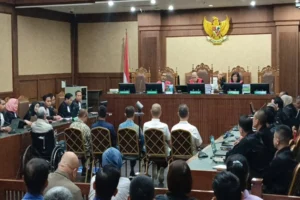
The Indonesian Attorney General’s Office (Kejaksaan Agung) has earned widespread acclaim from legal experts and anti-corruption watchdogs for its resolute decision to pursue in absentia trial mechanisms against two notorious high-profile fugitives, M Riza Chalid and Jurist Tan. This decisive legal breakthrough has been lauded as a watershed moment for the Korps Adhyaksa, demonstrating an unwavering institutional commitment to upholding the rule of law, securing public accountability, and aggressively pursuing state asset recovery without being indefinitely stalled by the deliberate evasion of suspects.
The deployment of the in absentia mechanism—whereby criminal proceedings move forward despite the physical absence of the accused—marks a strategic escalation in Indonesia’s ongoing battle against grand corruption and complex financial crimes. Legal analysts have underscored that this approach effectively dismantles the traditional impunity enjoyed by fugitive white-collar criminals who flee the jurisdiction of domestic courts while retaining control over illicitly acquired assets.
Legal Legitimization and the Progressive Stance of the Attorney General’s Office
The legal foundation for the Attorney General’s Office’s action is firmly anchored in statutory authority. Specifically, Article 38, Paragraph (1) of the Law on the Eradication of Criminal Acts of Corruption (UU Tipikor) grants the judiciary the explicit mandate to examine, try, and decide upon corruption cases even when the defendant, having been legally and properly summoned, fails to appear without a legitimate or justifiable excuse.
Prominent legal scholar Suparji Ahmad expressed strong support for the initiative, characterizing the move as a progressive, resolute exercise of power backed by robust juridical legitimacy.
"The step taken by the Attorney General’s Office to implement the in absentia trial mechanism represents a progressive, assertive legal measure equipped with solid juridical legitimacy. The intentional absence of a defendant must never be allowed to serve as an insurmountable bottleneck or an effective shield preventing the state from enforcing the law and delivering substantive justice," Suparji remarked in a public statement.
Legal experts note that while criminal trials historically emphasize the physical presence of the accused to ensure direct confrontation with evidence and witnesses, the modern landscape of transnational economic crime necessitates flexible legal instruments. When suspects intentionally make themselves scarce—often residing in foreign jurisdictions beyond easy extradition—traditional prosecution models grind to a halt. By invoking in absentia provisions, the Attorney General’s Office ensures that the wheels of justice continue to turn, preventing statutes of limitations from expiring and stripping fugitives of the tactical advantage provided by flight.
Balancing Expediency with the Principles of a Fair Trial
Despite the distinct advantages of proceeding without the defendants, legal safeguards remain paramount. Observers and constitutional law advocates have emphasized that in absentia trials must rigorously adhere to established evidentiary standards, prosecutorial objectivity, and the fundamental tenets of a fair trial.
Even in the absence of M Riza Chalid and Jurist Tan, the prosecution is legally obligated to present comprehensive, verifiable, and legally admissible evidence establishing the guilt of the accused beyond a reasonable doubt. Defense representation—often appointed by the state when defendants refuse to cooperate or retain counsel—plays a vital role in testing the strength of the prosecution’s case, ensuring that the proceedings maintain judicial integrity and withstand appellate scrutiny.
Furthermore, scholars emphasize that the ultimate objective of modern anti-corruption frameworks extends far beyond mere custodial sentences. While locking up offenders is a core component of criminal deterrence, recovering stolen public wealth is equally, if not more, critical for national economic stability.
Under Article 18 of the Law on the Eradication of Criminal Acts of Corruption, courts possess the authority to order the forfeiture of assets derived from criminal acts, the payment of replacement money (uang pengganti), and the closure of corporate entities or revocation of licenses linked to illicit enterprises. The in absentia mechanism is uniquely suited to facilitate these asset recovery objectives, enabling the state to legally seize and repatriate funds that would otherwise remain sequestered in offshore accounts or hidden behind complex corporate veils.
Background Context and the Stakes of Grand Corruption
The inclusion of high-profile figures such as M Riza Chalid and Jurist Tan in these landmark proceedings underscores the systemic gravity of the cases prosecuted by the Attorney General’s Office. Over the past decade, Indonesia has grappled with multi-trillion-rupiah financial scandals spanning the energy, mining, and state-owned enterprise sectors. These cases often involve intricate webs of domestic and international shell companies, political patronage, and sophisticated money laundering schemes (TPPU).
M Riza Chalid, a historically prominent figure in Indonesia’s energy and oil trading sectors, has long been associated with high-stakes investigations involving state-owned entities. Similarly, Jurist Tan has found himself at the center of complex corporate investigations involving severe financial irregularities. The ability of such individuals to evade domestic jurisdiction has historically frustrated investigators and demoralized the public, who view flight abroad as a guaranteed escape hatch from criminal accountability.
The decision of the Attorney General’s Office to pivot toward in absentia trials signals a paradigm shift. It communicates a clear message to white-collar criminals: escaping physical borders will no longer shield individuals from legal adjudication, nor will it protect illicitly accumulated wealth from state confiscation.
Broader Economic and Financial Implications
The ripple effects of this prosecutorial strategy extend well beyond the individual courtroom outcomes for Riza Chalid and Jurist Tan. Economists and governance experts point out that aggressive asset recovery plays a direct role in repairing national fiscal health.
In recent months, the Attorney General’s Office has demonstrated an escalating capacity to track, freeze, and seize assets tied to major financial crimes. For instance, parallel investigations into mining-related money laundering—such as the recent high-profile case involving Arif Kurniawan, where authorities successfully confiscated tens of billions of rupiah alongside vast quantities of precious metals—highlight a systematic, aggressive approach to financial policing.
When the state successfully concludes in absentia trials and secures court-ordered asset confiscations, the recovered funds are systematically channeled back into the state treasury. These financial inflows can subsequently be reallocated toward national development, public infrastructure, social welfare programs, and economic stimulus initiatives.
Moreover, demonstrating a zero-tolerance policy toward fugitive corruption suspects significantly enhances Indonesia’s standing within the global financial community. International rating agencies, foreign investors, and multilateral organizations closely monitor a nation’s commitment to the rule of law, anti-corruption enforcement, and asset recovery efficacy. Transparent, rigorous legal proceedings—even when conducted in the absence of fugitive defendants—reinforce investor confidence by signaling a predictable, rules-based business environment where regulatory evasion carries severe legal and financial consequences.
Institutional Challenges and Future Outlook
While the application of the in absentia mechanism is widely celebrated as a progressive leap forward, legal practitioners caution that enforcement is not without practical hurdles. Executing court verdicts rendered in absentia—particularly regarding the physical enforcement of prison sentences—remains contingent upon future international cooperation, extradition treaties, and red notices issued through international policing channels like Interpol.
If a defendant tried in absentia is eventually apprehended or voluntarily returns to Indonesia, specific procedural protections typically allow them to challenge the in absentia verdict or request a retrial under defined legal conditions, depending on the specifics of the governing statutes and court rulings. Consequently, prosecutors must treat in absentia judgments not as a final endpoint, but as a powerful legal instrument that permanently secures the state’s right to asset forfeiture while keeping the legal pressure active indefinitely.
As the Attorney General’s Office continues to refine and expand its application of progressive legal tools, the cases of M Riza Chalid and Jurist Tan will likely serve as vital precedents for future jurisprudence in Indonesia. By refusing to let the absence of fugitives obstruct the administration of justice, the Korps Adhyaksa has set a new benchmark for institutional resolve, proving that accountability cannot be outrun, and public wealth plundered through corruption can, and will, be reclaimed by the state.