
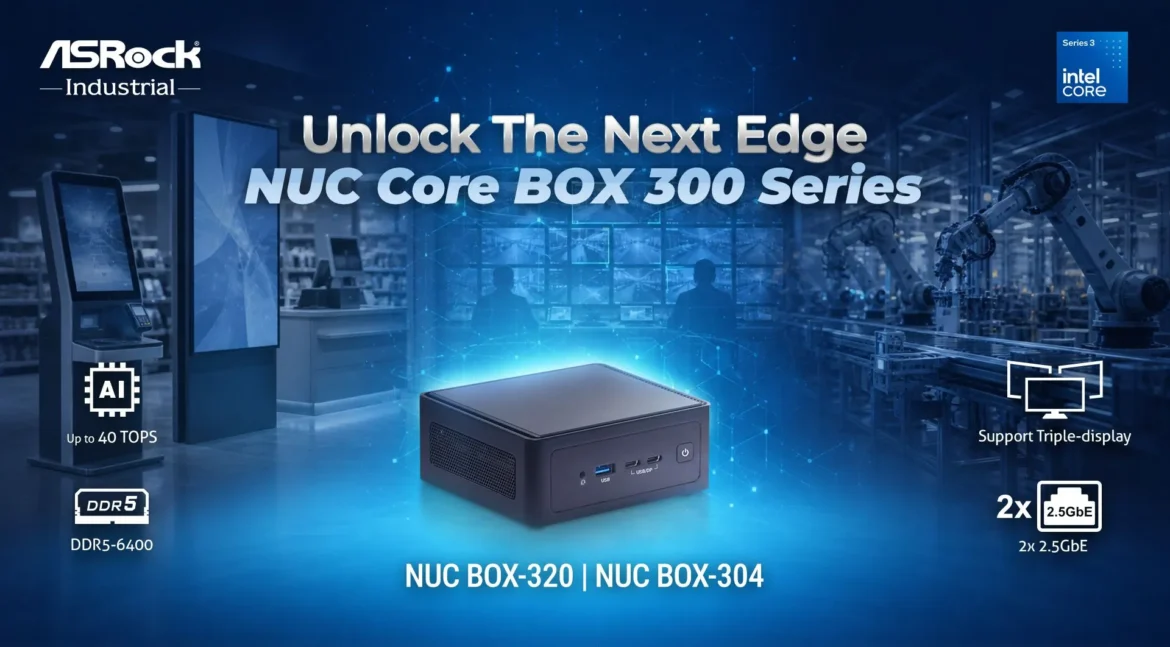
ASRock, a globally recognized leader in motherboard, graphics card, and small-form-factor PC manufacturing, has officially announced the expansion of its mini PC lineup with the introduction of the NUC BOX 300 Series. Aimed at bridging the gap between ultra-compact footprint constraints and enterprise-grade performance demands, the new series initially features two distinct models: the NUC BOX-320 and the NUC BOX-304. Both devices harness the computational capabilities of Intel’s latest Core 300 processors, which are built upon the advanced Wildcat Lake architecture. Despite occupying a physical volume of a mere 0.63 liters, these systems defy conventional expectations of small-form-factor (SFF) hardware by delivering substantial memory capacities, robust networking capabilities, and a comprehensive array of display and peripheral outputs.
The launch of the NUC BOX 300 Series represents a significant strategic maneuver in the rapidly evolving mini PC market. As remote work environments, digital signage deployments, and space-constrained office setups continue to proliferate, the demand for high-efficiency, low-power desktop replacements has escalated exponentially. By integrating Intel’s Wildcat Lake processors—silicon specifically engineered to balance thermal constraints with multi-threaded performance—ASRock aims to capture market share across commercial enterprises, educational institutions, and power-conscious prosumers.
Technical Specifications and Internal Architecture
At the heart of the NUC BOX 300 Series lies Intel’s heterogeneous processor design. The higher-tier model, the NUC BOX-320, is powered by the Intel Core 5 320 processor. This CPU features a six-core configuration divided into two performance cores (P-cores) and four efficient cores (E-cores), striking an optimal balance for demanding multitasking environments and localized computational workflows. Meanwhile, the NUC BOX-304 is equipped with the Intel Core 3 304 processor, featuring a leaner configuration comprising one P-core and four E-cores, tailored for lighter administrative tasks, edge computing, and media playback applications.
Memory and storage expansion capabilities within the NUC BOX 300 Series are uncommonly robust for a chassis of this scale. Both models support up to 64GB of high-speed DDR5-6400 memory via a single SODIMM slot, enabling substantial data bandwidth for memory-intensive workloads. Storage configuration is similarly versatile, accommodating dual internal drives through a compact M.2 2242 PCIe Gen 4 x1 slot alongside a standard M.2 2280 PCIe Gen 4 x2 slot. This dual-drive architecture allows users to configure high-speed caching solutions or separate operating system partitions from bulk data storage. Furthermore, ASRock has integrated a dedicated M.2 2230 key E slot pre-populated for wireless communication modules, delivering modern connectivity standards including Wi-Fi 6E and Bluetooth 5.3 out of the box.

Physical Design, Dimensions, and Ergonomics
The engineering philosophy behind the NUC BOX 300 Series prioritizes spatial economy without sacrificing structural integrity or thermal dissipation efficiency. The chassis measures precisely 117.5 x 110 x 49 millimeters, resulting in a total volumetric footprint of 0.63 liters and a baseline weight of approximately 1 kilogram. This diminutive physical scale permits seamless integration into cramped enterprise environments, retail kiosks, or behind display monitors via standard VESA mounting brackets.
The industrial design features clean geometric lines with strategic ventilation grill placement designed to maintain optimal thermal thresholds for the Intel Wildcat Lake processors under sustained workloads. Given the thermal density inherent in systems of this size, ASRock’s thermal solution utilizes a custom-engineered heatsink and fan assembly designed to dissipate heat quietly, ensuring acoustic comfort in noise-sensitive settings such as professional recording studios, libraries, or executive boardrooms.
Connectivity, Peripheral Interfacing, and Enterprise Integration
Enterprise readiness is frequently dictated by a device’s input/output flexibility, and the NUC BOX 300 Series addresses this requirement comprehensively. Despite its micro-scale dimensions, the rear and front panels are densely populated with modern communication and display interfaces. Video output capabilities are exceptionally versatile, featuring dual HDMI 2.1 ports capable of handling high-resolution displays at high refresh rates, supplemented by two USB Type-C ports equipped with DisplayPort 1.4a alternate mode support. This configuration empowers users to drive up to four independent displays simultaneously, making the units ideal for multi-monitor workstations, financial trading desks, or sophisticated digital signage networks.
For peripheral connectivity, the systems offer three traditional USB Type-A ports, ensuring backward compatibility with legacy keyboards, mice, and specialized industrial hardware. Network infrastructure integration is spearheaded by dual 2.5GbE Ethernet ports. The inclusion of dual high-speed LAN ports is a critical feature for enterprise and commercial deployments, enabling functions such as network link aggregation, redundancy failover, or the creation of localized software-defined networking (SDN) firewalls and gateways. Audio input and output are managed via a standard 3.5mm combination audio jack, completing an interface suite that rivals many mid-tower desktop computers.

Market Context, Background, and Evolution of the NUC Form Factor
The release of ASRock’s NUC BOX 300 Series arrives at a transitional period for the ultra-compact desktop ecosystem. The "Next Unit of Computing" (NUC) concept, originally pioneered and popularized by Intel over a decade ago, underwent a major structural shift when Intel dissolved its internal NUC division and transferred future development rights and hardware roadmaps to industry partners like ASUS. In the wake of this industry realignment, manufacturers such as ASRock have aggressively expanded their proprietary small-form-factor portfolios to fill the void, introducing increasingly sophisticated designs that push the boundaries of performance-per-liter metrics.
ASRock’s timing with the Wildcat Lake architecture aligns with a broader industry push toward energy-efficient, AI-ready edge computing. As businesses increasingly migrate data processing closer to the point of generation—often referred to as edge computing—hardware platforms must deliver reliable, 24/7 operational stability while consuming minimal electrical power. The NUC BOX 300 Series is positioned squarely to capture this segment, offering the reliability and manageability traditionally demanded by corporate IT departments within a consumer-friendly form factor.
Implications and Industry Outlook
While ASRock has officially unveiled the physical architecture and technical specifications of the NUC BOX-320 and NUC BOX-304, the company has yet to disclose official pricing structures or exact regional rollout timelines. Industry analysts project that pricing will be a decisive factor in determining the commercial success of the series, particularly as competition within the entry-level and mid-range mini PC market intensifies from rival manufacturers utilizing competing processor architectures.
The broader market implications of the NUC BOX 300 Series point toward a continued contraction in the market share of traditional desktop towers for standard office automation and administrative environments. As integrated graphics capabilities improve and memory bandwidths expand via technologies like DDR5, small-form-factor PCs are increasingly capable of handling professional workloads—including software development, heavy spreadsheet manipulation, and 4K media consumption—without thermal throttling or performance degradation. Whether these specific models will be officially imported and distributed in markets like Indonesia remains to be seen, but early reception from global tech communities indicates strong baseline interest among system integrators and technology enthusiasts seeking high-density, low-power computing solutions.
