
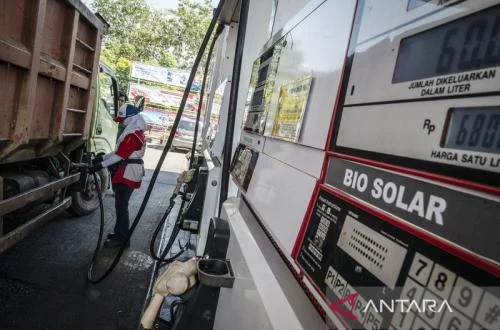
JAKARTA – The Indonesian Ministry of Energy and Mineral Resources (ESDM) has affirmed that the planned implementation of the 50 percent mandatory biodiesel blend program, known as B50, is poised to generate profound economic advantages for the nation. This strategic policy is also lauded as a crucial step towards strengthening Indonesia’s national energy resilience and autonomy. The B50 mandate, which integrates 50 percent palm oil-based biodiesel with 50 percent petroleum diesel, represents a significant escalation in Indonesia’s commitment to leveraging its abundant domestic resources for energy security.
Dwi Anggia, Spokesperson for the Ministry of ESDM, underscored that this transformative initiative heralds a new era where national energy sovereignty is increasingly driven by homegrown commodities, reducing reliance on volatile imported fossil fuels. With the B50 blend, a substantial portion of the diesel consumed nationwide will originate from crops cultivated and harvested by Indonesian local farmers, thereby creating a robust internal demand chain. Anggia highlighted the tangible economic gains, projecting that the B50 program could save Indonesia approximately Rp170 trillion (equivalent to about US$10.8 billion) in foreign exchange by the end of 2026. This substantial saving is anticipated to provide critical fiscal space for national development initiatives and insulate the economy from the unpredictable fluctuations of global oil markets.
The Evolution of Indonesia’s Biodiesel Mandate: A Chronology of Progress
Indonesia, as the world’s largest producer and exporter of palm oil, has long recognized the strategic potential of this commodity beyond food applications. The journey towards B50 is a testament to a progressive and carefully planned roadmap aimed at maximizing the benefits of its natural resources.
The nation’s biodiesel program officially commenced with the B7.5 mandate in 2008, requiring a 7.5 percent blend of fatty acid methyl ester (FAME) in diesel. This initial step was primarily driven by the need to stabilize Crude Palm Oil (CPO) prices and reduce carbon emissions.
By 2014, the government scaled up the ambition to B10, followed by B15 and B20 in 2015 and 2016 respectively. The B20 mandate, requiring a 20 percent biodiesel blend, marked a pivotal moment, significantly increasing domestic palm oil absorption and demonstrating the feasibility of higher blends across various sectors. The B20 program successfully reduced diesel imports, supported local farmers, and contributed to emission reductions.
In January 2020, Indonesia escalated its commitment further with the nationwide implementation of B30, mandating a 30 percent palm oil-based biodiesel blend. This move was particularly ambitious, making Indonesia a global frontrunner in high-blend biodiesel utilization. The B30 program faced initial technical challenges, particularly concerning engine compatibility and cold flow properties, but extensive research and collaboration with automotive manufacturers and industry stakeholders ensured its successful rollout. The B30 program proved instrumental in mitigating the economic impact of falling CPO prices during global market downturns and demonstrably contributed to foreign exchange savings and job creation.
Building on the successes and lessons learned from B30, the government launched B35 in February 2023. This 35 percent blend was introduced as an intermediate step towards higher blends, allowing for further technical fine-tuning and supply chain optimization. The B35 program continued to reinforce the strategic objectives of energy independence and environmental sustainability, showcasing Indonesia’s unwavering dedication to its biofuel agenda. The current announcement regarding the B50 program, therefore, is not an isolated policy shift but a logical progression within this well-established and continually advancing national energy strategy. The phased approach, from B7.5 to B35 and now to B50, highlights a deliberate, adaptive, and long-term vision for sustainable energy.
Profound Macroeconomic Impact and Job Creation
The projected foreign exchange savings of Rp170 trillion (approximately US$10.8 billion) by 2026 from the B50 program are not merely an abstract figure; they represent a tangible boon for Indonesia’s macroeconomic stability. This significant reduction in crude oil and diesel imports directly alleviates pressure on the nation’s trade balance and current account deficit, key indicators of economic health. A stronger trade balance contributes to the stability of the Indonesian Rupiah against foreign currencies, fostering a more predictable economic environment for investors and businesses. Moreover, by reducing dependence on imported fossil fuels, Indonesia gains a crucial hedge against the inherent volatility of global oil prices, which can often destabilize national budgets and consumer costs.
Beyond fiscal benefits, the B50 program is poised to be a powerful engine for job creation, with projections indicating the generation of up to 2.1 million new employment opportunities across the archipelago. This figure underscores the positive multiplier effect of agricultural-based industrial downstreaming on public welfare. These jobs will span the entire value chain of the palm oil industry, from upstream activities such as planting, harvesting, and processing at the farm level, to midstream operations involving transportation, refining, and manufacturing of biodiesel, and downstream roles in distribution, retail, and maintenance services. The increased demand for palm oil as a feedstock will directly benefit millions of smallholder farmers, enhancing their livelihoods and contributing to poverty reduction in rural areas. This widespread job creation is a critical component of the government’s inclusive economic development agenda, ensuring that the benefits of national policies reach a broad segment of the population.
Strengthening Energy Independence and Security
Indonesia’s historical reliance on fossil fuel imports has, at times, rendered it vulnerable to global energy market shocks and geopolitical tensions. The B50 program significantly enhances the nation’s energy independence by transitioning from imported petroleum to domestically produced palm oil. By utilizing an abundant local resource, Indonesia fortifies its strategic autonomy over its energy supply, reducing exposure to international price swings and supply disruptions. This move is not merely about substituting one fuel source for another; it is about fundamentally reorienting Indonesia’s energy matrix towards self-sufficiency.
This diversification strategy is a cornerstone of Indonesia’s broader energy policy, which aims to create a resilient and sustainable energy mix. By fostering a robust domestic biofuel industry, the nation builds a buffer against external pressures, ensuring a more stable and predictable energy supply for its growing economy and population. The B50 program thus represents a critical national security imperative, safeguarding the country’s economic and social stability in an increasingly uncertain global landscape.
Significant Contributions to Climate Targets
Beyond its profound economic implications, the B50 mandate is a pivotal instrument in Indonesia’s commitment to achieving its national climate targets. The Ministry of ESDM projects that the transition to this higher biodiesel blend will lead to a substantial reduction in greenhouse gas (GHG) emissions, estimated at 44.46 million tons of CO2 equivalent by 2026. This contribution is vital for Indonesia to meet its Nationally Determined Contribution (NDC) under the Paris Agreement, which outlines its pledge to reduce emissions.
Palm oil-based biodiesel, when produced sustainably, offers a lower carbon footprint compared to conventional fossil diesel. Its combustion releases fewer particulate matter and sulfur, contributing to improved air quality, particularly in densely populated urban areas. The government is actively promoting sustainable palm oil practices through certification schemes like the Indonesian Sustainable Palm Oil (ISPO) and supporting international standards like the Roundtable on Sustainable Palm Oil (RSPO). While debates around the full lifecycle emissions of palm oil-based biofuels persist, the Indonesian government emphasizes its commitment to responsible and environmentally sound production, ensuring that the expansion of palm oil cultivation for biodiesel does not come at the expense of critical ecosystems. The B50 program is thus framed as a dual-benefit strategy, simultaneously addressing energy security and climate change mitigation.
Implementation Challenges and Mitigation Strategies
The successful rollout of a high-blend biodiesel program like B50 necessitates meticulous planning and robust mitigation strategies to overcome potential challenges.
Technical Readiness and Engine Compatibility: A primary concern is ensuring that existing diesel engines in various sectors—transportation, industrial, and power generation—can seamlessly operate with a B50 blend without performance degradation or increased maintenance. Extensive testing and collaboration with automotive manufacturers are crucial to develop compatible engine technologies and adaptation kits. The government has learned from previous mandates (B20, B30, B35) and is engaging closely with original equipment manufacturers (OEMs) to ensure a smooth transition, including potential modifications to fuel systems and materials.
Fuel Specifications and Quality Control: Maintaining consistent fuel quality is paramount. Biodiesel quality, including parameters like oxidation stability, cold flow properties, and water content, must meet stringent national standards to prevent engine issues. Robust quality control measures across the supply chain, from biodiesel producers to distribution points, are essential. Research and development efforts are also focused on enhancing biodiesel properties to perform optimally in diverse climatic conditions across Indonesia.
Supply Chain Management: Guaranteeing a consistent and sufficient supply of Crude Palm Oil (CPO) feedstock for B50 production requires effective coordination across the agricultural and industrial sectors. This involves optimizing logistics from palm oil plantations to processing refineries and then to end-users. Weather patterns, crop yields, and global CPO market dynamics can influence supply, necessitating flexible and responsive supply chain management. Investment in storage and transportation infrastructure is also critical.
Funding and Subsidies: The price differential between biodiesel and fossil diesel often necessitates government subsidies to make the biofuel competitive. The Palm Oil Plantation Fund Management Agency (BPDPKS) plays a crucial role in collecting levies from palm oil exports and channeling these funds to support the biodiesel program. Balancing producer incentives with affordability for consumers, while ensuring the fiscal sustainability of the subsidy scheme, is an ongoing challenge that requires careful financial management and policy adjustments.
Stakeholder Perspectives and Collaborative Efforts
The success of the B50 program hinges on broad stakeholder buy-in and collaborative efforts.
Ministry of Energy and Mineral Resources (ESDM): As the primary driver, ESDM, through figures like Dwi Anggia, consistently emphasizes the strategic vision behind B50 – energy independence, economic resilience, and climate action. Their role involves policy formulation, regulatory oversight, and technical guidance for implementation.
Ministry of Finance: From a fiscal perspective, the Ministry of Finance strongly supports the B50 program for its significant contribution to foreign exchange savings, which directly strengthens Indonesia’s balance of payments and provides fiscal flexibility. While acknowledging the need for biodiesel subsidies, they view these as an investment yielding broader macroeconomic benefits.
Ministry of Agriculture: The Ministry of Agriculture champions the program for its direct positive impact on palm oil farmers, stabilizing CPO prices and stimulating demand for their produce. This aligns with their mandate to enhance agricultural sector productivity and rural economic development.
Palm Oil Industry Associations (e.g., GAPKI): Industry groups generally welcome the increased domestic absorption of CPO, which provides market stability and encourages investment in downstream processing facilities. They advocate for continued government support, stable policy frameworks, and investment in sustainable practices to meet growing demand.
Automotive Industry: While acknowledging the technical adjustments required for engine compatibility with higher biodiesel blends, the automotive industry has expressed its commitment to collaboration. Manufacturers are investing in R&D to ensure their vehicles are B50-ready, emphasizing the need for clear timelines and consistent fuel standards.
Environmental Organizations: Environmental groups often present a nuanced perspective. While generally supportive of emission reduction efforts, they frequently raise concerns about the sustainability of palm oil expansion, particularly regarding deforestation and biodiversity loss. They advocate for stringent enforcement of sustainable palm oil certification (ISPO) and transparent land-use policies to ensure that biofuel production does not undermine environmental conservation goals. The government’s narrative consistently underscores its commitment to sustainable and deforestation-free palm oil production.
Energy Experts and Economists: Independent experts largely commend the B50 program for its strategic benefits in energy security and economic stimulus. However, they also highlight the importance of careful fiscal management of subsidies, transparent cost-benefit analyses, and continuous monitoring of environmental impacts to ensure the program’s long-term sustainability and effectiveness.
The Road Ahead: Future Outlook and Broader Implications
The B50 program is not an endpoint but a significant milestone in Indonesia’s ambitious biofuel journey. The government has indicated a potential roadmap towards even higher blends, including B70 and eventually B100 (pure biodiesel), once technical and logistical challenges are fully addressed. This forward-looking approach necessitates ongoing investment in research and development to improve biodiesel production efficiency, explore advanced biofuel technologies, and potentially diversify feedstock beyond palm oil.
Indonesia’s leadership in implementing high-blend biodiesel mandates positions it as a key player in the global energy transition, particularly among developing nations. Its experience offers valuable lessons for countries grappling with similar challenges of energy security, economic development, and climate action. The long-term vision for B50 and subsequent programs is deeply integrated into Indonesia’s broader ambition for a green economy, fostering sustainable industries, and reducing its overall carbon footprint.
In conclusion, the B50 biodiesel program represents a multifaceted strategic instrument designed to fortify Indonesia’s economic resilience, enhance its energy independence, and accelerate its progress towards ambitious climate commitments. By harnessing its indigenous palm oil resources, Indonesia is charting a course towards a more sustainable and prosperous future, demonstrating a clear commitment to maximizing public welfare and economic prosperity through innovative energy policies.
