
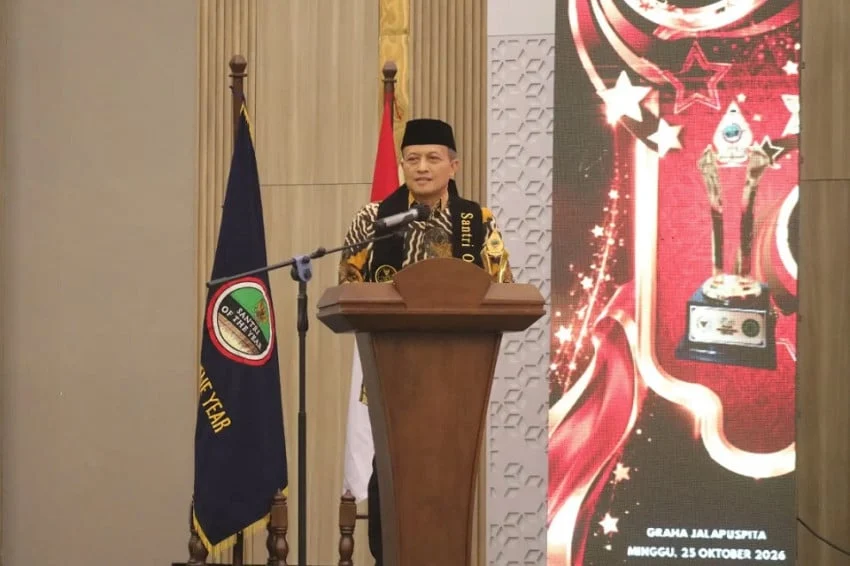
The landscape of national leadership and public service in Indonesia continually witnesses the intersection of traditional Islamic educational values and modern institutional governance. This dynamic was prominently displayed as the Junior Attorney General for Oversight (Jamwas) at the Attorney General’s Office of the Republic of Indonesia, Rudi Margono, was formally honored with the prestigious Santri Dhyaksa Inspiratif award during the Santri of The Year 2026 ceremony. The high-profile event, which celebrates the multifaceted contributions of individuals with Islamic boarding school (pesantren) backgrounds who have achieved distinction in various professional sectors, took place at the Graha Jalapuspita venue in Central Jakarta.
The conferral of this accolade underscores the growing recognition of figures who successfully bridge the rigorous ethical frameworks cultivated within traditional santri environments with the complex demands of modern state administration and law enforcement. Organized collaboratively by the Islam Nusantara Center (INC) and Majelis Pesona, with robust institutional backing from the House of Representatives of the Republic of Indonesia (DPR RI), the annual event has established itself as a premier platform for acknowledging excellence, dedication, and moral integrity among alumni of Indonesian pesantrens.
Background Context and Significance of the Santri of The Year 2026 Event
The Santri of The Year awards initiative was originally conceptualized to dismantle stereotypes surrounding graduates of Islamic boarding schools, proving that santris are not confined solely to religious scholarship but are capable of competing at the highest levels of national leadership, academia, judiciary, politics, and socio-economic development. Over the years, the program has grown in stature, drawing national attention and participation from senior government officials, religious leaders, lawmakers, and civil society representatives.
The 2026 iteration carried heightened significance, focusing heavily on the theme of institutional integrity, public accountability, and the preservation of national values through moral governance. By honoring figures like Rudi Margono in the "Dhyaksa Inspiratif" category—a designation specifically tailored for inspiring legal professionals and prosecutors of santri origin—the organizers sought to highlight the vital role that spiritual grounding plays in upholding justice and combatting corruption within the state apparatus.
Highlights from the Ceremony and Rudi Margono’s Address
The ceremony at Graha Jalapuspita was marked by solemnity and enthusiasm, drawing prominent figures from across the political, religious, and legal spectrums. In his formal acceptance speech, Rudi Margono expressed profound gratitude for the recognition while emphasizing the indispensable role played by institutions like the Islam Nusantara Center in shaping the nation’s human resource development.
Rudi underscored that gatherings of this magnitude should transcend mere ceremonial pageantry. Instead, he argued, they must serve as substantive forums designed to strengthen institutional and communal networks, while actively fostering a renewed commitment to public service and societal welfare.
"This is an extraordinary initiative," Rudi remarked during his address. "Hopefully, events like this will not only strengthen our bonds of brotherhood and fellowship in this world but also unite us eventually in grace and goodness."
His remarks resonated deeply with the audience, reflecting a worldview rooted in the traditional santri ethos of humility, collective solidarity, and lifelong dedication to community upliftment. Organizers and attendees alike praised his ability to maintain these foundational values despite navigating the high-pressure environment of the nation’s premier prosecution office.
Career Profile and Academic Journey of Rudi Margono
To understand the weight of the recognition bestowed upon Rudi Margono, one must examine his extensive trajectory within Indonesia’s legal and judicial framework. Born in Magetan, East Java, on December 6, 1969, Rudi represents a classic model of regional educational attainment scaling the heights of national public service.
His foundational legal education began at the Faculty of Law, Universitas Brawijaya, located in Malang, East Java, where he earned his Bachelor of Laws (Sarjana Hukum) degree. Demonstrating an enduring commitment to academic rigor and continuous professional development, Rudi pursued advanced legal studies, securing a Master of Humanities (Magister Humaniora) degree from Universitas Gadjah Mada (UGM) in Yogyakarta. He later returned to his alma mater, Universitas Brawijaya, to complete his doctoral studies, earning a Doctorate in Legal Science (Doktor Ilmu Hukum).
As a career prosecutor, Rudi has traversed numerous strategic positions within the Attorney General’s Office. His decades of service have spanned various regional jurisdictions and central directorates, earning him a reputation as a meticulous jurist, methodical investigator, and steadfast administrator. His appointment to sensitive leadership roles—including his tenure as Acting Deputy Attorney General for Special Crimes (Plt Jampidsus)—highlights the high level of trust placed in his administrative and analytical capabilities by the Attorney General and the executive branch.
Intellectual Contributions and Stance on Asset Recovery
Beyond his administrative duties, Rudi Margono has garnered academic and professional acclaim for his progressive legal philosophies, particularly concerning asset recovery and financial crime prosecution. In an era where white-collar crimes, transnational financial fraud, and systematic corruption threaten the economic stability of the republic, Rudi has consistently advocated for robust legal mechanisms to retrieve stolen state assets.
His doctoral research and subsequent academic writings have frequently explored the theoretical and practical dimensions of asset recovery laws in Indonesia. Rudi has argued that traditional punitive measures—such as imprisonment and monetary fines—are insufficient deterrents for modern economic criminals unless accompanied by aggressive, systematic asset tracing and confiscation protocols. His forward-thinking approach has significantly influenced internal policy discussions at the Attorney General’s Office, positioning him as a key intellectual driver behind contemporary prosecutorial reforms aimed at maximizing the recovery of state financial losses.
Broader Impact and Implications of the Award
The recognition of Rudi Margono as Santri Dhyaksa Inspiratif carries several broader implications for the Indonesian legal system and society at large:
- Bridging Traditional Ethics and Modern Jurisprudence: The award validates the proposition that traditional moral and religious education within Islamic boarding schools provides a resilient ethical compass necessary for navigating the ethical dilemmas inherent in high-level law enforcement and judicial administration.
- Inspiring the Younger Generation: By highlighting the achievements of a senior career prosecutor who maintains his santri identity, the event provides a powerful role model for millions of students currently enrolled in Indonesia’s thousands of pesantrens, demonstrating that the highest offices of the state are accessible through dedication, integrity, and academic excellence.
- Enhancing Public Trust in the Judiciary: At a time when public confidence in law enforcement agencies is constantly scrutinized, recognizing officials who embody both professional competence and moral accountability helps reinforce institutional credibility. It signals to the public that the Attorney General’s Office values oversight, transparency, and ethical leadership.
- Institutional Synergy: The active participation of the DPR RI and civic organizations like the Islam Nusantara Center in events of this nature underscores a collaborative approach to national development, where legislative, executive, and civil society actors unite to celebrate civic virtue and institutional excellence.
Conclusion
The presentation of the Santri Dhyaksa Inspiratif award to Jamwas Rudi Margono at the Santri of The Year 2026 ceremony is more than a personal milestone; it is a celebration of institutional resilience, ethical governance, and the enduring legacy of Indonesia’s santri community. As Rudi continues to steer oversight mechanisms within the Attorney General’s Office, his journey from Magetan to the upper echelons of national legal administration serves as an enduring testament to the power of education, moral integrity, and unwavering dedication to public service.
