The Komando Pasukan Katak, widely known as Kopaska, stands as the premier maritime special operations force of the Indonesian Navy (TNI AL). Formally established on March 31, 1962, this elite unit has carved out a reputation as one of the most formidable and secretive military branches in Southeast Asia. While their operational excellence in amphibious warfare is well-documented, they are perhaps most distinctively recognized by their iconic, albeit intimidating, signature gear: the skull-faced masks. This article explores the historical origins of the "Skull Force" moniker, the strategic philosophy behind their specialized equipment, and the operational doctrine that defines their service to the Indonesian state.
Origins and Operational Genesis
The foundation of Kopaska was not merely an administrative creation but a strategic necessity born during a period of intense geopolitical instability in the Indonesian archipelago. By the early 1960s, the Indonesian government recognized the imperative for a maritime unit capable of unconventional warfare, particularly as the nation navigated territorial disputes and internal security challenges. Inspired by the tactical successes of international counterparts such as the United States Navy SEALs (then in their nascent stages) and the British Special Boat Service (SBS), Indonesian military leaders sought to develop a force that could project power beneath the waves and along the treacherous littoral zones of the Indonesian coast.
On March 31, 1962, President Sukarno officially commissioned the unit. The command was tasked with a mandate that transcended conventional naval warfare. They were trained to function as a "tri-phibious" force, capable of operating with lethal precision across land, sea, and air domains. From its inception, the unit was placed directly under the Komando Armada (Fleet Command) and reported to the Chief of Staff of the Indonesian Navy (KSAL), ensuring that the unit remained a high-level strategic asset rather than a conventional infantry detachment.
The Iconography of the Skull Mask
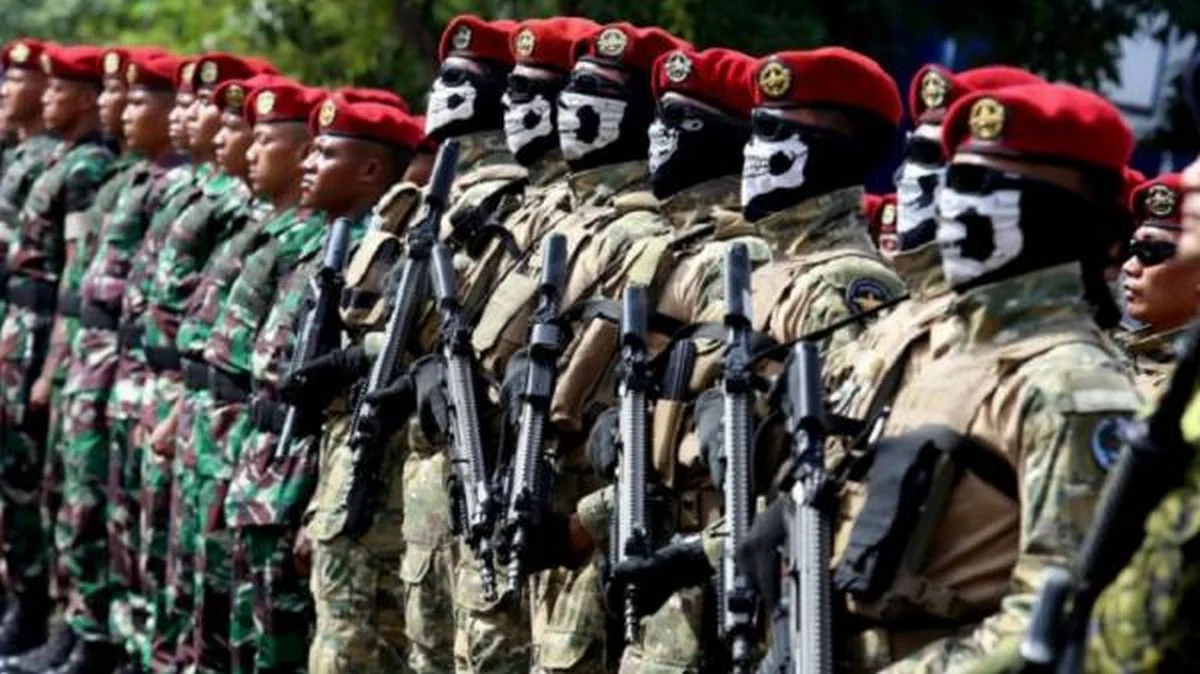
The moniker "Pasukan Tengkorak" or "Skull Force" is derived from the unit’s distinctive tactical appearance during clandestine missions. The use of skull-motif masks serves a dual purpose: psychological warfare and operational anonymity. In the theater of special operations, the psychological impact of a faceless, death-themed adversary is a proven tool to destabilize opponents during boarding actions or night raids.
However, beyond the theatricality, the masks serve a practical function. In the harsh environments where Kopaska operates—ranging from saltwater-drenched tropical climates to high-pressure underwater environments—the mask protects the operative’s identity and provides a layer of protection against the elements. The combination of the red beret, symbolizing the elite status of the unit, and the skull mask creates a visual identity that has become synonymous with the unit’s "Tan Hana Wighna Tan Sirna" motto—meaning "there is no obstacle that cannot be overcome."
Strategic Doctrine and Capabilities
The operational scope of Kopaska is vast, categorized primarily into five distinct pillars: underwater demolition, sabotage of enemy vessels and installations, reconnaissance, preparation of landing beaches for amphibious assaults, and maritime counter-terrorism.
- Underwater Demolition: The unit is highly specialized in the clearing of obstacles, such as mines or physical barriers, that would prevent the Indonesian Navy from executing successful amphibious landings.
- Sabotage and Direct Action: Kopaska operatives are trained to infiltrate enemy naval bases, attach limpet mines to hulls, and neutralize high-value assets without triggering alarms.
- Maritime Reconnaissance: They provide critical intelligence on hydrographic conditions and enemy disposition, acting as the eyes and ears of the Navy in denied areas.
- Counter-Terrorism: Given the strategic importance of the Indonesian archipelago’s shipping lanes—including the Malacca Strait—Kopaska provides a rapid response force for anti-piracy and counter-terrorism operations, ensuring the safety of international maritime traffic.
Their training regimen is notoriously rigorous, designed to weed out all but the most resilient candidates. Training involves prolonged immersion in aquatic environments, high-altitude jumps, and complex jungle survival scenarios. This "three-dimensional" proficiency ensures that a Kopaska operator can transition from a deep-sea dive to a high-speed boat extraction or an airborne insertion with seamless efficiency.
Historical Context and Evolution
The history of Kopaska is intertwined with the history of the Indonesian Navy itself. Throughout the latter half of the 20th century, the unit played a quiet but pivotal role in numerous domestic operations. During the transition to the New Order and subsequent decades, the unit maintained a low public profile, adhering to the standard of "silent professionals."
Unlike conventional military units, the exact numerical strength of Kopaska remains a closely guarded state secret. This obscurity is intentional, contributing to the "mythos" surrounding the unit. By refusing to confirm personnel numbers or individual identities, the Indonesian Navy ensures that the unit remains a psychological deterrent. Foreign intelligence observers note that the unit’s equipment has evolved significantly over the decades, moving from basic diving gear to advanced rebreathers, thermal imaging systems, and modern naval weapon platforms.
Official Stance and Professionalism
While the skull mask often attracts media attention, the Indonesian Navy emphasizes that it is a tool of the trade rather than a defining characteristic of their professionalism. Officials from the Indonesian Ministry of Defense have consistently highlighted that the core value of Kopaska lies in its discipline, technological adaptability, and unwavering commitment to sovereignty.
In recent years, the unit has increased its presence in international joint exercises, such as the Cooperation Afloat Readiness and Training (CARAT) series with the United States and other regional partners. These exercises have showcased the high standard of training maintained by Indonesian frogmen. Observers from these partner nations often note that the Kopaska operatives possess a unique "sea-centric" tactical mindset, which is critical for defending an archipelago as vast as Indonesia.
Implications and Future Outlook
The strategic importance of Kopaska continues to grow as the maritime landscape of the Indo-Pacific becomes increasingly contested. With the rise of regional tensions and the constant threat of non-state actors operating at sea, the need for a force that can operate independently and decisively is greater than ever.
The evolution of the unit is currently focused on modernization. As the Indonesian Navy expands its fleet, Kopaska is being integrated into newer platforms, including advanced submarine-launch systems and modernized littoral combat ships. This integration allows for a "force multiplier" effect, where a small team of Kopaska operators can exert influence over a much larger area, effectively securing key maritime chokepoints.
Conclusion
The "Skull Force" title, while evocative and slightly ominous, is merely the surface of a highly sophisticated military institution. Kopaska represents the synthesis of traditional naval heritage and modern special operations doctrine. Their history, dating back to 1962, is one of constant adaptation. From the early days of basic underwater sabotage to their current role as a multi-domain elite force, Kopaska has remained a pillar of the Indonesian Navy’s defensive posture. By maintaining their mysterious persona and rigorous standards, they ensure that the "Pasukan Tengkorak" remains not just a name, but a formidable reality in the defense of Indonesia’s sovereign waters. Their legacy is defined not by the masks they wear, but by the silent, effective service they provide in the shadows of the sea.