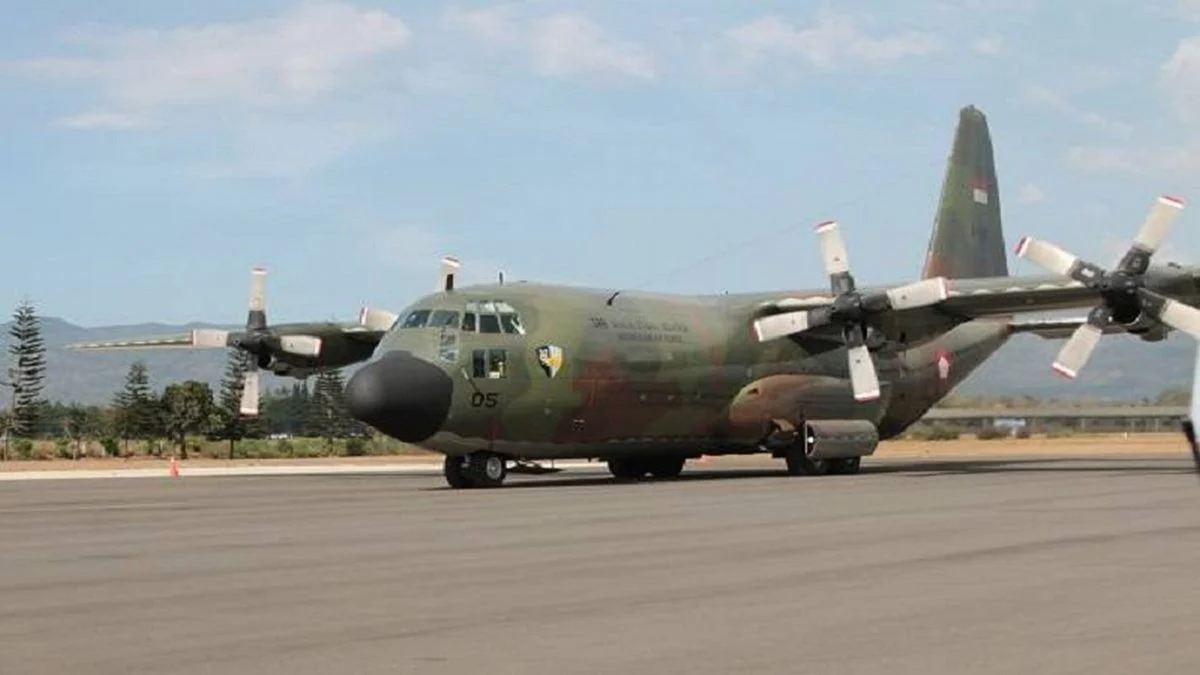
The Indonesian National Armed Forces (TNI) has intensified its commitment to mitigating the environmental crisis in Kalimantan by deploying an additional Hercules C-130 transport aircraft, tail number A-1328, to the region. Departing from the Halim Perdanakusuma Air Force Base in East Jakarta on Saturday, October 24, 2026, the aircraft arrived at the Syamsudin Noor Air Force Base in Banjarmasin, South Kalimantan, to serve as a critical asset in the ongoing Weather Modification Operations (WMO). This strategic reinforcement is designed to accelerate the suppression of forest and land fires (karhutla) that have historically plagued the Kalimantan region, triggering hazardous haze conditions that impact both public health and regional economic activities.
Strengthening the Aerial Response
The deployment of the Hercules C-130 represents a significant escalation in the government’s operational capacity. According to the official statement released by the TNI Information Center (Puspen TNI) on Sunday, October 25, 2026, the aircraft is not merely a transport vehicle but a specialized platform for cloud seeding. The C-130 has been outfitted with dual dispensing consoles capable of releasing significant quantities of salt (sodium chloride) or dry ice into atmospheric clouds to induce artificial rainfall.
By increasing the frequency and coverage of these sorties, authorities aim to saturate fire-prone areas with moisture, thereby suppressing active flames and reducing the density of smoke particulate matter in the air. The mission involves a collaborative synergy between the military’s logistical prowess and the scientific expertise of the National Research and Innovation Agency (BRIN). Specialized engineers from BRIN are embedded in the deployment to analyze meteorological data in real-time, ensuring that seeding missions are conducted under optimal cloud conditions to maximize rainfall probability.
Chronology of the Crisis and Response
The current situation in Kalimantan is part of a recurring cycle of fire incidents, often exacerbated by the dry season and local land management practices. Throughout October 2026, satellite monitoring indicated an increase in hotspots across the peatland regions of South, Central, and West Kalimantan.
The timeline of the current intervention began in early October when provincial governments declared a state of emergency due to rising air quality index (AQI) levels. By mid-October, the TNI and the National Disaster Management Agency (BNPB) coordinated to initiate a series of Weather Modification Operations. However, the initial response was hindered by limited aircraft availability and unfavorable wind patterns that rapidly shifted smoke plumes toward residential areas and neighboring regions. The decision to deploy the A-1328 Hercules was made following a strategic assessment that existing assets were insufficient to cover the vast, rugged, and often inaccessible terrain of Kalimantan’s forests.
Data-Driven Disaster Mitigation
The effectiveness of Weather Modification Operations relies heavily on precise data. Meteorologists and atmospheric scientists involved in the mission utilize satellite imagery and radar telemetry to identify “seedable” clouds. The success of these operations is measured not only by the reduction in the number of hotspots but also by the measured precipitation levels over affected zones.
Historical data suggests that successful WMO missions can reduce the number of hotspots by up to 60-70% within a 48-hour window, provided the atmospheric moisture content is sufficient. In the context of 2026, the stakes are exceptionally high. Peatland fires, which are notoriously difficult to extinguish, can smolder underground for weeks. Consequently, the reliance on aerial firefighting—both via water bombing and cloud seeding—has become the primary line of defense. The addition of the Hercules C-130 allows for larger payloads of seeding agents, which theoretically increases the duration and intensity of the induced rainfall compared to smaller aircraft currently in the fleet.
Stakeholder Perspectives and Institutional Coordination
The operation is a multi-agency effort requiring seamless communication between the TNI, BRIN, the Ministry of Environment and Forestry (KLHK), and the Meteorology, Climatology, and Geophysics Agency (BMKG).
From a military perspective, the mission underscores the TNI’s role in Military Operations Other Than War (MOOTW). The commander of the operation noted that the technical readiness of the C-130 crew is paramount, as cloud seeding requires precise navigation through turbulent, smoke-filled air.
From the scientific standpoint, BRIN researchers emphasize that cloud seeding is a drought-mitigation tool, not a "silver bullet." Dr. Andi Wijaya, a senior climatologist, explained in a briefing that while the Hercules significantly bolsters the effort, the success of the mission is ultimately dependent on the availability of convective clouds. "We are manipulating the physics of the clouds, but we are still bound by the laws of meteorology," he stated. "The extra capacity provided by the Hercules allows us to capitalize on short-lived weather windows that we might have missed with a smaller, slower fleet."
Implications for Public Health and the Economy
The haze resulting from forest fires in Kalimantan carries severe socio-economic implications. Prolonged exposure to particulate matter (PM2.5) leads to spikes in respiratory illnesses, including acute respiratory infections (ARI), asthma, and cardiovascular complications among the local population. Schools and public offices are often forced to implement remote operations or closures when air quality reaches hazardous levels.
Economically, the haze disrupts regional logistics, including aviation safety at airports such as Syamsudin Noor and Tjilik Riwut. Reduced visibility due to smoke frequently leads to flight cancellations, delaying cargo and passenger transit. By deploying the Hercules to proactively induce rainfall, the government is attempting to mitigate these disruptions before they reach critical levels.
Furthermore, the environmental impact of recurring fires is a subject of intense domestic and international scrutiny. The destruction of peatland ecosystems releases vast amounts of carbon into the atmosphere, contributing to global climate change. The TNI’s mission, therefore, serves a dual purpose: immediate disaster response and the preservation of vital carbon sinks.
Strategic Analysis: The Future of Aerial Firefighting
The integration of the Hercules C-130 into the WMO framework marks a shift toward more robust, heavy-duty disaster response strategies. In previous years, reliance on smaller aircraft often limited the scope of cloud seeding to localized areas. The current strategy reflects a regional, holistic approach, covering multiple provinces simultaneously.
However, the reliance on weather modification raises questions regarding long-term sustainability. Analysts argue that while cloud seeding provides essential relief, it must be accompanied by aggressive ground-level firefighting and strict enforcement of land-clearing regulations to prevent the fires from starting in the first place. The transition toward a "prevention-first" model is increasingly discussed in governmental policy circles, yet until such measures are fully implemented, the military’s aerial capabilities remain the most vital tool in the national arsenal.
The deployment of the A-1328 Hercules is expected to continue for as long as the meteorological conditions and the fire threat persist. The TNI has signaled its readiness to extend the deployment if the situation warrants, highlighting a commitment to regional stability and environmental protection. As the operation unfolds, the coordination between the flight crews, the meteorological experts, and the ground teams will serve as a blueprint for future disaster management protocols in Indonesia.
Conclusion
As of late October 2026, the mission in Kalimantan remains active. The arrival of the additional Hercules aircraft has provided a much-needed morale boost for ground crews and local residents alike. While the battle against the haze is far from over, the increased capacity for cloud seeding represents a significant step forward in the Indonesian government’s ability to respond to large-scale environmental disasters. The coming days will be critical, as authorities look to the skies to bring the rain necessary to quench the fires and clear the air, restoring normalcy to the lives of millions in Kalimantan.