
ings as Subjective in High-Stakes Extortion and Threat Trial at Central Jakarta District Court
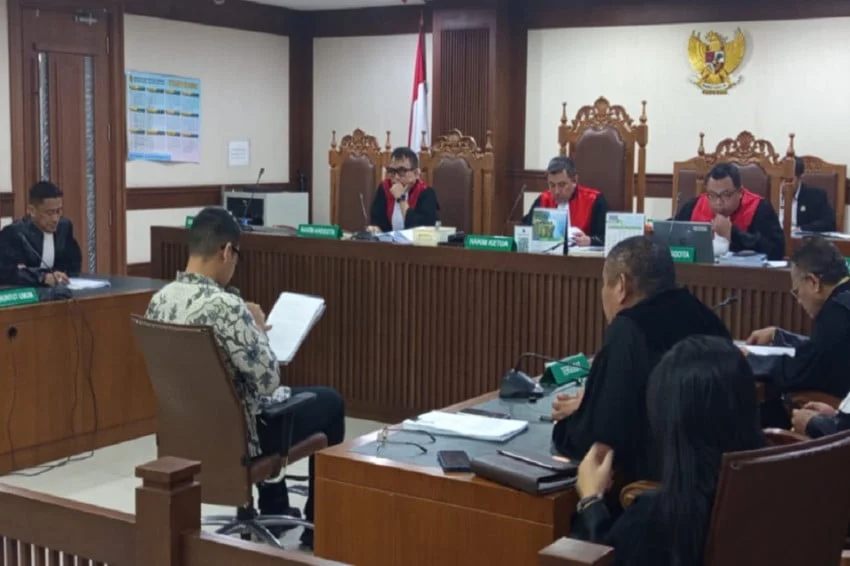
The Central Jakarta District Court remains the epicenter of intense legal friction as the high-profile extortion and criminal threat trial involving defendant Bangun Paulus Tudungta (BPT) proceeds toward its final stages. During the latest court session held on Wednesday evening, November 25, 2026, the proceedings focused heavily on the ideological and evidentiary clash between the prosecution and the defense. Jaksa Penuntut Umum (JPU) Andri Saputra publicly characterized the defense’s written memorandum of defense, or pleidoi, as inherently subjective. According to the prosecution, the spirited attempts by the legal counsel and the defendant to dismantle the state’s indictment reflect a natural inclination to protect the accused rather than an objective reflection of the trial’s factual record.
The case, which has drawn considerable public and media attention, centers on allegations of extortion combined with criminal threats leveled against the victim, Vincent Leo Karlius. As the judicial calendar presses forward, the legal teams are bracing for the subsequent rebuttal phase, where the state aims to reinforce its foundational arguments before the presiding panel of judges takes the matter under advisement for a final verdict.
Background and Context of the Extortion and Threat Allegations
The legal entanglement involving Bangun Paulus Tudungta (BPT) originated from a complex dispute that escalated from civil friction into alleged criminal conduct. According to court documents and initial police investigations, the core of the dispute involves accusations that the defendant utilized unlawful pressure, coercion, and direct threats against Vincent Leo Karlius to extract financial concessions or assets. Extortion and criminal threats, governed strictly under the Indonesian Criminal Code (KUHP), are viewed by law enforcement agencies as severe offenses that undermine public order, personal security, and fair economic transactions.
In recent years, the Central Jakarta District Court has handled a rising number of white-collar and coercion-related disputes. Cases involving complex financial pressures and alleged threats require rigorous evidentiary standards, particularly when establishing the delicate line between aggressive negotiation, civil debt collection, and outright criminal extortion. The prosecution maintains that BPT crossed this legal threshold by employing intimidation tactics that instilled genuine fear in the victim, thereby fulfilling the elements required under Article 483 paragraph (1) letter a of the KUHP regarding criminal threats and associated coercive acts.
Chronology of Court Proceedings and Evidentiary Disputes
The courtroom battle reached a critical milestone when the defense team presented their comprehensive pleidoi. During this session, the defense vehemently rejected all charges and formal demands presented by the state. A primary pillar of the defense’s argument was the assertion that the prosecution failed to secure and present the mandatory minimum of two valid pieces of legal evidence required under the Indonesian Criminal Procedure Code (KUHAP) to substantiate a criminal conviction.
Defense attorneys argued that without robust, corroborated physical or digital evidence, alongside credible witness testimonies free from contradiction, the entire structure of the indictment collapses. They contended that the accusations leveled against BPT were built on fragile assumptions and a misinterpretation of civil interactions that were erroneously recast as criminal acts.
However, the state’s lead prosecutor, Andri Saputra, stood firm against these assertions. Speaking to reporters outside the courtroom following the Wednesday evening adjournment, Saputra offered a candid assessment of the defense’s strategy. He noted that while submitting a pleidoi is a fundamental constitutional right guaranteed to every defendant and their legal counsel, the arguments put forth must be viewed through the lens of advocacy.
"The pleidoi is a right granted by law to the defendant and their team of advocates. Naturally, in our view, the pleidoi tends to be somewhat subjective because it undoubtedly stands from a position of favoring the defendant," Saputra stated. He added that the state remains entirely unfazed by the defense’s attempts to pick apart the prosecution’s evidentiary framework. "Of course, their opinion is fine, it is entirely valid in my view. But we remain confident, because as I said earlier, advocates naturally lean toward subjectivity. They undoubtedly side with the defendant. As for us, we operate strictly according to the facts of the trial, and in our view, the charges have been proven."
The Prosecution’s Strategy and Upcoming Replik Phase
With the defense having presented its case for acquittal or dismissal, the procedural spotlight now shifts back to the state. The prosecution is scheduled to deliver its formal response, known as a replik, on Thursday, November 26, 2026. This legal instrument allows the JPU to systematically dismantle the claims made in the defense’s pleidoi and reaffirm the validity of the original sentencing demands.
Saputra emphasized that the upcoming replik will serve to underscore and solidify the prosecution’s stance. The state intends to explicitly re-highlight how the trial testimony and exhibits satisfy every statutory element of the primary charge.
"We will reinforce our demands; we have already detailed the elements that have been proven to violate Article 483 paragraph (1) letter a of the KUHP concerning threats. Regarding the final outcome, we will leave it to the judgment of the panel of judges," Saputra explained.
Legal analysts observing the trial note that the replik phase is often decisive in shaping the narrative that the judges will review during their deliberations. While the defense attempts to expose gaps in the chain of custody or witness credibility, the prosecution uses the replik to weave the individual evidentiary threads back into a cohesive narrative of guilt.
Broader Legal Implications and Public Impact
The resolution of this case carries significant implications beyond the immediate parties involved. It serves as a litmus test for how the judiciary in the nation’s capital handles complex allegations of coercion and threat in an era where commercial and personal disputes frequently spill over into the criminal justice system.
When civil or business disagreements cross into the realm of criminal threats, the courts face the delicate task of protecting victims of genuine extortion while ensuring that the criminal justice system is not weaponized to resolve ordinary contractual disputes. The strict adherence to the two-evidence rule remains a cornerstone of the Indonesian legal system, designed to prevent wrongful convictions based solely on circumstantial or uncorroborated testimonies.
Furthermore, the public discourse surrounding this trial highlights ongoing debates regarding the perception of judicial fairness and the adversarial nature of criminal trials. The clear division between the defense’s perspective—that the state’s case is legally insufficient—and the prosecution’s absolute confidence in its evidentiary buildup underscores the tension inherent in high-stakes litigation.
As the Central Jakarta District Court prepares for the upcoming replik session on November 26, 2026, all eyes remain fixed on the judicial bench. The ultimate decision rests with the judges, who must weigh the subjective nature of the advocacy against the objective criteria of the law, determining whether the actions of Bangun Paulus Tudungta constitute a prosecutable violation of the Criminal Code or fall short of the evidentiary threshold required for conviction.
