
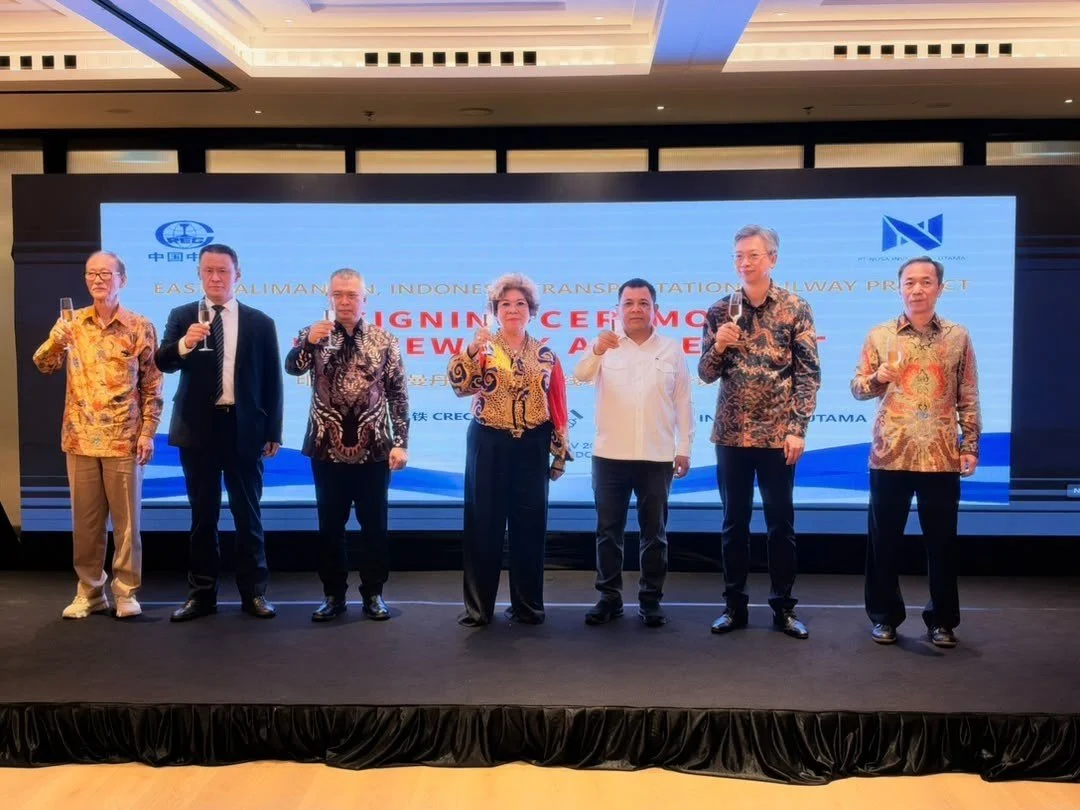
The development of the Trans-Kalimantan railway network has officially transitioned from a conceptual vision to a concrete collaborative effort following the signing of a Framework Agreement between the Indonesian firm PT Nusa Investama Utama and the state-owned China Railway Engineering Corporation (CREC). This strategic partnership marks the commencement of a multi-billion dollar endeavor aimed at establishing a robust logistics and transportation backbone across the Kalimantan archipelago, with the initial phase of construction slated to begin in East Kalimantan.
The agreement, formalized in a high-profile ceremony attended by industry leaders and diplomatic officials, signals a significant shift in Indonesia’s infrastructure strategy. By leveraging private sector capital through a business-to-business (B-to-B) framework, the project bypasses the reliance on the State Revenue and Expenditure Budget (APBN), reflecting a modern approach to large-scale infrastructure financing that minimizes fiscal burden while maximizing regional economic integration.
The Strategic Significance of the Trans-Kalimantan Railway
For decades, the connectivity landscape in Kalimantan has been dominated by maritime and road-based logistics. However, the geographic vastness and rugged terrain of the island have long hindered the efficient movement of natural resources and people. The Trans-Kalimantan railway is envisioned as a catalyst for economic diversification, moving the region away from a singular reliance on raw commodity exports toward a more industrialized, integrated economy.
The choice of East Kalimantan as the starting point is deeply strategic. As the host of the new national capital, Nusantara (IKN), the province is currently the epicenter of Indonesia’s infrastructure development. A rail link originating in this region is expected to provide essential support for the logistics requirements of the capital city, while simultaneously unlocking the economic potential of the interior regions of Kalimantan that have historically been isolated.
Chronology of the Partnership and Project Development
The collaboration between PT Nusa Investama Utama and CREC did not emerge in a vacuum. It follows a series of bilateral discussions between the Indonesian government and Chinese trade representatives aimed at accelerating the "Global Maritime Fulcrum" and the "Belt and Road Initiative" synergies.
- Initial Feasibility Studies (2024-2025): Preliminary assessments were conducted by both private entities and regional governments to evaluate the topographical challenges and potential economic corridors in Kalimantan.
- Bilateral Strategic Alignment (Early 2026): High-level talks between the Ministry of Transportation and Chinese economic delegates emphasized the need for modern rail technology to navigate Kalimantan’s unique landscape.
- Formalization (November 25, 2026): The signing of the Framework Agreement in Jakarta, attended by Minister Counselor for Economic and Commercial Affairs of the Chinese Embassy, Li Hongwei, and President of CREC International Engineering Company, Zhang Yongkang, officially sanctioned the project.
- Future Phase (2027 and beyond): The project is expected to move toward detailed engineering design (DED) and land acquisition phases, with initial construction mobilization planned for the following year.
Economic and Logistical Implications
The project is designed to bridge the gap between East Kalimantan and its neighboring provinces, specifically Central Kalimantan and South Kalimantan. By creating a continuous rail loop, the system will facilitate the movement of coal, palm oil, and processed industrial goods, significantly reducing logistics costs—which currently account for a disproportionately high percentage of operational expenditures in the region.
From an industrial standpoint, the railway acts as an "economic artery." Improved connectivity allows for the establishment of specialized industrial zones along the rail route. Analysts note that when freight costs decrease, the feasibility of downstream industries—such as refined mineral processing and advanced manufacturing—increases substantially. This aligns with President Prabowo Subianto’s broader policy directive to enhance regional connectivity and strengthen the internal supply chain of the Indonesian archipelago.
Official Perspectives and Ministerial Expectations
Minister of Transportation Dudy Purwagandhi has been vocal about the government’s support for this B-to-B arrangement. During the signing ceremony, he emphasized that the project serves as a cornerstone of the administration’s focus on regional equity.
"The development of the rail network outside of Java is not merely an infrastructure project; it is a manifestation of the government’s commitment to national integration," Minister Purwagandhi stated. "We expect that the technical expertise brought by CREC, combined with local operational insights from PT Nusa Investama Utama, will create a model of efficiency. Our hope is that this infrastructure will not be limited to East Kalimantan but will eventually form a comprehensive network linking Central and South Kalimantan, and potentially other provinces, creating a seamless logistics loop across the island."

The presence of approximately 300 business leaders at the signing event underscored the high level of investor confidence in the project. For the private sector, the Trans-Kalimantan railway represents a long-term investment opportunity in one of the world’s most resource-rich regions.
Technical Challenges and Sustainable Development
Constructing a railway across Kalimantan presents significant engineering hurdles. The island’s soil composition, characterized by soft peatlands and varied elevations, requires advanced geotechnical solutions. CREC, known for its extensive experience in high-speed rail and mountainous terrain construction in China, is expected to deploy specialized technologies to ensure the structural integrity of the tracks.
Furthermore, the project is under strict scrutiny regarding environmental compliance. The Indonesian government has emphasized that the railway must adhere to sustainable development principles, particularly given the ecological sensitivity of Kalimantan’s rainforests. Project planners have indicated that the rail design will include wildlife crossings and drainage systems designed to mitigate the impact on the local ecosystem.
Broader Impact on Indonesian Connectivity
The Trans-Kalimantan railway is part of a larger, ambitious master plan to upgrade Indonesia’s transportation infrastructure. While previous decades focused heavily on road networks, the current administration is pivoting toward mass rail transit as a more sustainable and efficient mode of transport.
Should the project meet its milestones, it will redefine the economic landscape of Borneo. By connecting the ports of the east coast with the resource-rich hubs in the center and south, Indonesia aims to create a more resilient economy capable of withstanding global commodity price fluctuations.
For the local communities, the rail network promises improved accessibility to social services, education, and healthcare, which have long been hindered by the reliance on riverine and road transport. The creation of transit-oriented developments (TOD) around planned stations is expected to spur urban growth in smaller municipalities, preventing over-concentration in major metropolitan areas.
Future Outlook and Next Steps
As the project moves into the implementation phase, the focus will shift to regulatory approvals, environmental impact assessments (AMDAL), and securing long-term operational financing. The success of this B-to-B model will likely serve as a blueprint for future infrastructure projects in Indonesia. If the government can successfully facilitate private investment without tapping into the national budget, it could unlock a new era of infrastructure development across the archipelago.
With the backing of major international players and a clear mandate from the Ministry of Transportation, the Trans-Kalimantan railway represents a critical step in Indonesia’s transition toward becoming a more integrated, globally competitive economic power. The vision of a connected Kalimantan, from the borders of the East to the hubs of the South, is now officially in motion, setting a new trajectory for the region’s development in the coming decade.
While the timeline remains ambitious, the collaborative spirit displayed by both the Indonesian and Chinese parties suggests a high degree of commitment to overcoming the logistical and geographical barriers that have long defined the Kalimantan landscape. As the project proceeds, stakeholders will be monitoring the progress of the East Kalimantan initial phase closely, as its success will dictate the pace and scale of subsequent expansions into Central and South Kalimantan.
