
The modern landscape of Indonesian tourism is deeply intertwined with the architectural and infrastructural developments initiated during the Dutch colonial era. Following the opening of the Suez Canal in 1869, maritime trade routes between Europe and the Dutch East Indies flourished, dramatically reducing travel time and transforming the archipelago into an accessible frontier for international travelers. By the late 19th century, steamships operated by companies such as the Koninklijke Paketvaart-Maatschappij (KPM) began regularly docking at various ports across the islands, disgorging waves of European tourists, dignitaries, and businessmen seeking exotic leisure and commercial opportunities.
To accommodate this burgeoning influx of foreign visitors, the colonial administration, alongside private European and Armenian entrepreneurs, commissioned the construction of luxury accommodations primarily centered on the island of Java and later expanding to Bali. These establishments were designed not merely as places of lodging, but as symbols of European prestige, architectural innovation, and modern comfort in the tropics. Remarkably, despite the sweeping political upheavals, the Japanese occupation, the Indonesian National Revolution, and the rapid pace of modern modernization, several of these historic hotels have survived, successfully adapting to contemporary hospitality standards while rigorously preserving their rich architectural and historical heritage.
The Intersection of Architecture, Colonial Legacy, and Modern Tourism
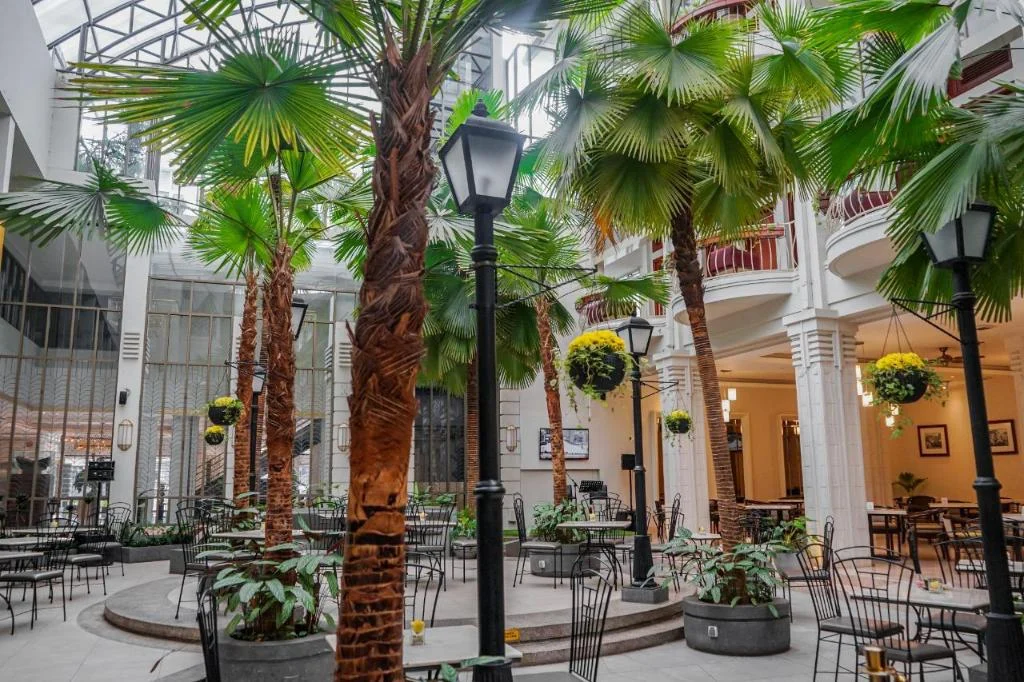
The historical trajectory of Indonesia’s hospitality sector serves as a physical timeline of the nation’s socio-political transformation. Architectural historians note that these early hotels introduced Western building techniques adapted to tropical climates—featuring high ceilings, extensive verandas, open-air courtyards, and neoclassical or Art Deco facades. Over the decades, these properties transitioned from exclusive enclaves for colonial elites and international jet-setters into national landmarks that bore witness to critical milestones in Indonesian history, including the struggle for independence, the birth of the non-aligned movement, and the establishment of diplomatic ties.
Today, maintaining these heritage properties presents a complex operational challenge. Modern hospitality conglomerates and state-owned enterprises charged with their management must balance stringent historic preservation mandates with the installation of contemporary amenities, high-speed telecommunications, and rigorous safety standards demanded by today’s international travelers. Despite these challenges, these five historic hotels continue to operate, offering guests an immersive journey into the past without sacrificing modern luxury.
1. Hotel Indonesia Kempinski Jakarta: A Symbol of Post-Colonial Ambition and Luxury
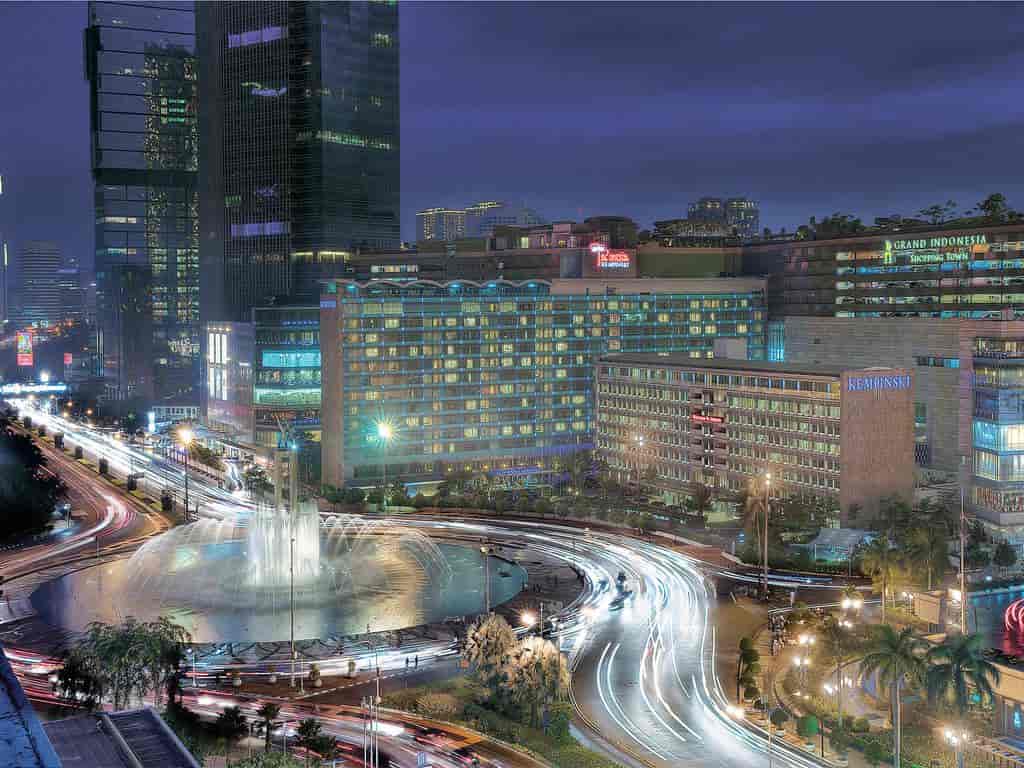
Standing proudly in the heart of the capital city, the Hotel Indonesia Kempinski Jakarta holds the distinction of being Indonesia’s first luxury five-star hotel. Its origins are deeply tied to the visionary nation-building projects of President Sukarno in the late 1950s and early 1960s. Funded partly through Japanese war reparations, the hotel was conceived to showcase a newly independent Indonesia to the global community and to serve as the primary athletes’ village for the IV Asian Games held in Jakarta in 1962.
Designed by the renowned American architectural firm Abel Sorenson and Associates, the hotel represented a radical departure from colonial architecture, embracing modernist international design principles. Upon its inauguration, it quickly became the social and political epicenter of Jakarta, hosting international diplomats, heads of state, and global celebrities. Over the decades, the property underwent extensive modernization, eventually coming under the management of the prestigious European luxury brand Kempinski.
The hotel’s historical significance was underscored in March 2020, when King Willem-Alexander and Queen Máxima of the Netherlands chose the property as their official residence during their historic state visit to Indonesia. To accommodate the royal couple, security protocols were significantly heightened, with the royal entourage occupying the hotel’s premier suites outfitted with specialized bulletproof glass. Currently managed as a benchmark of luxury in Southeast Asia, room rates at the Hotel Indonesia Kempinski generally begin at approximately Rp 2.98 million per night, fluctuating seasonally based on demand and economic indicators.
2. Hotel Majapahit Surabaya: The Crucible of the Indonesian National Revolution
Located on Tunjungan Street in Surabaya, the Hotel Majapahit stands as a solemn monument to the fierce determination of the Indonesian people during the National Revolution. Originally constructed in 1910 by the Sarkies Brothers—a prominent family of Armenian hoteliers renowned for developing luxury properties across Southeast Asia, including the Strand Hotel in Yangon and the Raffles Hotel in Singapore—the property originally opened under the name Hotel Oranje.
During the Dutch colonial era, Hotel Oranje was the premier social hub for European expatriates and sugar barons in East Java. Following the invasion of the Japanese imperial forces in 1942, the property was commandeered and renamed Hotel Yamato. However, the hotel’s most consequential chapter unfolded in September 1945, mere weeks after Indonesia proclaimed its independence.
The establishment became the focal point of a tense standoff between defiant Indonesian nationalists and Dutch internees attempting to reassert colonial control. On September 19, 1945, tensions boiled over when Dutch representatives hoisted the Dutch tricolor flag (red, white, and blue) atop the hotel roof. Outraged by this perceived provocation, Indonesian youths stormed the building. Amid the ensuing scuffle, figures including Kusno Wibowo and Abdul Wahab managed to tear off the blue section of the flag, converting it into the red-and-white Indonesian national flag. This historic act of defiance directly precipitated the historic Battle of Surabaya on November 10, 1945.
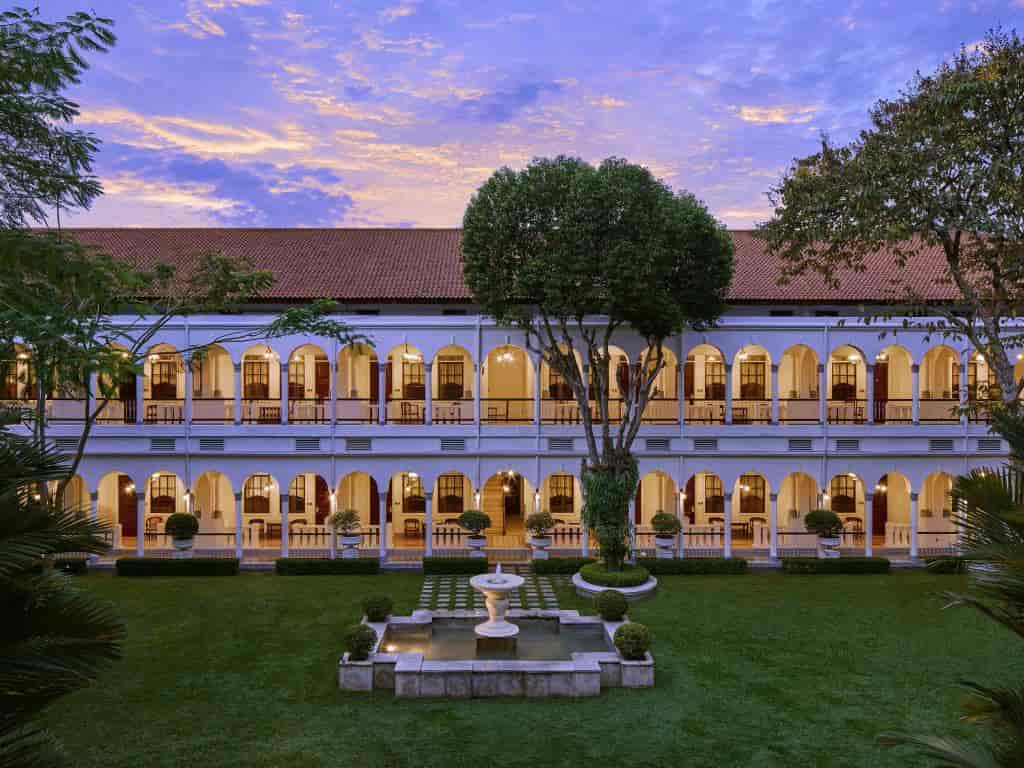
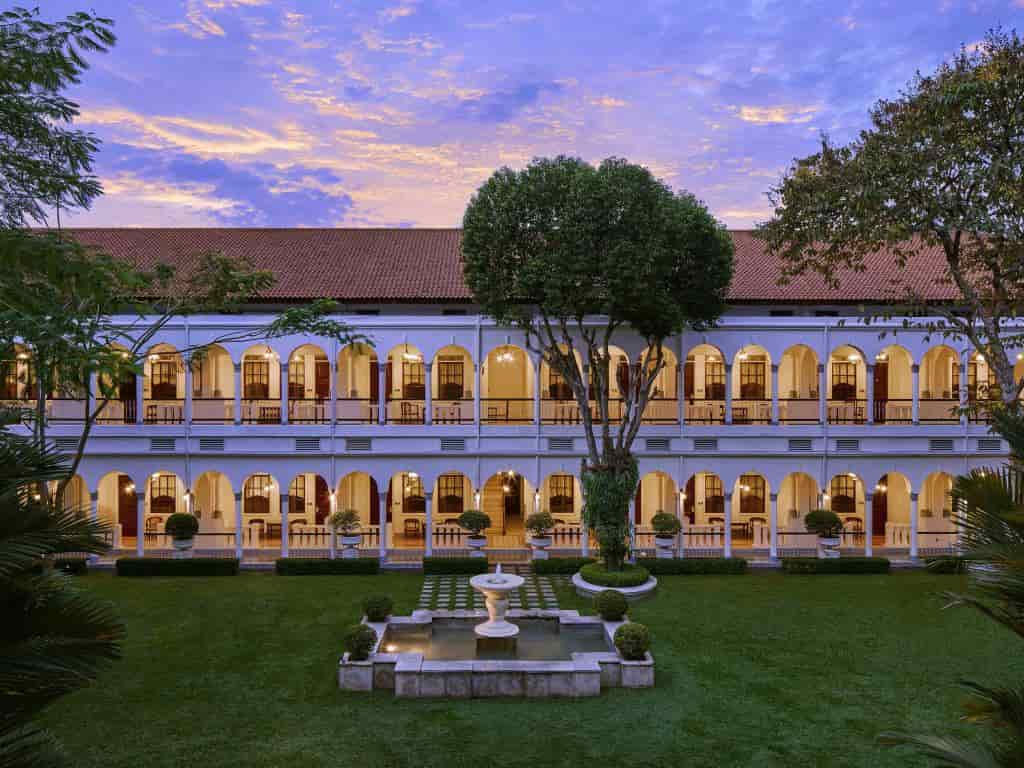
Nationalized after the war and subsequently rebranded as Hotel Majapahit under the management of various hospitality groups, the property has undergone meticulous preservation to retain its 20th-century colonial elegance, characterized by sprawling tropical gardens, long corridors, and classic courtyards. Nightly rates for guests wishing to walk the historic halls begin at approximately Rp 985,125.
3. Royal Ambarrukmo Yogyakarta: Royal Heritage Meets Modern Elegance
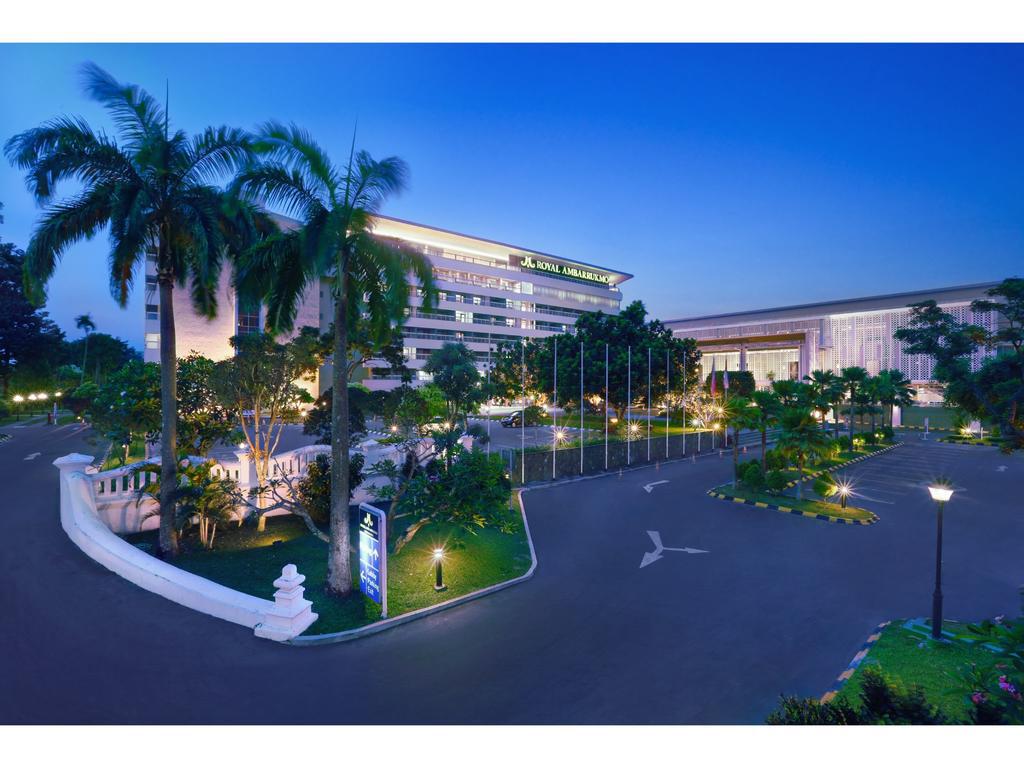
Situated along Jalan Laksda Adisucipto in Depok, Yogyakarta, the Royal Ambarrukmo represents a unique fusion of Javanese royal heritage and modern hospitality infrastructure. The site was originally an ancient royal compound and pleasure garden (Pesanggrahan) commissioned by Sultan Hamengku Buwono V and later expanded by Sultan Hamengku Buwono VII in the 19th century as a residence for visiting colonial dignitaries and a retreat for the royal family.
In the mid-1960s, as part of President Sukarno’s nationwide push to establish international-grade tourism infrastructure, the Indonesian government transformed the adjacent grounds into a modern luxury hotel. Along with Hotel Indonesia in Jakarta, Bali Beach Hotel, and Hotel Ambarrukmo was officially inaugurated as one of the country’s first four international-standard hotels in 1966.
The integration of the original 19th-century Loji (administrative building) and the historic Bale Ambarrukmo pavilion within the hotel complex provides guests with direct access to tangible elements of Javanese royal history. Operating today as a five-star luxury property under regional management, Royal Ambarrukmo offers high-end amenities including championship golf access, expansive swimming pools, and traditional spa treatments, all while maintaining its cultural mandate to preserve Javanese arts and architecture. Accommodation rates start at approximately Rp 911,250 per night.
4. Hotel Savoy Homann Bandung: An Art Deco Masterpiece on the Asia-Afrika Corridor
Positioned strategically on Jalan Asia-Afrika in Bandung—the historic venue of the 1955 Asian-African Conference—the Hotel Savoy Homann is an architectural icon of the Dutch colonial era, heavily celebrated for its striking Streamline Moderne and Art Deco design.
The history of the hotel dates back to the early 19th century when the Homann family, German immigrants, established a modest accommodation known for its legendary rijsttafel (traditional Indonesian feast) prepared by Mrs. Homann. As Bandung grew into the "Paris of Java," renowned for its progressive urban planning and European architectural experiments, the original structure was entirely demolished and redesigned in 1939 by the celebrated Dutch architect Albert Aalbers. Aalbers envisioned the building to mimic the sleek, aerodynamic curves of an ocean liner, complete with rounded balconies, porthole-like windows, and sweeping horizontal lines.
Renamed Savoy Homann in 1940 to reflect its elevated status, the hotel quickly attracted global luminaries. Most famously, the legendary silent film actor and comedian Charlie Chaplin stayed at the hotel during his travels through Java in the 1930s. During the 1955 Asian-African Conference, the hotel served as the primary residence for numerous international delegates and heads of state. Today, the hotel remains a vital landmark in Bandung’s heritage tourism sector, offering rooms starting at an accessible rate of approximately Rp 390,880 per night.
5. Inna Bali Heritage Hotel: Pioneering Luxury Tourism in the Island of the Gods
As the first modern luxury hotel established on the island of Bali, the Inna Bali Heritage Hotel (historically known as the Bali Hotel) represents the genesis of international tourism in Bali. Opened on August 22, 1927, in the heart of Denpasar, the hotel was constructed by the colonial government and KPM steamship lines to accommodate the growing number of foreign artists, anthropologists, and wealthy travelers arriving via steamship.
During the 1930s, the hotel served as a central hub for the burgeoning expatriate arts community in Bali, frequented by renowned painters, writers, and scholars such as Walter Spies, Miguel Covarrubias, and Margaret Mead, who found deep inspiration in Balinese culture. The property’s architecture successfully merges European colonial structural layouts with traditional Balinese aesthetic motifs, featuring open-air pavilions, lush tropical gardens, and carved stone reliefs.
Operated today as a three-star heritage property, Inna Bali continues to offer guests an authentic glimpse into the early era of Balinese tourism development. With basic nightly rates starting at approximately Rp 270,000, it remains one of the most historically significant yet financially accessible heritage accommodations in Indonesia.
Economic and Strategic Implications for the Heritage Hospitality Sector
The continued operation of these historic hotels carries significant economic, cultural, and diplomatic implications for Indonesia. From an economic perspective, heritage hotels act as anchors for cultural tourism, attracting high-spending travelers interested in experiential and historical travel rather than standard resort vacations. According to hospitality analysts, properties that successfully integrate authentic historical narratives into their marketing strategies experience higher customer loyalty and greater resilience during economic downturns compared to standardized chain hotels.
Furthermore, these properties serve as active instruments of cultural diplomacy. Hosting international leaders, such as the Dutch royal family at Hotel Indonesia Kempinski or global delegates in Bandung and Yogyakarta, reinforces Indonesia’s image as a nation that respects its complex history while projecting forward-looking hospitality standards.
However, industry experts caution that managing heritage properties requires specialized regulatory frameworks. Governments and private operators must navigate strict conservation laws that often limit structural expansions, necessitating innovative engineering solutions to upgrade plumbing, electrical grids, and digital infrastructure without compromising historical structural integrity.
Ultimately, these five hotels transcend their commercial functions. They remain living archives of Indonesia’s national evolution—physical spaces where the complexities of colonial history, the fervor of the independence movement, and the aspirations of modern tourism converge under one roof. Guests and prospective travelers are advised to verify final booking rates directly through official channels or authorized platforms, as pricing is subject to seasonal demand fluctuations, local tax policies, and macroeconomic adjustments.
