
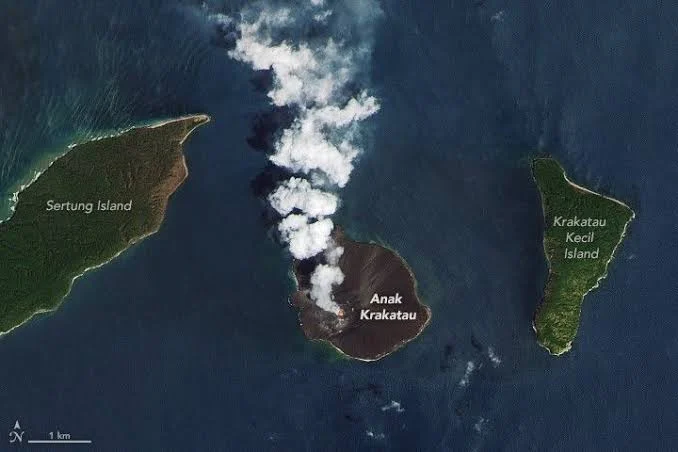
The recurring volcanic activity of Anak Krakatau, the resilient offspring of the legendary 1883 Krakatoa eruption, continues to draw intense scientific scrutiny as researchers analyze the potential for future seismic events. With recent forecasts pointing toward significant activity by 2026, the global community has begun to question whether such eruptions carry the potential to alter global climate patterns or mitigate the escalating warming trends associated with the strengthening El Niño phenomenon. However, leading volcanologists and meteorologists emphasize that while the spectacle of the eruption is profound, its atmospheric impact remains confined to local and short-term environmental fluctuations.
The Science of Volcanic Climate Forcing
To understand why Anak Krakatau’s recent and predicted activities are unlikely to trigger a global cooling event, one must analyze the mechanics of volcanic climate forcing. For a volcanic eruption to induce a measurable drop in global temperatures, it must be of a magnitude sufficient to inject massive quantities of sulfur dioxide (SO2) into the stratosphere—the layer of the atmosphere extending from roughly 10 to 50 kilometers above the Earth’s surface.
Once in the stratosphere, these sulfur gases oxidize to form sulfate aerosols. These aerosols act as microscopic mirrors, reflecting incoming solar radiation back into space and cooling the planet’s surface. This was famously demonstrated in 1991 during the eruption of Mount Pinatubo in the Philippines, which ejected roughly 20 million tons of SO2 into the stratosphere, causing a global temperature decrease of approximately 0.5 degrees Celsius for over a year.
In contrast, the plumes generated by Anak Krakatau predominantly remain within the troposphere—the lowest layer of the atmosphere where weather occurs. Data from atmospheric monitoring stations indicate that even when ash columns reach heights of 15,240 meters, they rarely breach the tropopause, the critical threshold between the troposphere and the stratosphere. Consequently, the volcanic material is quickly washed out by precipitation and atmospheric circulation, limiting its lifespan and its capacity to influence global radiative forcing.
Analyzing the 2026 Forecast
The prediction regarding 2026 is rooted in the cyclical nature of Anak Krakatau. Since its emergence in 1927, the volcano has undergone phases of rapid growth interrupted by massive structural collapses. The most notable recent instance occurred in December 2018, when a significant portion of the volcano’s southwestern flank collapsed into the sea, triggering a devastating tsunami that struck the coastlines of Banten and Lampung in Indonesia.
Volcanologists utilize a variety of indicators to forecast these periods of unrest, including seismic monitoring, ground deformation measurements, and gas emission analysis. Dan DePodwin, Director of Forecasting Operations at AccuWeather, maintains that the atmospheric profile of Anak Krakatau’s eruptions is insufficient to counteract the current trajectory of global warming.
"The plumes generated by this volcano are localized events," DePodwin explains. "While the visual intensity of an eruption may be alarming to those in the immediate vicinity, the atmospheric residence time of the particulate matter is too short and the altitude too low to provide any meaningful ‘volcanic winter’ effect or to serve as a buffer against the heating effects of El Niño."
Chronology of Recent Volcanic Unrest
The history of Anak Krakatau is one of perpetual rebuilding. Following the 2018 flank collapse, which reduced the volcano’s height from approximately 338 meters to 110 meters, the island entered a state of rapid geological recovery.
- December 2018: The catastrophic flank collapse caused a tsunami and triggered a massive reduction in the volcano’s physical stature.
- 2019–2022: A period of persistent, low-level strombolian activity, characterized by intermittent explosions and lava flows, allowed the island to begin re-accumulating mass.
- 2023: Monitoring agencies noted an increase in the frequency of eruptions, with ash columns frequently reaching several kilometers in height, prompting periodic evacuations and exclusion zones.
- 2024–2025: Current monitoring shows sustained seismic activity, which serves as the foundation for the projections leading into 2026. Experts anticipate that as the volcano continues to build its height, the potential for explosive activity increases, though the structural integrity of the mountain remains a volatile variable.
Data-Driven Perspectives on Atmospheric Impact
The Indonesian Agency for Meteorology, Climatology, and Geophysics (BMKG) has consistently tracked the dispersal of volcanic materials. Their data shows that ash and gas plumes, while reaching impressive vertical heights—noted at 15,240 meters to the west and 6,096 meters to the east—consistently remain contained beneath the tropopause.
The distinction between the troposphere and the stratosphere is the defining factor in climate impact. In the troposphere, aerosols are removed by clouds and rain within days or weeks. In the stratosphere, there is no weather to "wash" these particles out, allowing them to circulate the globe for years. Because Anak Krakatau lacks the explosive power to punch through the tropopause, its impact is relegated to localized air quality issues, respiratory health concerns for nearby populations, and potential disruption to regional aviation corridors.
Official Responses and Mitigation Efforts
The government of Indonesia, through the Center for Volcanology and Geological Hazard Mitigation (PVMBG), maintains a rigorous monitoring protocol. This includes a four-tier alert system (Levels I through IV) designed to provide timely warnings to local communities and shipping interests.
During the buildup to expected 2026 activity, official efforts are focused on:
- Exclusion Zones: Maintaining a 5-kilometer radius around the crater to prevent fatalities from pyroclastic flows or sudden explosions.
- Real-time Monitoring: Using satellite imagery and seismic arrays to track deformation that might signal an imminent structural failure, similar to the 2018 event.
- Public Awareness: Educating coastal communities on tsunami early warning signs, as the primary threat from Anak Krakatau remains mass movement into the sea rather than atmospheric contamination.
The Broader Context: Volcanism vs. Anthropogenic Warming
It is vital to distinguish between the natural, localized cooling effects of volcanoes and the systemic, long-term warming driven by human activity. While a massive volcanic eruption (the size of Mount Tambora in 1815, for instance) can disrupt global agriculture and temperatures for several years, Anak Krakatau’s current output is negligible in the global context.
Recent studies published in journals such as Nature Geoscience suggest that volcanic activity has accounted for only a minor fraction of the observed temperature changes over the last century. In contrast, the accumulation of greenhouse gases—carbon dioxide, methane, and nitrous oxide—continues to trap heat at an unprecedented rate. The El Niño-Southern Oscillation (ENSO) cycle further modulates this, with El Niño years typically seeing a spike in global surface temperatures due to the release of heat from the Pacific Ocean.
Researchers warn against the narrative that natural phenomena might "save" the planet from human-induced climate change. The data indicates that even if Anak Krakatau were to erupt with higher intensity, the effect would be fleeting. The planet’s current energy imbalance is a product of long-lived greenhouse gases, not the transient presence of ash or sulfates in the lower atmosphere.
Implications for Regional Stability
For the Indonesian archipelago, the implications of predicted 2026 activity are socioeconomic rather than climatological. The proximity of the volcano to the Sunda Strait—a vital artery for maritime trade—means that even small eruptions can lead to flight cancellations, shipping delays, and the temporary closure of coastal tourism hubs.
Furthermore, the threat of tsunamis remains the most significant hazard. The 2018 disaster served as a stark reminder that the volcano’s growth is inherently unstable. As the mountain reaches a critical mass, the weight of the new material, combined with the underlying geothermal pressure, increases the likelihood of another flank failure. Consequently, the focus of civil protection agencies is on building resilient infrastructure and ensuring that early warning systems are robust enough to withstand the next cycle of growth and potential collapse.
Conclusion: A Managed Risk
As the scientific community looks toward 2026, the consensus is clear: while Anak Krakatau is a geological marvel and a significant regional hazard, it is not a primary driver of the global climate. The volcano will continue to puff, erupt, and reshape itself, serving as a reminder of the Earth’s dynamic nature. However, the global climate trajectory will remain dominated by the broader trends of atmospheric greenhouse gas concentrations and the cyclical nature of oceanic phenomena.
For the people of Indonesia, the 2026 forecast is a call for vigilance, preparedness, and continued investment in monitoring technologies. For the rest of the world, the activity of Anak Krakatau offers a lesson in the scale of natural forces—reminding us that while volcanoes can shape the local landscape with terrifying speed, their power to influence the global climate is governed by strict atmospheric laws that, in the case of this specific volcano, ensure its impact remains confined to its own backyard.
