
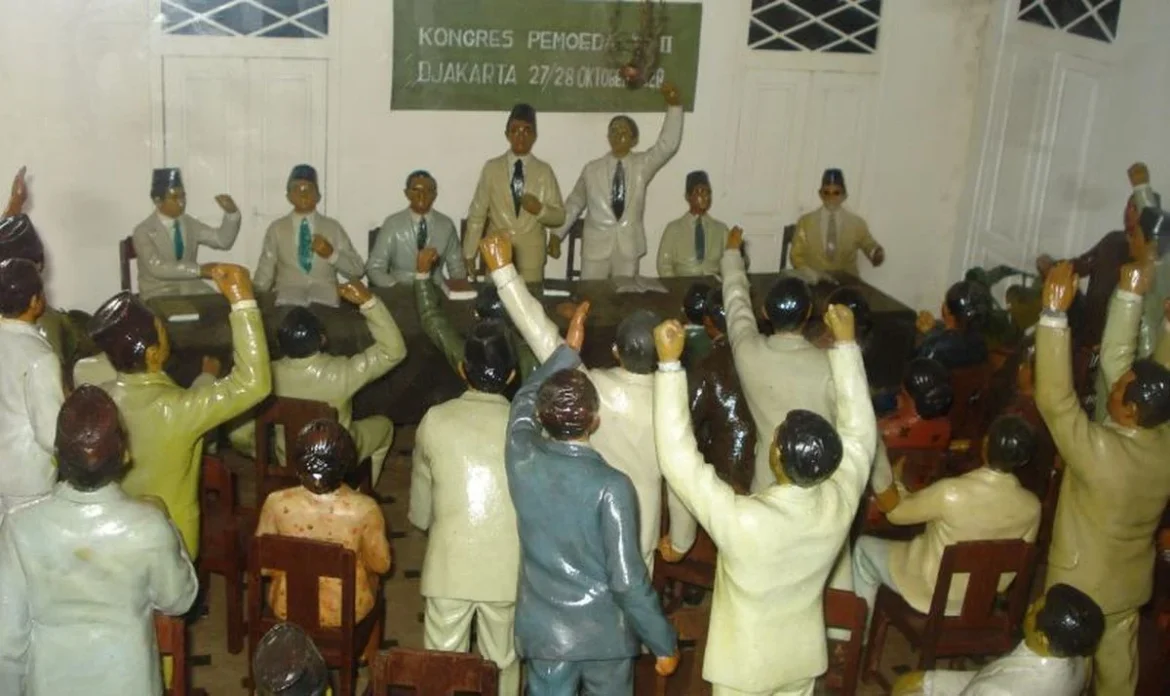
The date of October 27 stands as a significant marker in the annals of global and national history, serving as a confluence point for revolutionary political movements, the consolidation of national identity, and the formalization of essential state infrastructure. From the foundational echoes of the Indonesian youth movement in 1928 to the geopolitical restructuring of Soviet Central Asia in 1924 and the birth of Indonesia’s energy backbone in 1945, this day encapsulates the transition from colonial or imperial structures toward independent nation-building.
The Dawn of National Identity: Kongres Pemuda II
On October 27, 1928, the trajectory of Indonesian nationalism was irrevocably altered. In Jakarta, the Kongres Pemuda II (Second Youth Congress) commenced, serving as the crucible for what would become the Sumpah Pemuda, or the Youth Pledge. This event was not merely a meeting; it was a strategic synthesis of various regional youth organizations—such as Jong Java, Jong Sumatranen Bond, and Jong Celebes—aiming to overcome parochialism in favor of a unified Indonesian identity.
The atmosphere in Jakarta during the late 1920s was thick with the tensions of colonial oversight. The Dutch East Indies government, while wary of the gathering, allowed the congress to proceed under strict surveillance. The significance of the congress lay in its rejection of tribalism. By shifting the discourse from regional loyalty to a singular national consciousness—"One Motherland, One Nation, and One Language"—the delegates effectively dismantled the divide-and-rule tactics that had sustained Dutch colonial authority for centuries.
Historically, this congress provided the intellectual and psychological scaffolding for the eventual proclamation of independence in 1945. It transformed the Indonesian nationalist movement from a series of disparate, localized rebellions into a cohesive, nationwide political entity. The implications were profound: for the first time, the concept of "Indonesia" as a singular, indivisible nation-state was articulated with formal institutional backing.
The Birth of Energy Sovereignty: PLN’s Foundational Moment
Following the proclamation of independence on August 17, 1945, the new Indonesian government faced the immediate challenge of reclaiming state assets from Japanese occupation forces and pre-existing Dutch utility entities. On October 27, 1945, the Indonesian government took a decisive step toward energy sovereignty by establishing the Jawatan Listrik dan Gas (the Department of Electricity and Gas), which would eventually evolve into the Perusahaan Listrik Negara (PLN).
This move was more than administrative; it was a symbolic assertion of control over the nation’s critical infrastructure. In the immediate post-war period, the control of power plants was a strategic necessity for the survival of the fledgling Republic. The transition was marked by the historic handover of the Gambir Electric Power Plant from Japanese forces to Indonesian engineers and workers. This act of "nationalizing" the infrastructure signaled to the international community that Indonesia was capable of managing its own technical and industrial affairs, a prerequisite for modern statehood.
Today, PLN stands as a cornerstone of the Indonesian economy. The evolution from a modest department in 1945 to a massive state-owned enterprise underscores the importance of energy infrastructure in facilitating the nation’s socio-economic development. The legacy of October 27, 1945, is reflected in the modern mandate to provide universal electricity access, a task that remains central to Indonesia’s current goals of industrialization and digital transformation.
Geopolitical Realignment: The Creation of the Uzbek Soviet Socialist Republic
While the Indonesian narrative of October 27 focuses on liberation and nation-building, the same date in 1924 saw a radical geopolitical restructuring in Central Asia. The formation of the Uzbek Soviet Socialist Republic (RSS) was an exercise in Soviet administrative engineering. Under the policy of "national delimitation," the Soviet government sought to categorize and compartmentalize the diverse ethnic groups of Central Asia into distinct territorial units.

The creation of the Uzbek SSR was intended to curb the influence of Pan-Turkism and Pan-Islamism, which the Soviet leadership viewed as potential threats to their central authority. By partitioning the region into smaller, manageable republics based on linguistic and ethnic lines, the Soviet Union created a system of dependencies that would last for nearly seven decades.
Chronology of Uzbek Territorial Shifts:
- 1924: Formation of the Uzbek SSR, which initially included the Tajik Autonomous SSR.
- 1929: Tajikistan is separated from the Uzbek SSR and elevated to a full Union Republic.
- 1930: The capital of the Uzbek SSR is moved from the historic city of Samarkand to Tashkent, reflecting a move toward a more centralized, urbanized administration.
- 1991: Following the collapse of the Soviet Union, Uzbekistan formally declares its independence on August 31, ending the Soviet era.
The implications of the 1924 restructuring are still felt in the region today. The arbitrary borders drawn by Soviet cartographers have historically complicated inter-ethnic relations and regional diplomacy in Central Asia. The study of this event serves as a reminder of how external administrative decisions can reshape the demographic and political landscape of a region for generations.
Comparative Analysis: Infrastructure, Identity, and Sovereignty
When analyzing these events together—the Kongres Pemuda II, the founding of PLN, and the formation of the Uzbek SSR—a clear theme emerges: the intersection of administrative definition and national sovereignty.
In Indonesia, the events of October 27 were bottom-up movements driven by a burgeoning desire for self-determination. The Youth Congress was a manifestation of civil society, while the takeover of the power plants was an assertion of administrative control by the new state. Both events were essential for the legitimacy of the Republic of Indonesia.
In contrast, the creation of the Uzbek SSR was a top-down, imperial administrative act. It highlights the stark difference between the nationalist aspirations of colonized peoples in Southeast Asia and the state-building mandates of the Soviet Union. While both processes aimed to create "modern" states, the underlying impetus—freedom versus integration—remains a critical distinction for historians and political scientists.
Official Perspectives and Historical Legacy
Historians often emphasize that the events of October 27 serve as a lens through which to view the evolution of governance. Regarding the Indonesian context, scholars note that the Sumpah Pemuda remains a cultural touchstone that informs current debates on national unity. As Indonesia navigates the complexities of the 21st century—including regional autonomy and globalization—the ideals of the 1928 congress are frequently invoked by policymakers to maintain social cohesion.
Similarly, the professionalization of PLN is often cited by economic analysts as a case study in the successful transition from colonial-era management to indigenous operation. The resilience of these institutions demonstrates that the legacy of October 27 is not just historical, but operational and ongoing.
Conclusion: A Legacy of Transformation
The date of October 27 serves as a reminder that history is not merely a collection of past events, but a series of interconnected processes that define the structures of the modern world. Whether through the intellectual labor of the youth delegates in Jakarta, the technical efforts of engineers in 1945, or the complex geopolitical maps drawn in Central Asia, this day highlights the constant human endeavor to define, control, and improve the environments in which we live.
As we look back at these milestones, the lessons are clear: national identity is forged through collective action, and state sovereignty is maintained through the diligent management of critical infrastructure. The history of October 27 continues to resonate, providing a foundation for understanding the complex realities of nationhood in the modern era. For Indonesia, it remains a date of profound pride, marking the moment when the nation first spoke with a singular voice and began the long, challenging journey toward building a sovereign, electrified, and unified future.
