
Absolute zero, defined precisely as 0 Kelvin (K) or -273.15 degrees Celsius (-459.67 degrees Fahrenheit), represents the theoretical floor of the thermodynamic temperature scale. In the realm of physics, it is the point at which the fundamental particles of nature reach their minimum vibrational motion, retaining only quantum mechanical zero-point energy. While humanity has achieved remarkable feats in cryogenic engineering, the attainment of absolute zero remains an elusive, perhaps impossible, frontier according to the foundational laws of physics.
The Thermodynamic Barrier
The Third Law of Thermodynamics provides the bedrock for our understanding of why absolute zero is unreachable. Formulated by Walther Nernst in the early 20th century, the law states that as the temperature of a system approaches absolute zero, the entropy of a perfect crystal approaches a constant minimum. Crucially, the law implies that no process, no matter how idealized, can reduce the temperature of a system to zero Kelvin in a finite number of steps.
As researchers strip away thermal energy from a sample, each incremental step becomes exponentially more difficult. To remove heat from an already frigid environment requires an increasingly complex apparatus and an disproportionate amount of energy. The closer one gets to the 0 K threshold, the more the quantum nature of reality begins to dominate, rendering classical thermodynamic cooling methods ineffective.
A Chronology of Cryogenic Exploration
The pursuit of the coldest temperatures in the universe has been a century-long endeavor, marked by significant milestones in low-temperature physics:
- 1908: Heike Kamerlingh Onnes, a Dutch physicist, successfully liquified helium for the first time, reaching temperatures near 4 K. This breakthrough allowed for the discovery of superconductivity in 1911.
- 1920s–1930s: The development of adiabatic demagnetization allowed scientists to cool substances to millikelvin temperatures by manipulating the magnetic moments of atomic nuclei.
- 1980s: The invention of laser cooling, pioneered by physicists such as Steven Chu, Claude Cohen-Tannoudji, and William Phillips, revolutionized the field. By using precisely tuned laser beams to counteract atomic motion, researchers could reach microkelvin temperatures.
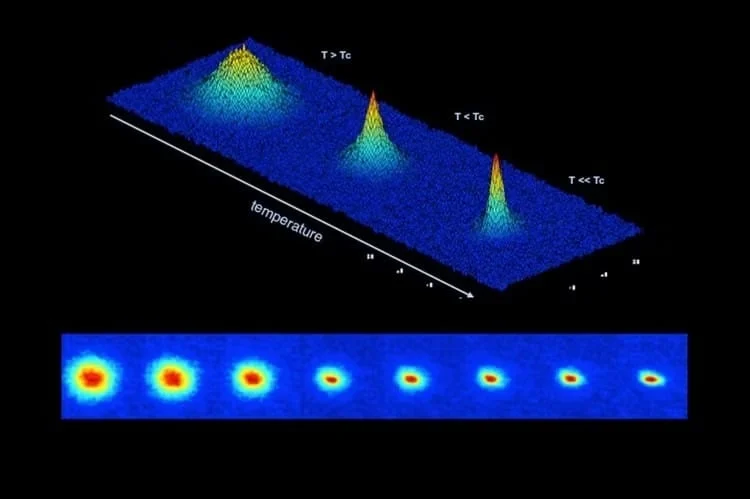
- 1995: The realization of the Bose-Einstein Condensate (BEC) by Eric Cornell, Carl Wieman, and Wolfgang Ketterle marked a new era. By cooling rubidium atoms to nanokelvin temperatures, they observed a state of matter where individual atoms lose their identity and merge into a single, collective quantum wave.
- 2017: The Cold Atom Lab (CAL), a multi-user facility on the International Space Station, began operations. By utilizing the microgravity environment of space, scientists were able to observe ultra-cold quantum gases for much longer durations than is possible on Earth, where gravity pulls atoms downward.
Mechanisms of Extreme Cooling
The transition from liquid helium cooling to the sophisticated techniques used today involves a multi-stage approach. The most prominent method is Laser Cooling, often referred to as "optical molasses." Contrary to the intuition that lasers provide heat, they are used to dissipate kinetic energy. When a laser is tuned slightly below the resonance frequency of an atom, the atom only absorbs photons if it is moving toward the laser source, due to the Doppler effect. This absorption imparts a momentum kick that opposes the atom’s motion, effectively slowing it down.
Following laser cooling, scientists employ magnetic trapping. Atoms with magnetic moments are confined within a vacuum chamber using magnetic fields, preventing them from touching the walls of the container, which would transfer heat. Finally, "evaporative cooling" is used—similar to how steam cools a cup of coffee. By selectively allowing the most energetic atoms to escape the trap, the remaining ensemble reaches an even lower average temperature, often hitting the nanokelvin regime.
Implications for Quantum Science
The ability to reach temperatures just a fraction above absolute zero is not merely an academic exercise; it is the cornerstone of modern quantum technology. At these extreme temperatures, the wave-like nature of matter becomes dominant. Atoms begin to overlap, creating states of matter that allow for unprecedented precision in measurement and calculation.
- Quantum Computing: Many qubit architectures, such as superconducting loops, require temperatures near absolute zero to maintain coherence. Thermal fluctuations at higher temperatures cause "noise" that collapses the delicate superposition required for quantum calculations.
- Precision Metrology: Atomic clocks, which serve as the foundation for GPS and global synchronization, rely on ultra-cold atoms to measure time with an accuracy that would drift by less than a second over the age of the universe.
- Fundamental Physics Research: The study of BECs allows physicists to simulate complex quantum systems, including those found in the interiors of neutron stars or the early stages of the Big Bang, providing insights into the fabric of spacetime and gravity.
Challenges and Official Perspectives
Leading institutions, including the National Institute of Standards and Technology (NIST) and various CERN research groups, maintain that while we can get within billionths of a degree of absolute zero, the "final step" remains a physical impossibility.
"We are essentially fighting the fundamental uncertainty of the universe," says a senior researcher in condensed matter physics. "As we approach 0 K, the quantum fluctuations described by the Heisenberg Uncertainty Principle become the limiting factor. You cannot simultaneously know the position and momentum of a particle with infinite precision, and as you constrain the motion to reach 0 K, the spatial uncertainty grows, effectively introducing energy back into the system."
This inherent "zero-point energy" ensures that atoms are never truly at rest. Even at the theoretical absolute zero, an atom maintains a ground-state energy, preventing a complete cessation of all physical activity. This is a critical distinction: absolute zero refers to the removal of thermal kinetic energy, not the total absence of all energy.
Future Horizons: The Coldest Places in the Universe
While human laboratories are limited by current technology and the laws of thermodynamics, nature provides its own cryogenic environments. The Boomerang Nebula, located 5,000 light-years away, is known as the coldest natural place in the known universe, with a temperature of approximately 1 K (-272.15°C). This extreme cold is caused by the rapid expansion of gas escaping from the dying star at the center of the nebula, acting as a massive, cosmic-scale refrigerator.
As research continues, the scientific community is looking toward "sub-nanokelvin" cooling. Future missions, including advanced iterations of the Cold Atom Lab and proposed space-based interferometers, aim to push the boundaries of temperature control even further. The objective is to utilize the vacuum of space to create temperatures that are physically impossible to maintain on the surface of the Earth.
Broader Impact on Society
The implications of this research extend far beyond the laboratory. As we master the art of temperature control, we unlock new materials that could revolutionize energy efficiency. Room-temperature superconductivity, often considered the "holy grail" of physics, is theoretically linked to our understanding of ultra-cold matter. If scientists can replicate the quantum behavior observed at nanokelvin temperatures at higher, more practical temperatures, it would result in lossless power grids, ultra-efficient transportation, and the next generation of medical imaging technology.
In summary, absolute zero serves as both a physical limit and a conceptual North Star for physics. It defines the absolute boundaries of the thermodynamic scale while simultaneously acting as the gateway to the quantum world. Though the human race may never touch the 0 K mark, the journey toward it has already reshaped our understanding of the universe, proving that in the quest for the coldest possible environment, humanity has uncovered some of the hottest discoveries in modern science.
