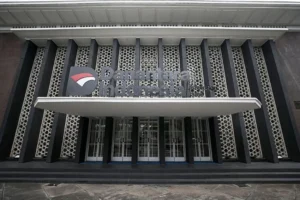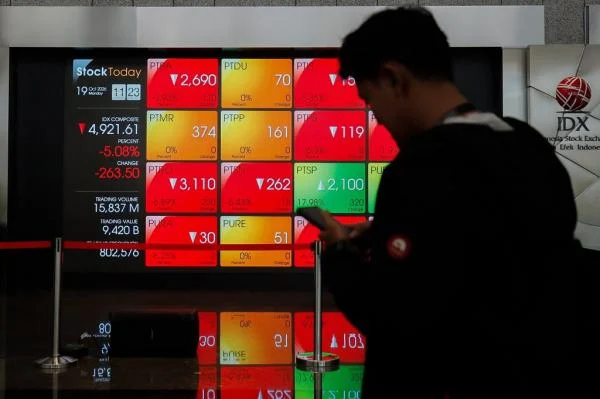
The Jakarta Composite Index (Indeks Harga Saham Gabungan / IHSG) opened in negative territory during the trading session on Friday, October 30, 2026, extending a cautious sentiment across the domestic capital market. The benchmark index slipped to the level of 5,066.94 as market participants responded to a broad wave of selling pressure that impacted the majority of listed equities. This early session downturn reflects ongoing volatility within the Indonesian financial ecosystem, compounded by localized sector rotations and prevailing macroeconomic uncertainties influencing investor risk appetite both regionally and domestically.
Market breadth at the opening bell clearly demonstrated a bearish bias dominating the trading floor. Data compiled from the Indonesia Stock Exchange (IDX) indicated that 383 stocks experienced downward corrections, while only 105 issues managed to record positive movements. Meanwhile, 475 stocks remained stagnant, refusing to move from their previous closing prices. This wide distribution of losses highlights that the selling pressure was not isolated to specific heavyweight counters but rather distributed evenly across various market capitalizations, affecting large-cap blue chips as well as second- and third-liner equities.
Trading Activity and Liquidity Metrics
Despite the negative opening trajectory, market participants maintained a moderate level of transactional engagement during the early hours of the session. The total value of transactions reached Rp383.5 billion, supported by an aggregate trading volume of 1.417 billion shares changing hands. Market participants executed these transactions through 44,200 separate frequencies. Concurrently, the overall market capitalization of the Indonesia Stock Exchange stood robustly at Rp8,881 trillion, demonstrating that the structural valuation of the exchange remains substantial despite short-term downward corrections in index points.
This level of liquidity suggests that institutional and retail investors remain active, albeit with a heightened sense of caution. Analysts point out that sudden contractions in index levels often prompt bargain hunting, though market participants in the current session appeared more inclined toward risk-mitigation strategies. The divergence between active trading volume and cautious price movements underscores a market searching for definitive catalysts to establish a clearer medium-term direction.
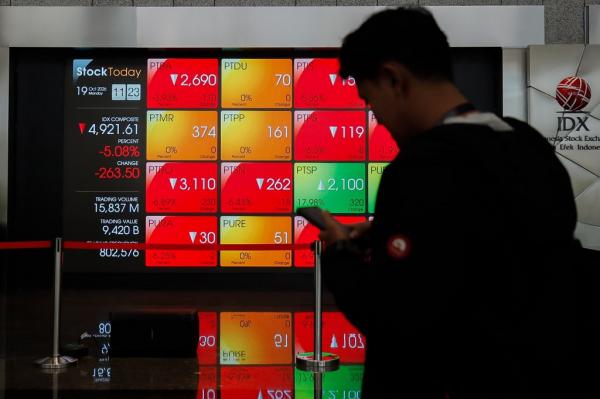
Sectoral Breakdown: Infrastructure and Cyclicals Lead the Decline
A closer examination of the sectoral indices reveals that the downward movement was spearheaded by heavy losses in specific industrial segments. The infrastructure sector bore the brunt of the selling pressure, plunging by 1.97 percent and emerging as the session’s worst performer. Analysts attribute this pullback to profit-taking following previous sessions of relative resilience, alongside concerns over capital expenditure cycles and financing costs within infrastructure development corporations.
Following closely behind was the non-primary consumer goods sector, which contracted by 1.52 percent. Weakness in this sector often signals underlying consumer hesitancy regarding discretionary spending, as households potentially reallocate budgets toward essentials amid broader inflationary pressures. The transportation sector also faced significant headwinds, dropping by 1.48 percent, while the basic materials sector recorded a 1.38-percent correction. The synchronized decline in basic materials and transportation points toward localized concerns regarding global supply chain adjustments and shifting input costs for manufacturing industries.
Bright Spots: Technology and Financials Offer Mild Cushion
Amid the widespread correction, a select few sectors managed to swim against the current, providing a modest cushion against a deeper plunge in the composite index. The technology sector stood out as a primary outperformer, registering a solid gain of 1.05 percent. Renewed interest in tech equities suggests that select investors continue to identify long-term growth potential in digital infrastructure, e-commerce enablers, and software service providers listed on the domestic exchange.
Additionally, the financial sector—traditionally viewed as the backbone of the IHSG due to its substantial market weighting—managed to post a positive increment of 0.44 percent. Gains in major banking institutions helped stabilize the index, preventing a more severe freefall during the opening minutes of trade. The healthcare sector similarly eked out a modest gain of 0.15 percent, reflecting defensive positioning by market participants favoring resilient, non-cyclical business models during periods of market turbulence.

Broader Context and Market Background
The negative opening on October 30, 2026, follows a particularly volatile period for the Indonesian capital market. Just a day prior, on October 29, 2026, the IHSG closed with a steep and dramatic plunge of 3.49 percent, settling at the 5,098 mark. In that chaotic session, universal selling was observed across all sectors without exception, leaving virtually no safe havens for equity investors. That prior session’s sharp correction set a nervous tone that naturally spilled over into the subsequent trading day, explaining the cautious and risk-averse attitude exhibited by traders at Friday’s open.
Conversely, market watchers noted that market sentiment can shift rapidly within a single trading week. Earlier in the same weekly cycle, specifically during the morning session on October 29, the index had briefly attempted a recovery, opening with a modest gain of 0.43 percent to reach 5,305. However, that early optimism proved ephemeral as persistent macroeconomic headwinds and external pressures quickly overwhelmed the buying interest, culminating in the sharp sell-off that closed out the mid-week trading.
Macroeconomic Implications and Investor Strategy
The ongoing fluctuations in the IHSG highlight the delicate interplay between domestic economic fundamentals and external global factors. Financial experts emphasize that market participants are currently navigating a complex landscape characterized by shifting monetary policy expectations, currency fluctuations, and varying corporate earnings reports. When the index breaches key psychological levels—such as moving below the 5,100 threshold—technical selling is often triggered, exacerbating downward movements as stop-loss orders are automatically executed across brokerage platforms.
For retail and institutional investors alike, periods of heightened volatility like the one observed on Friday necessitate a disciplined approach to portfolio management. Financial planners frequently advise maintaining adequate cash reserves, focusing on fundamentally sound companies with strong balance sheets, and avoiding panic-driven transactions. Diversification across defensive sectors—such as healthcare and select financial institutions—can also serve as an effective buffer against sudden market corrections.

Outlook for the Remainder of the Trading Day and Beyond
As the trading day progresses, market participants will closely monitor incoming macroeconomic data and foreign capital flow indicators. Foreign investor net sell or buy positions historically play a decisive role in determining the afternoon trajectory of the IHSG. If foreign institutional funds continue to exercise caution, the index may struggle to claw its way back into positive territory before the closing bell.
Ultimately, the performance of the IHSG on October 30, 2026, serves as a reminder of the inherent risks and dynamic nature of equity markets. While the morning session’s red zone reflects lingering anxieties from the previous day’s steep decline, the resilience of specific sectors like technology and finance indicates that pockets of opportunity remain available for discerning investors willing to navigate the volatility with a long-term strategic perspective. Market regulators and analysts alike will continue to observe how domestic sentiment adapts to these evolving financial conditions in the sessions ahead.