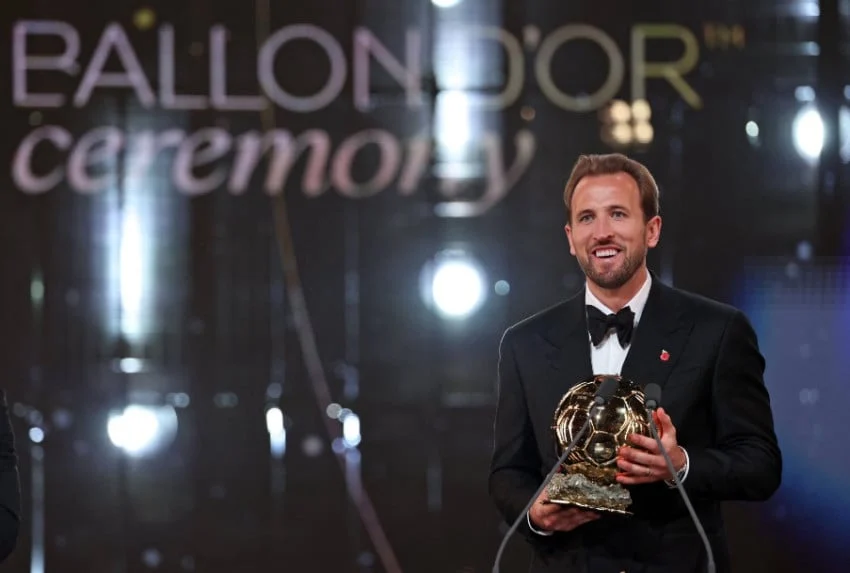
Harry Kane has officially been crowned the recipient of the 2026 Ballon d’Or, securing his place in football history during the 70th edition of the prestigious award ceremony held at the iconic London Palladium Theatre on Tuesday, October 27, 2026. This landmark event, which marks a significant departure from the award’s traditional home in Paris, saw the England captain rise above a field of elite international talent to claim the golden ball, the highest individual honor in the sport.
The evening was characterized by both the celebration of athletic excellence and a bizarre administrative controversy that dominated the news cycle in the hours leading up to the gala. As the global football community awaited the announcement, the official Ballon d’Or website inadvertently published pre-prepared profile articles for Kane, Kylian Mbappé, and Lamine Yamal. Each article prematurely declared its respective subject as the winner, triggering a wave of confusion and speculation across social media platforms and international news outlets.
A Night of Unexpected Drama and Resolution
The incident, which the organizing committee later attributed to a technical error involving pre-published draft materials, forced a swift clarification from the award’s administrators. According to a spokesperson for the event, the committee had prepared placeholder content for each of the top candidates to ensure a seamless transition from the announcement to the official digital rollout. Unfortunately, these drafts were toggled to ‘live’ prematurely due to a backend system glitch.
The committee emphasized that these accidental publications did not reflect the final tally of votes cast by the international panel of journalists. By the time the ceremony commenced at the London Palladium, the air of uncertainty had been replaced by the gravity of the official proceedings. When the envelope was finally opened, Kane’s name was announced, putting an end to the speculation and solidifying his status as the premier forward of the 2026 season.
Historical Significance of the 2026 Ceremony
The decision to host the 2026 Ballon d’Or in London represented a major shift in the brand’s strategy. For decades, the ceremony was synonymous with the Théâtre du Châtelet in Paris, a city that served as the spiritual home of the trophy since its inception in 1956 by France Football. By moving the event to the United Kingdom, organizers signaled an intent to globalize the brand further and acknowledge the massive commercial and cultural influence of the Premier League and English football on the world stage.
This 70th anniversary edition was designed to be the most expansive yet, incorporating a wider array of awards for youth development, tactical innovation, and humanitarian contributions alongside the standard individual honors. The choice of the London Palladium—a venue steeped in theatrical history—provided a sophisticated backdrop for what was widely considered the most competitive year for the Ballon d’Or in the post-Lionel Messi and Cristiano Ronaldo era.
The Path to Victory: Analyzing Kane’s 2026 Campaign
Harry Kane’s victory is the culmination of a career-defining season. The striker’s transition into a more creative role, while maintaining his prolific goal-scoring output, has been cited by analysts as the primary factor in his triumph. His influence on the pitch, characterized by deep-lying playmaking and clinical finishing, provided the backbone for his team’s performance throughout the year.
Statistically, Kane’s 2026 campaign was nothing short of extraordinary. He maintained a high goal-per-game ratio across all club competitions, while simultaneously leading the assist charts in major European tournaments. Beyond the numbers, his leadership during high-pressure knockout matches demonstrated a maturity that resonated with the voting panel, which consists of specialized journalists from the top 100 FIFA-ranked nations.
Alexia Putellas and the Ascendance of Women’s Football
While Kane’s victory drew significant headlines, the crowning of Alexia Putellas as the Ballon d’Or Féminin winner for 2026 was a testament to the continued rise of women’s football. Putellas, the Barcelona Femeni star, regained the top spot after a season of dominant midfield displays and crucial contributions in the UEFA Women’s Champions League.
Her win highlights the deepening talent pool in the women’s game. Barcelona Femeni’s recognition as the "Klub Putri Terbaik" (Best Women’s Club) of 2026 further underscores the club’s dominance in the sport. Under the current tactical setup, the team has managed to integrate young talent with veteran leadership, creating a blueprint for success that has set a new standard for women’s football clubs worldwide.
Institutional Awards: PSG and Unai Simon
The 2026 ceremony also sought to honor the collective efforts of teams and specialists. Paris Saint-Germain (PSG) was named the "Klub Putra Terbaik" (Best Men’s Club), reflecting a season of tactical evolution and success in domestic and European leagues. The award acknowledges the club’s recent shift in strategy, prioritizing sustainable squad building over high-profile individual transfers.
In the individual category for goalkeepers, Unai Simon was honored as the "Kiper Putra Terbaik 2026." Simon’s performance, particularly his penalty-saving prowess and commanding presence in defensive transitions, made him the clear choice for the award. His recognition marks a notable moment for Spanish football, reinforcing the nation’s historical reputation for producing world-class goalkeeping talent.
Implications for the Future of the Ballon d’Or
The events surrounding the 2026 Ballon d’Or—from the venue change to the digital publication error—have sparked a broader conversation about the transparency and modernization of the award. Critics have long argued that the voting process, while rigorous, lacks the real-time public scrutiny afforded to other major global awards.
The accidental leak of the winner profiles has ironically provided the committee with a mandate to modernize their digital infrastructure. Moving forward, observers suggest that the organizers may implement more robust cybersecurity measures and transparency protocols to ensure that the integrity of the voting process remains beyond reproach.
Furthermore, the shift to London suggests that future ceremonies could rotate between international football capitals. This "roaming" model could increase the prestige and reach of the award, ensuring that it remains the pinnacle of individual recognition in a sport that continues to grow in every corner of the globe.
Closing Reflections
As the lights dimmed at the London Palladium, the legacy of the 2026 Ballon d’Or was solidified. For Harry Kane, the trophy represents more than just a season’s worth of work; it is the ultimate validation of a career dedicated to professional excellence. For the organizers, the night was a successful, if occasionally chaotic, demonstration of the event’s ability to adapt to a changing media landscape.
The football world now looks ahead to the 2027 season, with a new set of contenders already emerging. The standards set by Kane, Putellas, and the rest of the 2026 honorees serve as a benchmark for the next generation of players. Whether the award returns to Paris or continues its global tour, one thing remains clear: the Ballon d’Or retains its power to capture the collective imagination of millions, serving as the definitive measure of greatness in the beautiful game.
The 2026 edition of the awards will be remembered not only for the winners but for the way it navigated the pressures of modern digital reporting and its successful debut on the London stage. As the industry moves forward, the focus will undoubtedly return to the pitch, where the pursuit of the next golden ball begins anew.