
Reach for MSMEs Across Strategic Urban Hubs
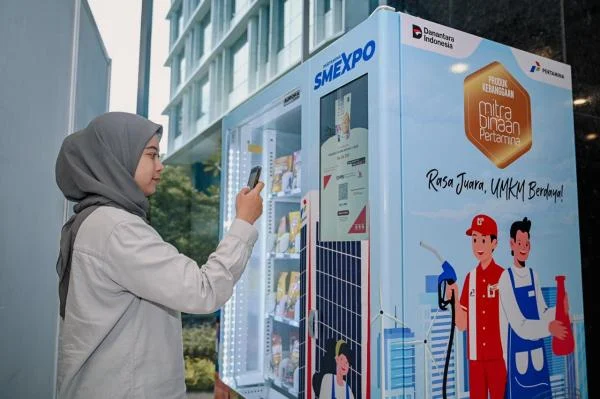
JAKARTA — In an ambitious move to bridge the gap between local micro-enterprises and modern consumers, PT Pertamina (Persero) has officially rolled out an innovative retail initiative utilizing smart vending machines. Designed exclusively to showcase and sell products curated from its extensive roster of fostered Micro, Small, and Medium Enterprises (MSMEs), this strategic intervention aims to solve one of the most persistent hurdles faced by small business owners: scalable market access and geographic penetration.
By positioning these automated retail units in high-traffic, strategic urban locations—ranging from corporate office complexes and higher education institutions to critical healthcare facilities—Pertamina is redefining how traditional Indonesian artisanal goods, snacks, and lifestyle products are retailed. This initiative forms part of the state-owned energy giant’s broader mandate to foster national economic resilience by empowering grassroots businesses, ensuring that high-quality local products are not only recognized for their excellence but are also easily accessible to the modern, fast-paced urban consumer.
The Evolution of MSME Market Access in Indonesia
For decades, the primary bottleneck for Indonesian MSMEs has not been the quality of their production, but rather their limited distribution channels. While many local business owners excel at creating unique culinary treats, artisanal crafts, and proprietary consumer goods, scaling beyond their immediate local communities often proves financially prohibitive. Traditional retail spaces demand steep upfront rental costs, intensive staffing, and complex supply chain logistics that routinely overwhelm small-scale operators.
Recognizing these structural limitations, state-owned enterprises (SOEs) like Pertamina have increasingly taken on the role of ecosystem facilitators. Through targeted corporate social responsibility and incubation programs, Pertamina has nurtured thousands of MSMEs across the archipelago, providing them with capital training, packaging design workshops, and regulatory compliance assistance. However, mentorship and production grants alone are insufficient without a sustainable pathway to end-consumers.
The introduction of specialized vending machines serves as a modern, cost-effective retail bridge. It eliminates the traditional overhead costs associated with brick-and-mortar storefronts while placing local products directly in the paths of thousands of daily commuters, students, office workers, and hospital visitors. This seamless integration of automated retail technology represents a critical evolutionary step in Indonesia’s retail landscape, demonstrating how traditional enterprises can leverage modern distribution tools to compete effectively in a digitized economy.
Strategic Rollout and Deployment Progress
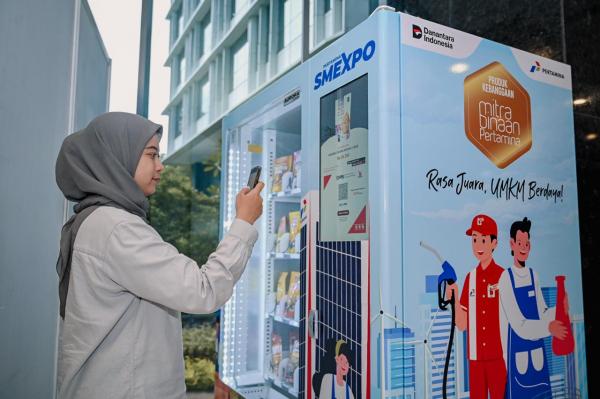
Pertamina’s visionary strategy involves the deployment of a targeted fleet of automated retail units designed to maximize visibility and sales volume. According to operational disclosures released by the corporation, Pertamina has slated a total of eight dedicated vending machine units for this initial phase, strategically chosen to capture diverse demographic segments.
As of November 2026, exactly half of this planned fleet—four sophisticated units—has been successfully installed and activated across high-profile locations in the capital region. The inaugural deployment sites were handpicked to test consumer behavior across varied institutional environments:
- Grha Pertamina: Situated in the heart of Jakarta’s central business district, this flagship corporate office building captures a high-density population of white-collar professionals, corporate executives, and visiting business delegates with high purchasing power.
- PGN Office: As a prominent energy sector hub, the State Gas Company (PGN) facility provides a steady, captive audience of technical and administrative professionals.
- Universitas Pertamina: Placing a unit within a prominent academic institution connects MSME products directly with Indonesia’s digitally native, trend-conscious student demographic, fostering brand loyalty from a young age.
- RS Pertamina Jaya: Positioned within a major healthcare facility, this unit caters to medical personnel, patients, and families looking for quick, high-quality, and reliable convenience items during stressful or busy hospital visits.
The remaining four units in the deployment pipeline are scheduled to come online sequentially, expanding the network’s footprint to encompass even more high-traffic public spaces over the coming months.
Bridging the Digital and Physical Retail Divide
The deployment of these smart vending machines is far more than a simple distribution tactic; it represents a comprehensive shift toward digitized, cashless, and autonomous retail experiences for local products. Modern vending machines are no longer primitive mechanical boxes limited to dispensing carbonated beverages and mass-produced snacks. Instead, the units utilized by Pertamina are equipped with advanced digital payment gateways—supporting QRIS (Quick Response Code Indonesian Standard), electronic money cards, and mobile banking applications—aligning seamlessly with the shifting payment habits of urban Indonesians.
Furthermore, these machines act as data-driven test markets. By tracking inventory turnover, peak purchasing times, and product popularity in real-time through integrated telemetry systems, Pertamina can provide invaluable feedback to the MSME owners. Small business operators can analyze which flavor profiles, packaging sizes, or product categories resonate best with corporate workers versus university students, enabling them to refine their manufacturing and marketing strategies based on hard empirical data.
This operational autonomy means that MSMEs do not need to assign dedicated personnel to manning retail booths. The automated systems manage inventory securely around the clock, drastically lowering transaction friction and maximizing profitability margins for the participating small business owners.
Broader Economic Implications and Corporate Synergy
Pertamina’s vending machine initiative does not operate in a vacuum; it is deeply intertwined with the company’s broader corporate restructuring and national development goals. In recent years, the energy conglomerate has systematically streamlined its internal operations—most notably demonstrated by its ongoing target to finalize the rationalization and streamlining of its vast network of 84 subsidiaries by the end of 2026. By trimming corporate fat and optimizing internal synergies, Pertamina has been able to redirect strategic capital and operational bandwidth toward high-impact social programs, including its flagship MSME development initiatives.
Moreover, the corporation’s recent accolades—such as sweeping multiple honors at the 2026 Anugerah Penggerak Nusantara awards—underscore its deeply entrenched institutional commitment to driving national energy security, economic equity, and sustainable community development. The MSME vending machine project serves as a tangible manifestation of this philosophy, proving that a major industrial enterprise can simultaneously manage complex macro-energy logistics while driving micro-economic empowerment at the community level.
Economic Analysts and Industry Perspective
Independent retail analysts have praised the initiative as a pragmatic, low-risk, high-reward model for corporate-backed enterprise development. In traditional corporate social responsibility (CSR) frameworks, financial aid or physical bazaar exhibitions often yield temporary visibility spikes that fade once the event concludes. In contrast, embedding MSME products into automated retail hardware establishes a permanent, self-sustaining distribution channel that generates continuous, recurring revenue for the business owners.
Experts note that as Indonesian cities continue to densify and real estate prices for commercial retail space skyrocket, alternative retail formats like vending machines, micro-hubs, and unmanned kiosks will play an increasingly vital role in urban commerce. By introducing local MSMEs to this cutting-edge retail format early, Pertamina is effectively future-proofing its fostered entrepreneurs, equipping them with the technological literacy and operational resilience required to thrive in an increasingly automated commercial environment.
Future Outlook and Scaling Potential
Looking ahead, the success of the initial eight-unit rollout is expected to serve as a proof-of-concept for a much larger national expansion. If utilization rates, sales velocity, and profit margins meet or exceed internal corporate projections, stakeholders anticipate that Pertamina will scale the initiative significantly. Future iterations could see hundreds of similar automated units deployed across transportation hubs—such as mass rapid transit (MRT) stations, commuter rail terminals, and airports—as well as major shopping malls and public parks across major metropolitan areas throughout Indonesia.
For the individual MSME entrepreneur, this scalable horizon transforms what was once a localized, subsistence-level enterprise into a dynamic commercial entity capable of competing on equal footing with established national brands. By leveraging Pertamina’s formidable logistics, infrastructure, and institutional reputation, these small business operators are gaining unprecedented access to the formal economy.
Ultimately, Pertamina’s smart vending machine network stands as a benchmark for modern state-driven enterprise development. By intelligently blending autonomous retail technology, strategic asset placement, and grassroots economic empowerment, the corporation is not merely selling snacks and crafts; it is actively constructing a resilient, inclusive, and future-ready commercial ecosystem for the backbone of Indonesia’s national economy.
