
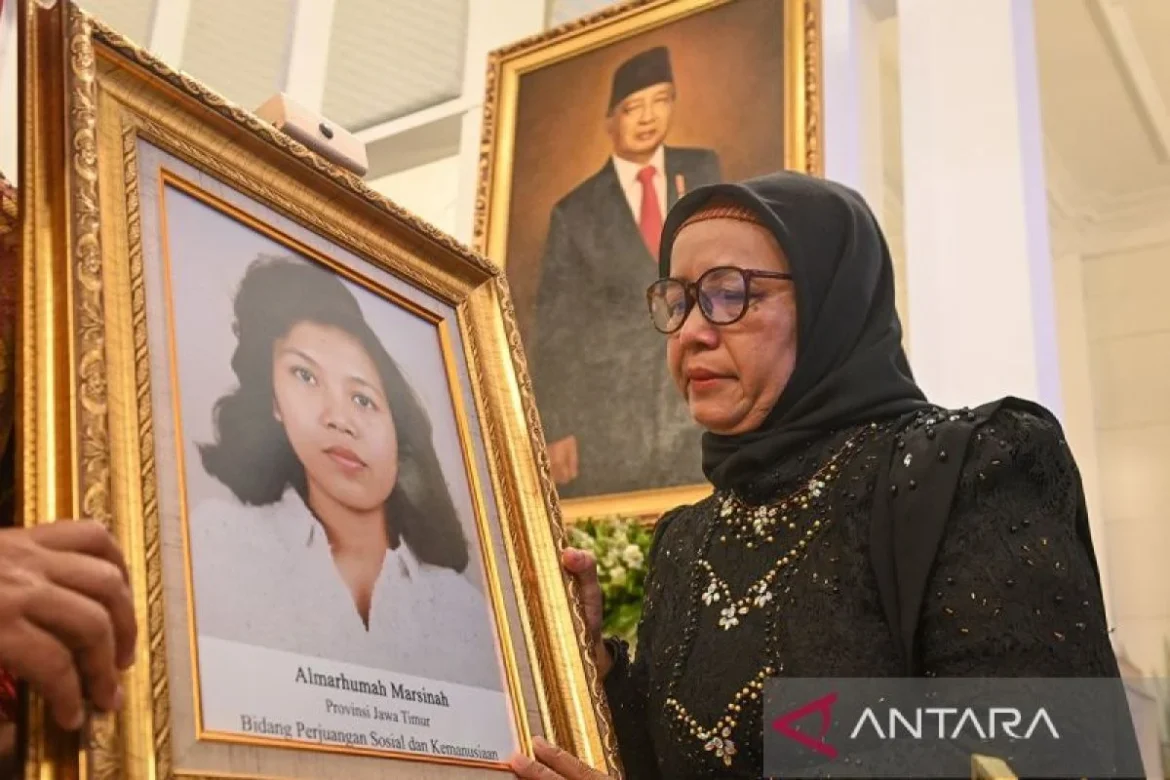
Jakarta, Indonesia – President Prabowo Subianto officially conferred the prestigious National Hero title upon Marsinah, a revered labor activist known for her courageous advocacy for workers’ rights, during a solemn ceremony at the State Palace in Jakarta on Monday, November 10, 2025. The event, held in commemoration of National Heroes’ Day, highlighted Marsinah’s enduring legacy as a symbol of resilience and an unwavering voice against injustice, particularly during the repressive New Order era when workers frequently faced severe social disparities and oppressive treatment. This posthumous recognition, formalized through Presidential Decree (Keppres) Number 116/TK/Tahun 2025, acknowledges Marsinah among ten distinguished figures honored this year for their significant contributions to the nation, especially in championing the rights of the populace, with a particular emphasis on the working class. The decision to elevate Marsinah to this esteemed status has been widely welcomed by human rights advocates and labor organizations, who have long campaigned for her recognition as a testament to the sacrifices made in the pursuit of justice and dignity for Indonesian workers.
Historical Context: Labor Under the New Order
To fully appreciate the significance of Marsinah’s struggle and her posthumous honor, it is crucial to understand the socio-political landscape of Indonesia during the New Order regime (1966-1998) under President Suharto. This era was characterized by strong economic development policies, often at the expense of human rights and democratic freedoms. Labor movements, in particular, were heavily suppressed. Independent trade unions were outlawed, and the government established a single, state-controlled labor organization, the All-Indonesia Workers Union (Serikat Pekerja Seluruh Indonesia or SPSI), which was widely perceived as serving the interests of the government and employers rather than the workers themselves. Strikes and protests were frequently met with intimidation, arrests, and sometimes violence, often involving military intervention. This climate of fear and repression meant that any act of defiance by workers required immense courage and carried severe risks, making Marsinah’s leadership all the more remarkable. The struggle for fair wages, safe working conditions, and the right to organize was a perilous endeavor, and those who dared to challenge the status quo often paid a heavy price.
The Early Life and Awakening of an Activist
Marsinah, born on April 10, 1969, in Desa Nglundo, Kecamatan Sukomoro, Nganjuk, East Java, grew up in humble circumstances. She was the second of three children born to Mastin and Sumi’ani and was primarily raised by her grandmother and aunt, a common arrangement in rural areas where families often pooled resources to survive. Her childhood was marked by frugality and hard work; she often helped her family by selling snacks, instilling in her a strong sense of independence and perseverance from a young age. Despite the financial hardships, Marsinah pursued her education diligently, attending SD Negeri Karangasem 189 and later SMP Negeri 5 Nganjuk. She also spent some time studying at Pondok Pesantren Muhammadiyah, a testament to her foundational moral and spiritual upbringing. However, like many young people from low-income families in rural Indonesia, her aspirations for higher education were curtailed by financial limitations, forcing her to seek employment to support herself and her family. This personal experience of limited opportunity and economic struggle undoubtedly fueled her empathy for fellow workers facing similar predicaments.
In 1989, seeking better economic prospects, Marsinah made the crucial decision to move to Surabaya, East Java’s provincial capital and a burgeoning industrial hub. She initially stayed with her older sister, Marsini, while actively searching for work. Her determination led her to various factories, and she eventually secured a position at SKW plastic factory in the Rungkut industrial area. This initial exposure to factory life offered a glimpse into the demanding and often exploitative conditions prevalent in the rapidly industrializing economy. The following year, in 1990, Marsinah joined PT Catur Putra Surya (CPS), a watch manufacturing company located in Porong, Sidoarjo, East Java. It was within the confines of this factory that Marsinah’s latent awareness of workers’ rights began to crystallize. She witnessed firsthand the pervasive injustices faced by her colleagues: meager wages that barely covered living expenses, excessive working hours without proper compensation, lack of job security, and an overall environment where the welfare of the workers was secondary to profit. These observations ignited a fire within her, transforming her into an outspoken advocate for change.
The Fateful Strike of 1993: A Stand for Justice
The catalyst for Marsinah’s ultimate sacrifice came in 1993. That year, the then-Governor of East Java, Soelarso, issued Circular Letter No. 50/Th.1992, which mandated a 20 percent increase in workers’ wages across the province. This directive was a small step towards improving the livelihoods of laborers, but its implementation was often met with resistance from employers. PT CPS, Marsinah’s employer, was among those companies that refused to comply with the new regulation, citing various reasons but effectively denying its workers a rightful wage increase. This blatant disregard for official policy and the welfare of its employees sparked widespread discontent among the workers at PT CPS.
Frustration simmered, eventually boiling over into organized protest. Between May 3 and May 4, 1993, Marsinah, alongside twelve other courageous workers, stood at the forefront of a major strike action. Their demands were clear and unequivocal: the immediate implementation of the mandated wage increase and the dissolution of the factory-level SPSI branch, which they viewed as ineffective and complicit in management’s exploitative practices. The workers argued that the SPSI leadership at their factory failed to genuinely represent their interests and instead served as a tool for management control. The strike gained momentum, and remarkably, their collective action yielded an initial success: 11 out of their 12 demands were provisionally agreed upon by the management. This momentary victory demonstrated the power of collective bargaining and Marsinah’s effective leadership in mobilizing her peers.
Military Intervention and Marsinah’s Disappearance
However, the workers’ triumph was short-lived. The fragile agreement quickly unraveled as external forces intervened. The very next day, the situation took a sinister turn when 13 workers, including those who had been prominent in the strike, were summoned to the District Military Command (Kodim) in Sidoarjo. There, under duress and implicit threats, they were coerced into signing letters of resignation. This military intervention in a civilian labor dispute was a stark illustration of the New Order regime’s pervasive control and its readiness to use force to suppress any form of dissent, particularly from organized labor. The act of forcing resignations effectively dismantled the leadership of the workers’ movement and sent a chilling message to anyone contemplating similar actions.
Upon learning of this alarming development, Marsinah, demonstrating her unwavering commitment to her fellow workers, sought justice. She bravely went to the Kodim Sidoarjo herself, not for personal reasons, but to request copies of the forced resignation letters. Her intention was to clarify the situation and, presumably, to find a way to challenge the legality of these coerced resignations, hoping to restore her colleagues’ jobs and rights. This was her last known public act of advocacy. After this courageous attempt to seek transparency and justice, Marsinah disappeared.
The Tragic Discovery and Unresolved Justice
The disappearance of Marsinah sent shockwaves through the community, immediately raising fears for her safety given the context of military intimidation. Tragically, her worst fears were realized just a few days later. On May 8, 1993, Marsinah’s lifeless body was discovered in a remote hut in Desa Jegong, Kecamatan Wilangan, Nganjuk, roughly 200 kilometers from Sidoarjo. The scene was horrifying: her body bore severe wounds and unmistakable signs of brutal torture, indicating a violent and premeditated murder. The gruesome nature of her death immediately pointed to the possibility of a targeted killing intended to silence a vocal labor leader and send a terrifying message to others who might dare to challenge the authorities or employers.
Marsinah’s murder ignited a national uproar, becoming a stark symbol of the violent repression faced by workers and human rights activists during the New Order era. The public outcry pressured authorities to launch an investigation. Initially, several individuals associated with PT CPS management were arrested and tried, including the factory owner, Yapto Suryosumarno, who was among those initially convicted. However, the legal proceedings were fraught with controversy and allegations of irregularities. Many believed that the investigations were superficial, designed to find scapegoats rather than uncover the true masterminds behind the murder. Subsequent appeals led to the overturning of these convictions at higher judicial levels, including the Supreme Court. To this day, the true perpetrators of Marsinah’s torture and murder, particularly those who might have ordered or orchestrated it, have never been definitively identified or brought to justice. This enduring impunity has remained a deep wound in Indonesia’s human rights record, symbolizing a broader failure to achieve accountability for past abuses.
The Long Road to Recognition and Enduring Advocacy
For decades following her murder, Marsinah’s case remained a touchstone for human rights and labor activists in Indonesia. Her name became synonymous with the struggle for justice, and her story was recounted annually on May 8th, serving as a powerful reminder of the sacrifices made in the fight for workers’ rights. Organizations such as the Commission for Missing Persons and Victims of Violence (Kontras) and various labor unions consistently campaigned for a thorough reinvestigation of her murder and for her official recognition as a national hero. These advocacy efforts kept her memory alive and ensured that her case was not forgotten amidst the broader narrative of Indonesia’s transition to democracy. Her image, often depicted with a determined gaze, became an icon for movements demanding justice and accountability for past human rights violations. The persistent calls for her national hero status reflected a collective desire to acknowledge her courage and to officially embed her story into the nation’s historical consciousness as a figure who epitomized the fight against oppression.
Significance of the National Hero Award
The conferment of the National Hero title upon Marsinah by President Prabowo Subianto carries profound significance on multiple levels. Firstly, it officially affirms that her struggle was not in vain, providing a long-awaited symbolic victory for the labor movement and human rights advocates. For decades, her sacrifice was acknowledged by civil society, but this state-level recognition elevates her status and integrates her narrative into the official history of Indonesia’s struggle for independence and justice.
Secondly, for the millions of Indonesian workers, this award serves as a powerful validation of their past and ongoing struggles for dignity, fair wages, and humane working conditions. It acknowledges the immense sacrifices made by individuals like Marsinah, whose courage paved the way for improved labor rights in the post-New Order era. The Confederation of Indonesian Trade Unions (KSPI), a prominent labor organization, swiftly reacted to the news, stating that the "hero title for Marsinah is an acknowledgment of the state towards workers." This sentiment underscores the symbolic weight of the award, recognizing the working class as an integral part of the nation’s heroes.
Thirdly, from a human rights perspective, while the award does not directly address the unresolved justice surrounding her murder, it represents a crucial step towards historical truth and reconciliation. It acknowledges a dark chapter in Indonesian history, where state power was used to suppress legitimate worker grievances, often with brutal consequences. By honoring Marsinah, the government implicitly recognizes the injustice she suffered and signals a commitment, however symbolic, to upholding human rights and democratic values. Her sister, Marsini, expressed immense pride, noting that this recognition brought a measure of comfort, even if the pain of unresolved justice for Marsinah’s murder still lingers.
Lastly, for the nation as a whole, Marsinah’s elevation to National Hero status encourages a deeper re-evaluation of its history. It reminds citizens that heroism is not solely confined to military prowess or political leadership but can also be found in the brave acts of ordinary individuals who champion the rights of the marginalized. It promotes a more inclusive understanding of national heroes, encompassing those who fought for social justice and human dignity within the country’s borders.
Broader Implications and Enduring Legacy
Marsinah’s name continues to live on as an inspiration for current and future generations of activists and workers. Her case remains a critical chapter in the history of human rights violations in Indonesia, serving as a stark reminder of the dangers of authoritarian rule and the imperative of protecting fundamental freedoms, including the right to organize and express dissent. The tragic events surrounding her life and death highlight the vital importance of independent labor movements in ensuring equitable economic development and social justice.
Her story resonates beyond labor rights, touching upon broader themes of impunity, state violence, and the struggle for accountability. Marsinah’s legacy is often mentioned alongside other prominent victims of New Order repression, such as poet-activist Wiji Thukul, who disappeared in 1998, and human rights defender Munir Said Thalib, who was assassinated in 2004. These cases collectively underscore a pattern of suppressing voices that challenged the authoritarian regime, and the persistent calls for justice for these figures reflect an ongoing national quest for historical truth and resolution. The recognition of Marsinah as a National Hero can thus be seen as part of a broader national effort to confront and reconcile with the darker aspects of its past, ensuring that such abuses are never repeated.
Furthermore, Marsinah’s recognition reinforces the ongoing relevance of labor rights advocacy in contemporary Indonesia. While the political landscape has changed dramatically since the New Order, challenges such as precarious employment, stagnant wages, and the suppression of union activities persist in various forms. Her legacy serves as a constant reminder for workers to remain vigilant and to continue fighting for their rights, drawing strength from her unwavering spirit. The recent dedication of a Human Rights Service Room in the Ministry of Law and Human Rights (Kemenham) named after Marsinah further solidifies her place as an icon of human rights and justice, ensuring that her name continues to inspire action and commitment to these fundamental principles within government institutions.
The National Hero title for Marsinah is more than just an honor; it is a powerful symbolic statement from the Indonesian state, acknowledging the immense sacrifices made in the pursuit of justice and dignity for all. It underscores the belief that courage in the face of oppression, particularly in advocating for the most vulnerable, is a defining characteristic of true heroism, a lesson that continues to shape Indonesia’s journey towards a more just and equitable society.
