
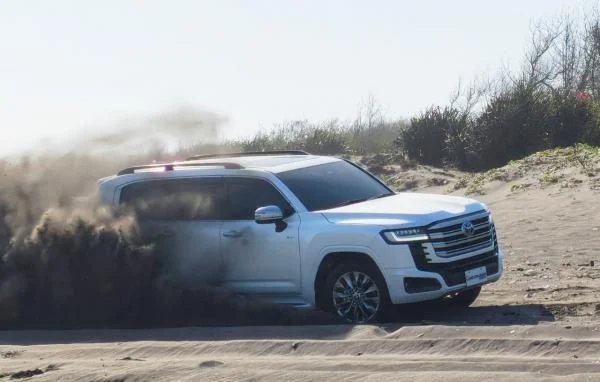
YOGYAKARTA – The iconic dunes of Gumuk Pasir, located on the southern coast of Yogyakarta, served as the challenging backdrop for the Toyota Journalist Test Drive: Drive & Joy Beyond The Road 2026. On Monday, September 14, 2026, automotive journalists were granted a rare opportunity to push the limits of Toyota’s latest flagship SUVs, the Toyota Land Cruiser 300 Hybrid EV and the All-New Land Cruiser FJ, in an environment that demands both precision engineering and raw power.
The event, designed to demonstrate the versatility of Toyota’s latest technological advancements, shifted the focus from urban asphalt to the shifting, unstable sands of the Indonesian coastline. By navigating these vehicles through steep gradients and loose terrain, Toyota aimed to highlight the evolution of its off-road pedigree in the age of electrification.
The Evolution of Off-Road Dominance
The Land Cruiser nameplate carries a legacy that spans over seven decades. Since its inception in 1951, the model has evolved from a utility vehicle into a global symbol of luxury, reliability, and extreme off-road capability. The introduction of the Land Cruiser 300 Hybrid EV represents a pivotal moment in this history.
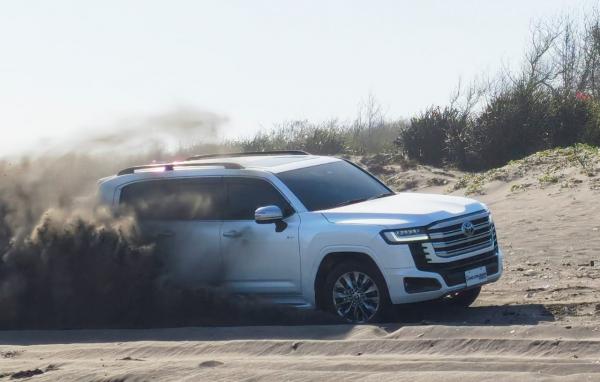
With a price point hovering around Rp2.7 billion, the vehicle is not merely a luxury status symbol but a sophisticated piece of machinery. The integration of hybrid technology into the Land Cruiser 300 series marks Toyota’s commitment to reducing carbon emissions without compromising the vehicle’s legendary torque and traction capabilities. The transition to hybrid power in such a heavy-duty platform addresses the growing demand for sustainable mobility in the luxury SUV segment, proving that high-performance off-roaders can adapt to global environmental standards.
Technical Performance in Shifting Sands
The testing session at Gumuk Pasir provided an ideal laboratory to evaluate the SUV’s electronic traction control systems. Participants engaged in both Taxi Drive sessions, where professional drivers demonstrated the vehicle’s threshold capabilities, and Test Drive sessions, which allowed media personnel to experience the vehicle’s handling firsthand.
The sand at Gumuk Pasir is notoriously difficult to navigate due to its varying density and the constant risk of "bogging down." The Land Cruiser 300 Hybrid EV, equipped with advanced multi-terrain select systems, managed the loose surface with remarkable composure. The hybrid powertrain provides immediate low-end torque—a critical advantage when attempting to climb steep, unstable dunes.
Unlike traditional internal combustion engines, which may require higher RPMs to generate maximum torque, the electric motor assists in providing instantaneous power. This prevents wheel spin, allowing the vehicle to maintain momentum even when the tires are buried in soft, shifting grains of sand.

Two Faces of the Land Cruiser 300
Toyota offers the new Land Cruiser 300 Hybrid EV in two distinct configurations: the VX-R Hybrid EV and the GR-S Hybrid EV. Each caters to a different segment of the luxury SUV market.
The VX-R variant emphasizes opulence, sophisticated interior materials, and a smooth ride quality tailored for high-end urban use and long-distance touring. Conversely, the GR-S (GAZOO Racing Sport) Hybrid EV brings the competition-bred DNA of the Toyota GAZOO Racing team to the consumer market. It features more aggressive suspension tuning and structural reinforcements, mirroring the engineering philosophies applied to the vehicles that dominate the grueling Rally Dakar.
Historical Context and Rally Heritage
The prowess displayed in Yogyakarta is deeply rooted in Toyota’s participation in international motorsports. The Land Cruiser has become synonymous with the Rally Dakar, one of the most punishing endurance races on the planet. The lessons learned from the mechanical failures and successes in the desert have directly influenced the chassis development of the 300 series.
Industry analysts note that the brand’s presence in rally raids is not just for marketing, but serves as a crucial R&D cycle. The durability of the drivetrain, the heat dissipation of the braking systems, and the structural integrity of the frame are all battle-tested in these races before they reach the production line. This lineage provides the "bulletproof" reputation that justifies the premium valuation of the Land Cruiser series.

Chronology of the 2026 Test Drive Event
The event in Yogyakarta was part of a larger, multi-stage initiative by Toyota to reintroduce its off-road lineup to the Indonesian market following recent product refreshes.
- Early August 2026: Toyota officially showcased the Land Cruiser 300 series at the GIIAS (Gaikindo Indonesia International Auto Show), where professional driver Julian Johan shared insights into the mechanical challenges faced during competitive rally events.
- Early September 2026: Initial reports regarding the release of competitor models, such as the latest generation Mitsubishi Pajero, surfaced, signaling an intensification of the rivalry in the premium SUV segment.
- September 14, 2026: The formal "Drive & Joy Beyond The Road" event took place in Yogyakarta, serving as the official media debut for the hybrid-integrated Land Cruiser 300 and the All-New Land Cruiser FJ on native soil.
Industry Implications and Competitive Landscape
The launch of the Land Cruiser 300 Hybrid EV comes at a time when the automotive industry is undergoing a structural shift. As manufacturers pivot toward electrification, luxury SUV owners are increasingly seeking vehicles that provide the "green" credentials of a hybrid or EV without sacrificing the go-anywhere capability associated with traditional 4x4s.
The competition is fierce. The recent release of the latest Mitsubishi Pajero has effectively reignited the "classic" rivalry between the two Japanese giants. While the Pajero is often lauded for its agility and mechanical ingenuity, the Land Cruiser has moved firmly into the premium luxury space, leveraging its hybrid powertrain to justify a higher market position.
Market observers suggest that the Land Cruiser 300 Hybrid EV acts as a bridge technology. It allows consumers to transition into electrified mobility while retaining the familiarity of a large-displacement internal combustion engine, which remains essential for high-load, off-road applications where pure battery-electric vehicles (BEVs) may still face challenges regarding range and energy density.

Future Outlook
Toyota’s strategy appears to be one of "Evolution through Heritage." By maintaining the robust ladder-frame chassis while integrating modern electrical propulsion, the company is catering to a loyal customer base that values the traditional Land Cruiser experience.
However, the path forward will likely involve further hybridization and potentially hydrogen-combustion experiments, as seen in other Toyota R&D projects. The success of the test drive in Yogyakarta proves that the brand remains the benchmark for off-road performance in the Indonesian market.
As the company looks toward the next phase of its product cycle, the focus will remain on the balance between luxury comfort and extreme capability. The Land Cruiser 300 Hybrid EV is not just a car; it is a manifestation of Toyota’s engineering philosophy: that no matter how much the world changes, the capability to traverse the most difficult terrains must remain an absolute constant.
For potential owners, the investment in a Land Cruiser remains an investment in a machine designed to survive conditions that most owners will likely never encounter. Yet, for those who do venture off the beaten path, the technology within the 300 series provides a safety net of power and control that is currently unrivaled in the mainstream luxury SUV market. As the sun set over the dunes of Yogyakarta, the gleaming silhouettes of the Land Cruiser 300 and the FJ served as a testament to a legacy that shows no signs of slowing down in the face of the electric revolution.
