
The political landscape in Indonesia has once again been set ablaze by ongoing discussions surrounding electoral reforms, specifically the legislative provisions governing presidential and vice-presidential nominations. The People’s Conscience Party, widely known as Partai Hanura, has officially voiced its strong opposition to a nascent proposal that would mandate any presidential and vice-presidential ticket to secure backing from a minimum of two parliamentary factions in the House of Representatives (DPR) before they can officially contest an election. This controversial discourse has emerged amidst deliberations over revisions to Law Number 7 of 2017 concerning General Elections.
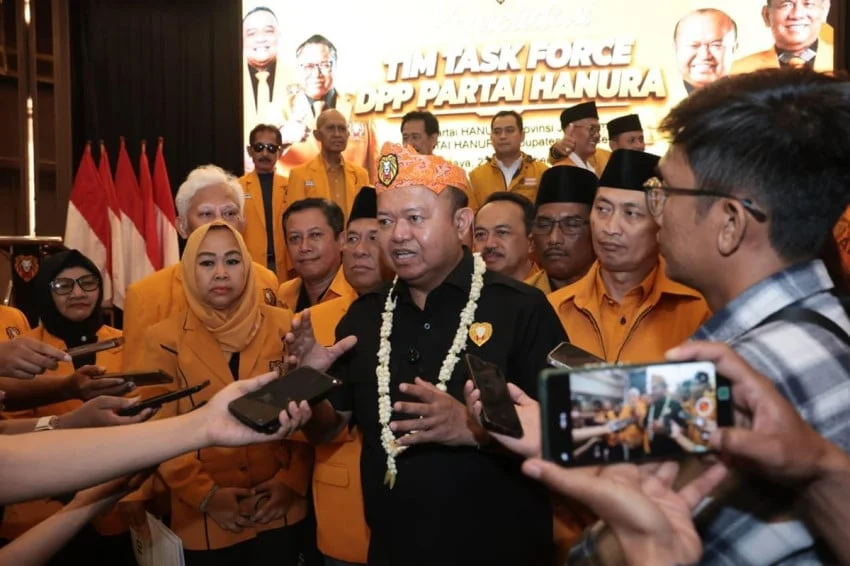
The rejection was articulated in no uncertain terms by Hanura Party Deputy Chairperson Patrice Rio Capella. Speaking to the press following a high-level consolidation meeting and internal strategy session with the Hanura Task Force for East Java province, held at the Platinum Tunjungan Hotel in Surabaya on Tuesday, September 22, 2026, Rio Capella criticized the rationale behind the proposed parliamentary support threshold. He maintained that introducing such a requirement not only lacks a coherent legal foundation but also directly contravenes established constitutional jurisprudence governing democratic participation in the archipelago.
Background Context and the Constitutional Court Ruling
To understand the weight of Hanura’s rejection, one must examine the legal evolutionary path of Indonesia’s presidential threshold regulations. For decades following the transition to the Reformasi era, presidential nominations were subject to varying degrees of parliamentary gatekeeping, commonly referred to as the presidential threshold (presidential threshold or PT). Historically, political parties or coalitions of parties were required to secure a specific percentage of seats in the DPR or a minimum share of the national popular vote in the preceding legislative election to nominate a presidential candidate pair.
Critics and various political entities long argued that these high thresholds effectively curtailed political pluralism, created high barriers to entry for emerging political forces, and consolidated power within a narrow oligarchy of major political parties. The debate reached a judicial turning point when landmark legal challenges were brought before the Constitutional Court (Mahkamah Konstitusi or MK). In subsequent landmark rulings, the Constitutional Court fundamentally overhauled the framework by effectively dismantling traditional presidential thresholds, bringing the requirement down to zero percent.
The core legal argument anchored by the Constitutional Court and echoed by legal scholars is that under Indonesia’s simultaneous election system, where legislative and presidential elections are held concurrently, applying a threshold derived from a previous election makes little constitutional sense. Furthermore, the court ruled that every political party participating in an election holds the inherent constitutional right to nominate candidates for the nation’s highest executive office.
Hanura’s Objections and Critique of Legislative Logic
During his address in Surabaya, Patrice Rio Capella expressed utter bewilderment regarding the provenance and intellectual rigor of the proposal requiring two-faction backing. He questioned the competence of those suggesting such statutory amendments, characterizing the idea as an unthinking regression that ignores binding legal precedents.
"I do not understand who provided that unintelligent input. The Constitutional Court has already decided that the presidential threshold is zero percent," Rio Capella stated firmly to journalists gathered at the event.

The Hanura executive elaborated on a crucial structural distinction that he believes proponents of the new proposal fail to grasp: the fundamental difference between political parties as legal electoral entities and factions within the parliamentary complex. Under Indonesian election law, political parties are recognized as legal participants authorized to field candidates. Conversely, a parliamentary faction (fraksi) is an internal working group formed by political parties that successfully win seats and enter the DPR.
By attempting to insert a requirement that a presidential candidate must obtain formal backing from at least two parliamentary factions, lawmakers would essentially be creating a secondary, backdoor threshold. Such a mechanism would force newly participating parties—or parties that manage to pass electoral verification but fail to secure a massive parliamentary footprint—into transactional alliances with established parliamentary giants simply to secure a ticket to run. Hanura argues that this undermines the very essence of open political competition and disenfranchises smaller or newly established political organizations.
Potential Confusion and Public Impact
Beyond the legal contradictions, Hanura raised serious concerns regarding the psychological and informational impact such a rule would have on the general electorate. In an era where democratic transparency and voter comprehension are paramount to ensuring high-quality civic participation, layering complex, restrictive, and constitutionally dubious prerequisites onto candidate nominations risks alienating voters.
When election laws are perceived as overly manipulated by elite political maneuvering to safeguard entrenched interests, public trust in democratic institutions diminishes. Hanura contends that introducing a two-faction support rule would create systemic confusion among voters, who might struggle to understand why a political party legally certified to contest an election is barred from running a presidential candidate due to internal parliamentary bottlenecks. This could lead to widespread public cynicism regarding the legislative drafting process within the DPR.
Broader Implications for the Electoral Law Revision
The debate over the revision of Law Number 7 of 2017 is taking place against a backdrop of wider institutional introspection within Indonesia’s legislature. Just weeks prior, leadership within the DPR, including high-profile initiatives spearheaded by senior figures such as Puan Maharani, has attempted to champion internal administrative reforms to restore public confidence in parliamentary oversight and lawmaking integrity. However, controversies surrounding electoral amendments threaten to overshadow these reform agendas if political parties perceive the revisions as attempts to tilt the playing field.
Political analysts observing the 2026 political landscape note that the push and pull between major coalition parties and smaller political entities regarding election rules is a perennial feature of Indonesian democratization. Major parties often favor mechanisms that stabilize governance and prevent an unmanageable multiplicity of candidates, arguing that too many pairs can fracture national unity and complicate administrative governance. On the other hand, smaller parties like Hanura champion radical openness, arguing that true democracy requires maximum optionality for the electorate.
As deliberations on the Election Law continue in Jakarta, the stance taken by Hanura is expected to galvanize other non-parliamentary parties and smaller factions within the legislature to mount a unified resistance against any provisions that mimic the abolished presidential threshold. The ultimate fate of the two-faction support proposal remains uncertain, but it has undoubtedly set the stage for a protracted legislative battle over the boundaries of political representation and constitutional rights in Indonesia.
