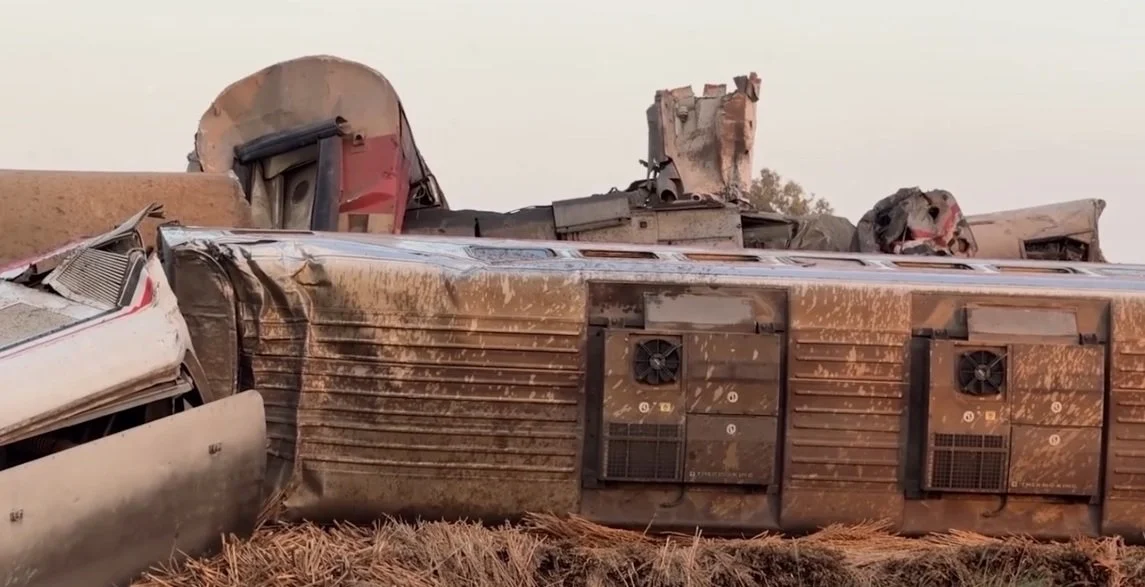
A catastrophic train collision occurred near Giza, Egypt, on Monday, November 9, 2026, resulting in at least seven fatalities and leaving more than 100 passengers injured. The incident, which has sent shockwaves through the nation, involved two passenger trains traveling southward from the capital, Cairo, toward Giza. The collision triggered a chaotic scene as multiple carriages derailed, plunging down a nearby embankment and complicating immediate rescue efforts. As emergency services continue to sift through the wreckage, authorities warn that the death toll may rise significantly given the severity of the impact and the high number of critically injured individuals currently receiving medical attention.
Chronology of the Disaster
The incident took place during the early hours of Monday morning, a period when rail traffic is typically heavy as commuters head toward urban centers. According to the Egyptian National Railways, the two trains were moving along the same corridor when a technical failure or human error resulted in a high-speed collision. Preliminary reports indicate that the lead train had either slowed down or stopped when the second train, traveling in the same direction, impacted it from behind.
The sheer force of the collision caused the trailing carriages of the lead train and the locomotive of the second train to leave the tracks. Witnesses described a deafening sound followed by the sight of carriages tipping over the side of a steep embankment. The remote nature of some sections of the track posed an initial challenge for emergency responders, though local security forces, paramedics, and civil defense teams were deployed to the site shortly after the alarm was raised.
Emergency Response and Medical Mobilization
In the immediate aftermath of the disaster, the Egyptian Ministry of Health declared a state of high alert across all hospitals in the Giza and Cairo governorates. Minister of Health Khaled Abdel Ghaffar confirmed that medical facilities are currently overwhelmed by the influx of casualties. “We are dealing with a significant number of victims suffering from complex fractures, internal trauma, and severe head injuries,” the Minister stated during a briefing.
Field hospitals were established near the crash site to provide triage for the wounded before they could be transported to major trauma centers. The Egyptian Red Crescent has also played a pivotal role in the recovery efforts, deploying specialized teams to provide both immediate medical assistance and psychological support to the survivors and the families of the victims. Among the confirmed fatalities is one of the train drivers, highlighting the extreme violence of the impact.
Presidential Intervention and Official Investigation
President Abdul Fattah al-Sisi responded to the tragedy by issuing a directive for a comprehensive and transparent investigation into the causes of the collision. The President emphasized that the state would hold those responsible accountable, signaling a zero-tolerance approach toward negligence in the operation of national infrastructure.
The Office of the Public Prosecutor has already begun collecting evidence, including data from the trains’ "black boxes" and communication logs between the drivers and the central signaling control. Prosecutors have hinted that the investigation will examine whether the accident was caused by signaling failure, mechanical malfunction, or human error. As the inquiry unfolds, the public’s frustration regarding the state of Egypt’s aging rail network is expected to grow, placing immense pressure on the Ministry of Transportation to provide clear answers.
Contextualizing Egypt’s Railway Challenges
The rail network in Egypt is one of the oldest in the Middle East and Africa, spanning thousands of kilometers of track. However, the system has been plagued by chronic underinvestment and poor maintenance for decades. While the government has embarked on ambitious modernization programs in recent years—including the procurement of new rolling stock from international suppliers and the upgrading of signaling systems—incidents of this nature continue to occur.

Statistically, Egypt has experienced several high-profile rail disasters over the past two decades. Factors frequently cited by experts include outdated signaling systems that still rely on manual intervention, human error due to fatigue or inadequate training, and the degradation of track infrastructure. The government has consistently argued that the scale of the system makes a total overhaul a multi-year, multi-billion-dollar endeavor, but critics often argue that safety protocols have not kept pace with the increasing demand for rail transit.
Socio-Economic and Political Implications
The human cost of this tragedy extends beyond the immediate casualties. Public confidence in the safety of the railway system is a critical component of Egypt’s economic stability, as millions of citizens rely on trains for their daily commute. A disaster of this magnitude risks disrupting economic activities and fostering civil discontent if the public perceives that the authorities are failing to prioritize safety over cost-cutting measures.
Furthermore, the government’s response to this incident will be closely watched by international observers and investors. Effective management of the aftermath—ranging from transparent reporting on the cause of the accident to the provision of adequate compensation for the victims—will be seen as a test of the administration’s governance capabilities.
Analysis of Systemic Risks
From a technical standpoint, the collision highlights the persistent risks associated with mixed-traffic corridors where high-speed passenger trains share tracks with slower-moving or older infrastructure. The reliance on manual signal switching in certain sections of the network has been identified by various transport safety audits as a "weak link." Even with modern trains, the lack of automated braking systems or advanced Collision Avoidance Systems (CAS) on older sections of the line remains a significant vulnerability.
The ongoing investigation will likely focus on why the warning systems failed to prevent the second train from entering the same block as the first. If the findings confirm a failure in the signaling architecture, it may necessitate an immediate, nationwide audit of all electronic signaling centers to prevent future occurrences.
Moving Forward: The Path to Recovery
As of late Monday, rescue operations are transitioning into recovery and site clearance. The Ministry of Transportation has announced that a committee of experts has been formed to oversee the removal of the damaged carriages and the restoration of track services. However, officials have warned that it could take several days for normal traffic flow to resume along this critical corridor.
For the victims and their families, the coming days will be filled with the somber tasks of funerals and medical rehabilitation. The tragedy serves as a grim reminder of the challenges inherent in modernizing massive, legacy infrastructure while ensuring the safety of millions of passengers. As the nation mourns, the focus remains on the dual goals of providing justice for the victims and implementing systemic changes to ensure that such a catastrophic failure is never repeated on the Egyptian rails.
The Egyptian government is expected to release a preliminary report on the investigation within the next 72 hours, which will likely provide a more granular look at the specific points of failure. Until then, the focus remains firmly on the humanitarian efforts and the medical stabilization of the over 100 individuals whose lives were forever changed by the events of this Monday morning.