
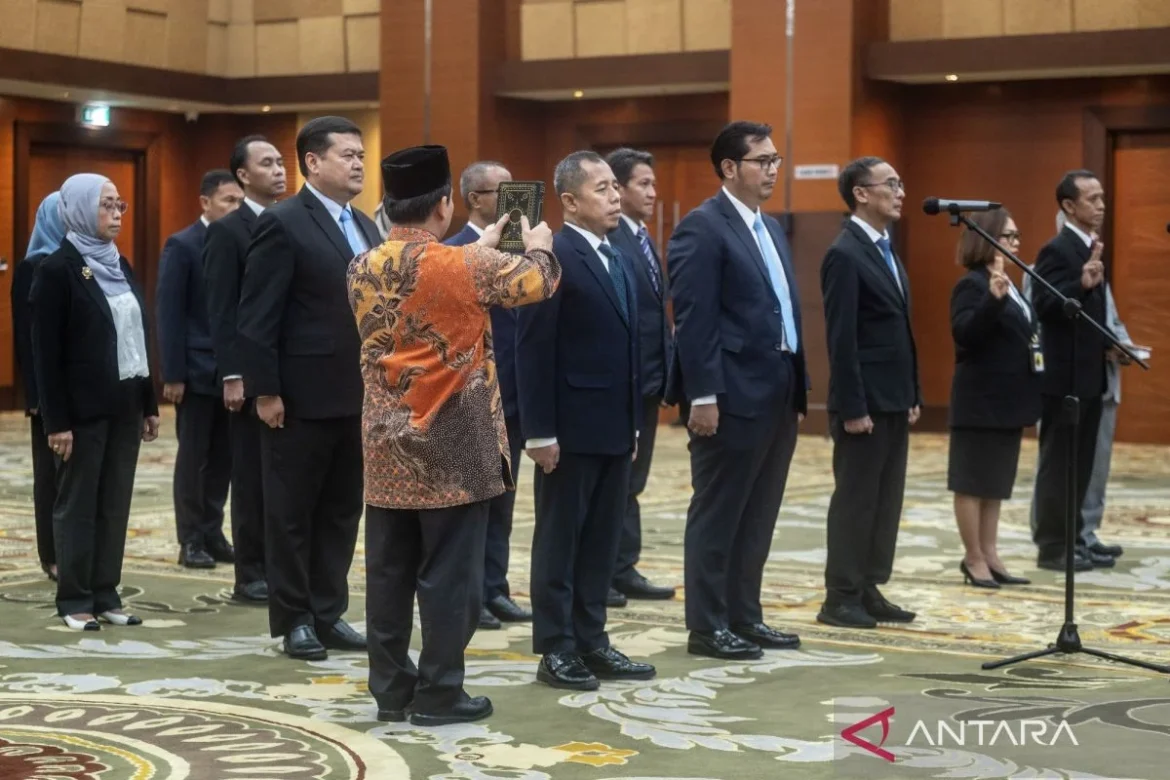
The Ministry of Finance of the Republic of Indonesia officially inducted fourteen new high-ranking officials to spearhead strategic divisions within the ministry and the Secretariat of the Financial System Stability Committee (KSSK). The swearing-in ceremony took place at the Mezanine Hall of the Ministry of Finance in Jakarta, marking a critical milestone in the ongoing institutional optimization of the nation’s financial governance. The newly appointed officials comprise twelve High-Ranking Pratama Officials, commonly designated as echelon II officials within the ministerial structure, and two strategic personnel assigned directly to the Secretariat of the KSSK. This comprehensive leadership refresh was executed through the rigorous evaluation mechanisms of the Advisory Board for Ranks and Appointments, widely known as Baperjakat. The structural appointments are designed to fortify administrative efficiency, enhance revenue collection, optimize state expenditure, and safeguard the macroeconomic stability of Indonesia amidst evolving global and domestic economic landscapes.
Background and Context of the Leadership Restructuring
The restructuring and replenishment of leadership positions within the Ministry of Finance are part of a continuous bureaucratic reform initiative aimed at ensuring institutional agility. The Ministry of Finance operates as the backbone of the national economy, managing the state budget, taxation, customs and excise, treasury operations, state assets, and fiscal policy formulations. In recent years, global economic uncertainties, geopolitical tensions, and inflationary pressures have necessitated a more dynamic and responsive fiscal bureaucracy.
The inclusion of two key officials within the KSSK Secretariat underscores the critical intersection between fiscal policy and financial sector stability. The KSSK itself plays an indispensable role in monitoring and mitigating systemic risks that could potentially disrupt the national financial architecture. By aligning these appointments with the newly adjusted organizational structures, the ministry aims to foster seamless institutional synergy among various directorate generals, the Tax Court, and financial regulatory bodies such as Bank Indonesia, the Financial Services Authority, and the Indonesia Deposit Insurance Corporation.
Chronology of the Selection and Appointment Process
The transition leading up to the official inauguration followed a meticulous administrative procedure governed by civil service regulations in Indonesia. The identification of vacant positions and potential candidates began months prior, driven by retirements, structural expansions, and the strategic rotation of senior bureaucrats.
- Identification of Vacancies: The Bureau of Human Resources within the Ministry of Finance audited structural needs across all directorates, identifying critical leadership gaps in tax administration, customs supervision, state asset management, and financial stability secretariats.
- Baperjakat Deliberations: The Advisory Board for Ranks and Appointments convened multiple sessions to evaluate the track records, competencies, leadership capabilities, and integrity profiles of eligible civil servants.
- Candidate Screening: Shortlisted candidates underwent comprehensive assessments, including managerial competency evaluations, psychological evaluations, and performance record reviews.
- Final Approval and Decree Issuance: Upon finalizing the selection, ministerial decrees were issued, culminating in the formal swearing-in ceremony on Monday, September 21, 2026.
Official Directives and Core Expectations
During the inauguration ceremony, officiating leaders emphasized the profound responsibility shouldered by civil servants entrusted with the nation’s financial machinery. The leadership mandated the newly inducted officials to immediately assume their duties and immerse themselves in their respective operational domains. The primary areas of focus encompass revenue optimization, stringent compliance monitoring, efficient budget absorption, and innovative fiscal financing strategies.
The directives extended beyond mere administrative compliance. Officials were explicitly instructed to cultivate strategic foresight and enhance cross-unit coordination. In a complex economic environment, siloed operations are no longer viable. The management of state finances extends far beyond numerical accuracy within the State Revenue and Expenditure Budget. It touches upon public trust, economic justice, and the realization of national development objectives. The leadership stressed that integrity and professionalism must remain non-negotiable pillars for every official operating under the banner of the Ministry of Finance.
Implications for Fiscal Policy and Financial Stability
The infusion of fresh leadership into echelon II positions and the KSSK Secretariat carries far-reaching implications for Indonesia’s fiscal governance.
Enhancing Revenue Collection and Customs Supervision
With newly appointed leaders taking charge of taxation and customs directorates, the ministry is poised to intensify efforts in broadening the tax base, enhancing digital tax administration, and curbing illicit trade practices. Effective customs supervision remains vital for protecting domestic industries while facilitating international trade corridors.
Optimizing State Expenditure and Asset Management
Efficiency in budget execution remains a perennial challenge for public administration. The new leadership cohort is expected to accelerate strategic spending without compromising accountability. Furthermore, the management of state-owned goods and properties requires innovative valuation and utilization strategies to generate non-tax state revenues that can further subsidize developmental priorities.
Reinforcing Financial System Resilience
The integration of specialized personnel into the KSSK Secretariat strengthens the institutional interface between fiscal policy implementers and macroprudential regulators. As financial markets grow increasingly interconnected, proactive monitoring of systemic vulnerabilities is paramount to prevent external shocks from cascading into domestic financial distress.
Broader Perspectives on Bureaucratic Reform
The ongoing administrative refinement within the Ministry of Finance aligns with broader governmental agendas to build a world-class civil service. Merit-based recruitment and promotion systems serve as the bedrock of these reforms. By minimizing political patronage and emphasizing operational competence, the ministry ensures that technical experts occupy critical decision-making nodes.
Observers and economic analysts have noted that the success of Indonesia’s medium-term economic roadmap heavily relies on the execution capacity of mid-level and senior bureaucrats. While high-level policy frameworks are formulated by ministers and political leaders, the actual translation of policies into actionable programs depends entirely on echelon II and III officials. Therefore, strategic placements such as those finalized in the September 2026 induction serve as a vital stress test for the ministry’s internal governance capacity.
Conclusion and Future Outlook
As the newly sworn-in officials formally assume their responsibilities across tax offices, customs checkpoints, treasury divisions, asset management bureaus, and the KSSK Secretariat, the immediate task ahead is seamless operational continuity. The convergence of strict oversight, strategic policy coordination, and unwavering integrity will determine how effectively the Ministry of Finance navigates upcoming economic challenges. Through these institutional renewals, the government reaffirms its commitment to maintaining fiscal prudence, safeguarding economic stability, and fostering sustainable, equitable growth for the future of Indonesia.
