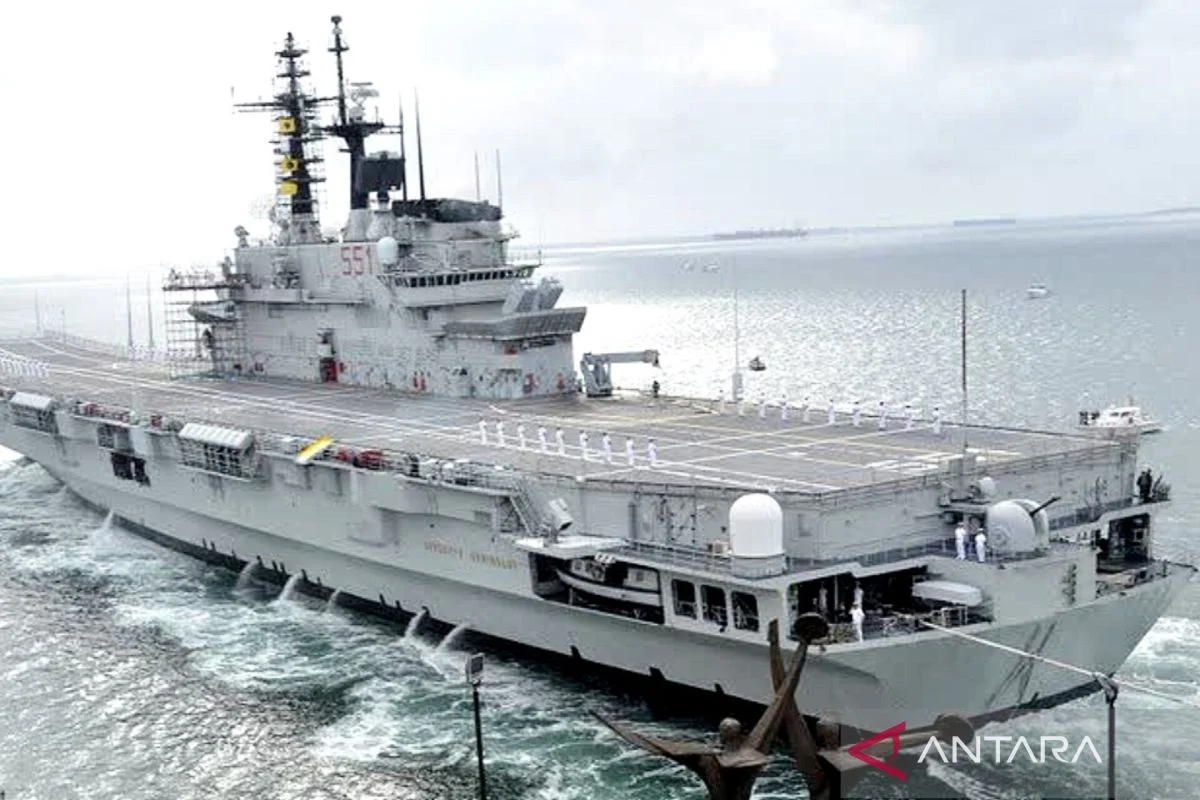
In a milestone event for Southeast Asian maritime defense, the Italian aircraft carrier ITS Giuseppe Garibaldi set sail from its home port on August 24, 2026, marking the beginning of a historic transit toward Indonesian waters. The vessel, which is slated to be commissioned as the KRI Gajah Mada, represents a transformative leap for the Indonesian Navy (TNI AL), as it will serve as the country’s first-ever aircraft carrier. The arrival of this formidable platform in mid-September 2026 is expected to redefine the power projection capabilities of the Indonesian Armed Forces in the Indo-Pacific region.
Chief of Staff of the Indonesian Navy, Admiral Muhammad Ali, confirmed that the vessel is currently navigating a complex maritime route, traversing the Suez Canal and the Red Sea under the protection of an Italian naval escort group. The transit, spanning over 20 days, serves as both a delivery mission and an intensive maritime exercise, preparing the crew for the complex operational requirements of a vessel of this magnitude.
A New Chapter for the Indonesian Navy: The KRI Gajah Mada
The procurement of the Giuseppe Garibaldi—a platform with a storied history in the Italian Marina Militare—is the result of a strategic inter-governmental agreement between Rome and Jakarta. Upon its arrival in Indonesian territorial waters, the ship will undergo a formal handover process. The transition from the Italian flag to the Indonesian Merah Putih is scheduled for September 25, 2026, symbolizing the official birth of KRI Gajah Mada.
The ship’s arrival is not merely a logistical milestone but a political and strategic statement. By incorporating a vessel of this scale into its fleet, Indonesia signals a shift toward a "Blue Water Navy" capability, allowing for sustained operations far from the archipelago’s home ports. This capability is essential for securing Indonesia’s vast Exclusive Economic Zone (EEZ) and providing rapid humanitarian assistance and disaster relief (HADR) across the region.
Technical Specifications and Engineering Prowess
The Giuseppe Garibaldi is a testament to late-20th-century naval engineering. Constructed at the Cantieri Navali di Monfalcone in Italy, the keel was laid on February 20, 1978, and the ship was officially commissioned on June 4, 1983. Despite its age, the vessel underwent several mid-life upgrades that kept its combat systems relevant to modern standards.
With a displacement of approximately 13,850 tons, the vessel measures 180.2 meters in length and 30.4 meters at the flight deck. Its propulsion system is a marvel of efficiency, utilizing a Combined Gas and Gas (COGAG) setup. Four FIAT/GE LM-2500 gas turbines generate a staggering 80,000 horsepower, driving two shafts that propel the ship to a maximum speed of 30 knots. With a range of 7,000 nautical miles, the ship is designed for long-endurance patrols, making it an ideal choice for the vast distances covered by the Indonesian archipelago.
Air Wing Capabilities and Tactical Flexibility
The core strength of the KRI Gajah Mada lies in its air wing. The vessel is designed as a STOVL (Short Take-Off and Vertical Landing) carrier, capable of hosting a versatile mix of fixed-wing aircraft and rotary-wing assets. The flight deck configuration is tailored for the AV-8B Plus Harrier II, providing the Indonesian Navy with a strike capability previously unavailable to its surface combatants.
Beyond fixed-wing aviation, the ship serves as a mobile hub for maritime domain awareness. It is equipped to carry a complement of helicopters, including the EH101, SH90A, and AB212 models. These aircraft are critical for anti-submarine warfare (ASW), search and rescue (SAR), and transport operations. The air wing capacity, which ranges between 18 and 20 aircraft depending on the mission profile, allows the Indonesian Navy to tailor its presence based on the specific threats or humanitarian needs in a given sector.
Defensive Systems and Combat Sustainability
A ship of this size requires significant self-defense capabilities to operate in contested environments. The Giuseppe Garibaldi is equipped with an octuple cell launcher for Aspide surface-to-air missiles, providing a robust layer of point defense against aerial threats. Complementing this are three DARDO systems featuring Breda 40/70 cannons, which are highly effective against incoming missiles and small, fast-moving surface targets.
The ship also hosts advanced electronic warfare (EW) suites for both active and passive defense, enabling it to jam incoming radar-guided threats or decoy anti-ship missiles. With a crew complement of 825 personnel, the ship functions as a self-contained command-and-control (C2) center. This capability allows the KRI Gajah Mada to coordinate multi-ship task forces, extending the Indonesian Navy’s operational reach far beyond the horizon.
Strategic Implications and Regional Security
The introduction of an aircraft carrier into the Indonesian inventory has prompted widespread discussion regarding regional security dynamics. Analysts suggest that the KRI Gajah Mada will enhance the interoperability of the Indonesian military with regional partners, particularly in the context of maintaining freedom of navigation in the South China Sea and the Indian Ocean.
However, the acquisition has also sparked internal debates regarding the logistics of maintenance and the necessity of technology transfer. Members of the Indonesian Parliament (DPR) have emphasized that the purchase must be accompanied by comprehensive knowledge sharing. The objective is to ensure that Indonesian engineers and shipyards eventually possess the capability to maintain and potentially modify the vessel without total reliance on foreign contractors.
Infrastructure and Future Milestones
In preparation for the arrival of its new flagship, the Indonesian Navy has been aggressively developing infrastructure in Lampung. The specialized naval facility, designed to accommodate the deep-draft and vast dimensions of the KRI Gajah Mada, is nearing completion. Admiral Ali indicated that the port facilities will be fully operational by the end of September 2026, coinciding with the ship’s formal induction.
The public debut of the KRI Gajah Mada is highly anticipated. It is scheduled to lead the sailing pass during the 81st anniversary of the Indonesian National Armed Forces (TNI) in October 2026. Beyond its military utility, the government intends to use the ship as a platform for VVIP engagements, reflecting the prestige that comes with operating an aircraft carrier.
Conclusion: A Strategic Shift for Indonesia
The journey of the Giuseppe Garibaldi from the Mediterranean to the Java Sea is a defining moment in the modernization of the Indonesian military. While the ship brings significant operational requirements, its inclusion in the TNI AL fleet represents a bold investment in Indonesia’s sovereignty and regional standing.
As the vessel traverses the Red Sea, the eyes of the global maritime community are fixed on its progress. The KRI Gajah Mada will not only serve as a symbol of national pride but will also stand as a core asset in ensuring maritime security, disaster response, and regional stability for decades to come. By the time the Merah Putih is raised over its deck in late September, the landscape of Southeast Asian naval power will have irrevocably changed, marking the beginning of a new era for the Indonesian Navy.