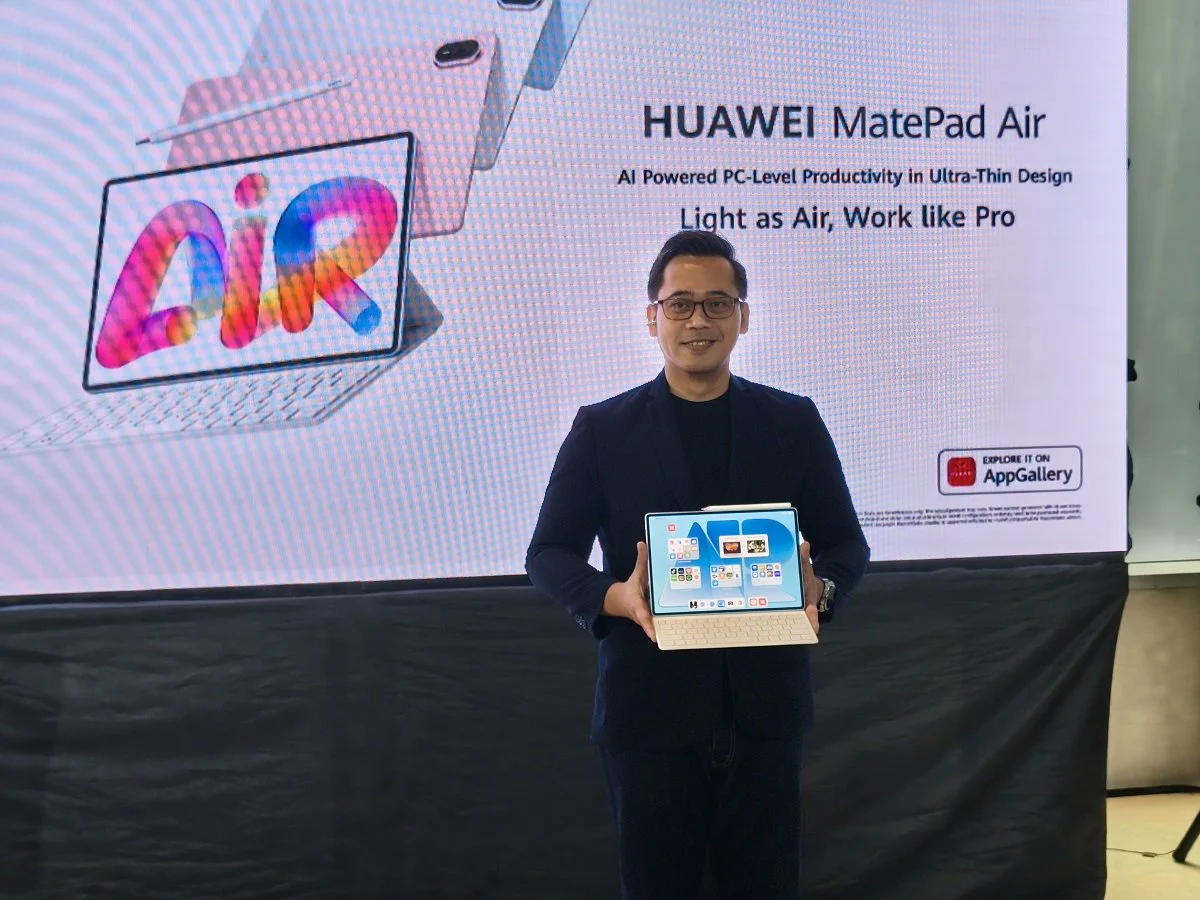
HUAWEI officially launched its latest premium tablet, the HUAWEI MatePad Air (2026), in the Indonesian market on Friday, September 18, 2026, marking a significant evolution in the company’s mobile productivity portfolio. Unveiled during a high-profile event in Jakarta, the device aims to bridge the gap between portable entertainment tablets and high-performance workstations. By combining a slim form factor with advanced AI-driven software, Huawei is positioning this device as a primary tool for professionals, students, and creative individuals who require mobility without compromising on computational power.
A New Standard in Portable Design and Aesthetics
The MatePad Air (2026) arrives with a design language that emphasizes extreme portability. With a thickness of only 5.3 mm and a total weight of 509 grams, it is among the lightest in the 12-inch tablet category. When combined with its dedicated Smart Magnetic Keyboard, the total setup weighs just 817 grams, making it lighter than most ultra-portable laptops currently on the market.
Beyond the dimensions, Huawei has introduced a unique material finish known as the Pearlescent Sheen E-Coating Process 2.0. This aesthetic choice is not merely for visual appeal; it serves a functional purpose by providing a tactile, non-slip surface that is highly resistant to fingerprints and smudges. This indicates a shift in design philosophy, where premium aesthetics are now inextricably linked with long-term device durability and maintenance ease for the end-user.
Technical Specifications and Display Innovation
For the first time in the MatePad Air lineup, Huawei has implemented a 12-inch OLED Eye-Soothing PaperMatte Display. This screen offers a 2.8K resolution and a high refresh rate of 144 Hz, providing fluid motion for both creative work and media consumption. The display boasts an impressive 92% screen-to-body ratio, minimizing bezels to create an immersive viewing environment.
The proprietary PaperMatte technology is the standout feature of this screen. Engineered to reduce ambient light reflection by up to 20%, the screen effectively eliminates glare in brightly lit environments, such as outdoor offices or classrooms with harsh fluorescent lighting. Furthermore, the display mimics the texture of paper, providing increased friction for stylus input, which significantly enhances the precision and feel of digital handwriting and sketching.

Performance and Hardware Architecture
At the heart of the MatePad Air (2026) is the Kirin T93C chipset. While Huawei has not disclosed the full microarchitecture, early benchmark reports suggest it is optimized for high-efficiency multitasking and AI-integrated applications. The processing unit is supported by a substantial 10,100 mAh battery, which is designed to sustain extended periods of usage. According to official testing, the device provides up to 10 hours of continuous video playback or 8 hours of intensive online conferencing, which covers the average workday for most professionals.
The device also supports the 66W HUAWEI SuperCharge protocol, allowing users to rapidly replenish the battery during short breaks. Connectivity has been bolstered by the inclusion of Wi-Fi 7, which ensures lower latency and faster data transfer speeds in compatible network environments. To manage the thermal output of the high-performance chipset, Huawei has integrated an advanced heat dissipation system, ensuring that the tablet maintains consistent performance even under heavy loads such as video editing or complex data processing.
The Role of Artificial Intelligence
The defining characteristic of the 2026 model is the integration of AI into the core user experience. Rather than treating AI as a superficial add-on, Huawei has baked it into the operating system and key productivity applications. The "PC-level" WPS Office AI suite allows users to perform complex document editing, data summarization, and spreadsheet automation directly on the tablet.
Furthermore, the HUAWEI Notes application has been updated with AI-powered features, including intelligent handwriting recognition, automatic transcription of audio during meetings, and real-time document layout adjustments. These tools are designed to streamline the workflow of professionals who move frequently between different environments and need to convert handwritten ideas into professional-grade digital documents instantaneously.
Industry Context and Market Positioning
The launch of the MatePad Air (2026) comes at a critical time for the Indonesian technology sector. With the digital transformation of local businesses and the rising popularity of the "hybrid work" model, there is an increasing demand for devices that can function as both a tablet and a laptop. Huawei’s move to introduce this device in Jakarta highlights the company’s commitment to the Southeast Asian market, which has become a primary battlefield for high-end mobile computing hardware.
Industry analysts note that the tablet market has experienced a bifurcation: while budget-friendly tablets dominate the educational sector, there is a growing segment of "prosumers" willing to pay a premium for hardware that replaces the traditional laptop. By introducing features such as Wi-Fi 7 and advanced AI, Huawei is attempting to capture the professional demographic that has traditionally favored Windows-based ultra-books.

Chronology of the Development
The development cycle of the MatePad Air (2026) represents two years of iterative design. Following the positive reception of the 2024 iteration, Huawei focused its R&D efforts on two main pillars: screen ergonomics and AI-integrated productivity.
- Q1 2026: Initial prototypes featuring the 2.8K OLED panel were tested in internal labs to ensure the PaperMatte coating did not compromise color accuracy.
- Q2 2026: Finalization of the Kirin T93C chipset optimization, with a focus on power efficiency for long-duration video conferencing.
- August 2026: Pre-production units were distributed to select enterprise partners in Indonesia to test the efficacy of the WPS Office AI integration.
- September 18, 2026: Official market launch in Jakarta.
Expert Perspectives and Market Implications
According to technology market researchers, the success of the MatePad Air (2026) will depend on the strength of its software ecosystem. While the hardware specifications are top-tier, the utility of the AI features hinges on the depth of the software integration. During the press conference, Huawei representatives emphasized that their ecosystem approach—allowing for seamless cross-device communication between the tablet, smartphones, and PCs—is the primary differentiator against competitors.
"The MatePad Air (2026) is not just a hardware upgrade; it is a declaration of intent," said a regional tech consultant who attended the launch. "By standardizing PC-level office software and AI features on a mobile-sized device, Huawei is effectively challenging the necessity of the traditional laptop for a large portion of the white-collar workforce."
Sustainability and Future Outlook
Environmental considerations were also highlighted during the presentation. The use of E-Coating Process 2.0 is cited as being more environmentally friendly than traditional solvent-based painting methods. Additionally, the device is designed for a longer lifecycle, with Huawei promising a commitment to software updates that ensure the AI features remain relevant as models evolve.
As the tablet enters the Indonesian retail market, initial consumer reception appears positive, particularly among the creative community and corporate professionals. With its combination of a lightweight design, high-resolution OLED display, and advanced AI utilities, the HUAWEI MatePad Air (2026) represents a significant milestone in the evolution of portable computing. It sets a new benchmark for what users can expect from a mobile device, effectively shifting the focus from simple consumption to high-level creation and productivity.
In the coming months, the performance of the device in real-world scenarios—specifically regarding its battery longevity under heavy AI usage and the stability of the Wi-Fi 7 connection—will be closely monitored by both enthusiasts and enterprise buyers. If the device performs as intended, it is likely to solidify Huawei’s position as a dominant player in the premium tablet space in Indonesia and beyond.