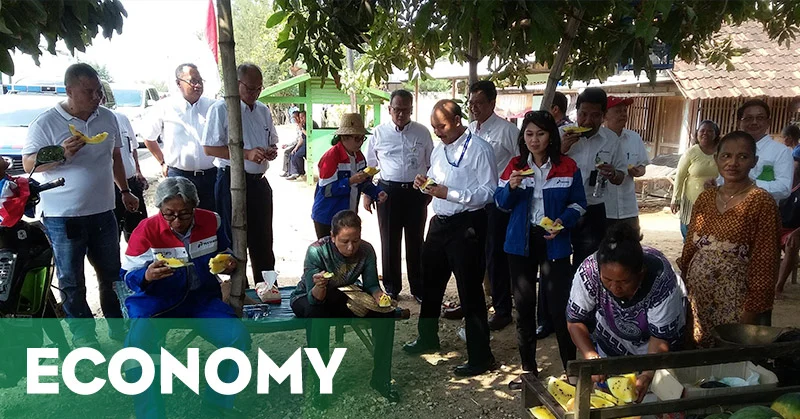
The official visit of high-ranking Indonesian government officials and state-owned enterprise leaders to the vital energy infrastructure facilities in East Java was marked by an unexpected and grounding moment of local engagement. On a warm morning in November 2015, then-Minister of State-Owned Enterprises (BUMN) Rini Soemarno, alongside key figures from PT Pertamina (Persero) and President Joko Widodo, took a brief detour from their strict itinerary to interact directly with the agrarian community residing near the industrial perimeter. Before conducting a rigorous inspection of the long-dormant PT Trans Pacific Petrochemical Indotama (TPPI) refinery in Tuban, the delegation paused to sample locally grown watermelons, blending high-level economic oversight with a display of grassroots connection.
The visit to the coastal regency of Tuban was far from a routine administrative tour. It represented a critical juncture in Indonesia’s ongoing pursuit of national energy independence, fiscal stabilization, and the reactivation of stalled strategic assets. The TPPI refinery, once a monument to unrealized potential and financial distress, stood at the center of government ambitions to reduce the nation’s heavy reliance on imported refined petroleum products. Yet, before confronting the complex macroeconomic challenges awaiting them inside the industrial complex, the leadership cadre chose to partake in a quintessentially local tradition—savoring the agricultural yield of the soil adjacent to one of the country’s most strategic petrochemical facilities.
Strategic Context and the Significance of the TPPI Facility
To fully understand the gravity of the presidential inspection in Tuban, one must examine the historical and economic weight carried by the TPPI complex. Established to bolster Indonesia’s domestic production of petrochemicals and refined fuels, the facility was envisioned as a cornerstone of the nation’s downstream energy sector. However, the plant had faced a tumultuous history marked by protracted financial restructuring, ownership disputes, and operational halts that spanned several years.
By 2015, the Indonesian government under President Joko Widodo had made energy security a paramount policy objective. The heavy reliance on fuel imports had long contributed to the widening current account deficit and left the domestic market vulnerable to global crude oil price volatility. Bringing the TPPI refinery back online was not merely a corporate objective for Pertamina; it was a national imperative designed to guarantee a stable supply of condensate, gasoline, and aromatics, thereby saving billions of dollars in foreign exchange reserves.
When President Widodo arrived in Tuban on Wednesday, November 11, 2015, he was accompanied by an elite delegation tasked with executing this turnaround. Alongside Minister Rini Soemarno, the entourage included Pertamina’s President Director Dwi Soetijpto, Vice President for Corporate Communication Wianda Pusponegoro, and the Ministry of Energy and Mineral Resources’ Director General of Oil and Gas, IGN Wiratmaja Puja. The presence of these key decision-makers underscored the collaborative effort required across ministries and state enterprises to resurrect the dormant giant.
A Humanizing Interlude: The Community Interaction in Tuban
Before the formal briefings, technical assessments, and security protocols took full effect, the delegation experienced an unplanned encounter with the local population. As the convoy approached the perimeters of the industrial complex, dozens of local residents gathered along the access roads to catch a glimpse of the national leaders. Rather than remaining sequestered within air-conditioned official vehicles, the officials chose to engage.
The atmosphere shifted from a tense security-heavy presidential tour to an informal community exchange. Residents approached the delegation, capturing photographs and exchanging pleasantries with the ministers and corporate executives. This spontaneous interaction highlighted the socioeconomic duality of the region: a massive, multi-billion-dollar industrial installation sitting directly adjacent to rural farming communities whose livelihoods depended on agriculture and local trade.
Continuing their walk toward the refinery gates, the high-ranking officials noticed a modest roadside stall operated by a local resident. The stall prominently displayed stacks of fresh, locally harvested watermelons—a staple crop of Tuban’s fertile coastal lowlands. Drawn by the local produce, the delegation made an impromptu stop.
Minister Rini Soemarno, known for her hands-on management style, took the initiative to engage the vendor and invite her colleagues to sample the goods. "Ayo-ayo coba dulu semangkanya. Enak ini semangkanya," remarking on the quality and sweetness of the fruit directly harvested from the fields surrounding the TPPI plant.
The brief pause allowed the national leaders to converse with the vendor, injecting a moment of levity and cultural warmth into an otherwise high-stakes official schedule. After enjoying several slices of the locally grown fruit and exchanging words of encouragement with the merchant, the delegation resumed their march toward the facility gates, ready to tackle the complex technical realities inside.
Chronology of the Presidential Inspection

The sequence of events on November 11, 2015, followed a carefully coordinated yet adaptable framework, balancing security protocols with public engagement:
- Arrival and Convoy Movement: President Joko Widodo and his ministerial entourage landed in East Java, proceeding directly via road transport toward the industrial zones of Tuban Regency.
- Community Engagement and Impromptu Detour: Prior to reaching the main security checkpoints of the TPPI complex, the convoy slowed down to accommodate crowds of local well-wishers, leading to an unplanned walking tour along the perimeter.
- The Agricultural Interlude: The delegation paused at a local vendor’s stall, where Minister Rini Soemarno, Pertamina CEO Dwi Soetijpto, and other officials tasted Tuban watermelons and interacted with residents.
- Formal Refinery Inspection: Following the break, the delegation entered the TPPI facility grounds to conduct a comprehensive walkthrough of the processing units, control rooms, and storage tanks.
- Technical Briefings and Policy Directives: Pertamina leadership presented operational updates, outlining the timeline for feedstock supply, debt resolution mechanisms, and the phased resumption of commercial production.
- Departure and Policy Mandate: The visit concluded with a clear presidential directive prioritizing domestic refining capacity and accelerating administrative clearance to ensure the plant achieved full operational status without delay.
Economic Implications of the TPPI Reactivation
The inspection of the TPPI facility was deeply tied to broader macroeconomic goals. At the time, Indonesia was grappling with structural deficits in its energy trade balance. The domestic refining capacity had failed to keep pace with soaring national demand, forcing the country to import vast quantities of refined fuels through third-party traders—a system that exposed the state budget to inefficiencies and potential governance risks.
By integrating TPPI under the operational umbrella of Pertamina—initially through tolling agreements and subsequent asset consolidation—the state energy company aimed to secure a reliable domestic source of petrochemical feedstocks. The facility was capable of processing substantial volumes of condensate per day, translating to significant reductions in imported finished products.
Experts and energy analysts noted that the reactivation of TPPI would yield multiple economic benefits:
- Foreign Exchange Savings: Reducing reliance on imported gasoline and petrochemicals conserved vital U.S. dollar reserves, stabilizing the Indonesian Rupiah against external pressures.
- Supply Chain Resilience: Direct control over refining assets mitigated supply chain vulnerabilities, ensuring uninterrupted fuel distribution across the archipelago.
- Regional Economic Stimulus: The operationalization of the plant injected capital into Tuban and surrounding East Java districts, creating direct and indirect employment opportunities for local populations, from logistics to small-scale commerce like the very fruit vendors who hosted the national leadership.
Official Responses and Stakeholder Perspectives
The successful resumption of operations at TPPI required unprecedented cooperation between financial institutions, regulatory bodies, and corporate management. Throughout the process, stakeholders maintained a unified stance regarding the necessity of state intervention to rescue the strategically vital asset.
Pertamina leadership emphasized that the integration of TPPI was a masterstroke in corporate asset optimization. Dwi Soetijpto, serving as Pertamina’s President Director during the period, consistently highlighted the technical readiness of the state-owned enterprise to absorb and manage the facility’s complex processing units. The collaboration with upstream suppliers ensured a steady stream of condensate, neutralizing the feedstock scarcity that had previously plagued the plant’s private operators.
Meanwhile, the Ministry of BUMN played a pivotal role in navigating the labyrinthine legal and financial obligations associated with the refinery’s previous debt burdens. Minister Rini Soemarno’s oversight ensured that state interests remained protected while cutting through bureaucratic red tape to expedite the operational handover. The combination of executive political will, championed by President Widodo, and rigorous corporate execution transformed TPPI from a symbol of industrial stagnation into a beacon of national self-reliance.
Broader Impact on Indonesia’s Energy Landscape
The lighthearted moment of sharing local fruit outside the gates of the TPPI refinery ultimately belied the profound structural transformation taking place within Indonesia’s energy sector. The events of November 11, 2015, served as a microcosm of the administration’s governing style: a blend of high-level strategic intervention in national infrastructure coupled with direct, unscripted engagement with ordinary citizens.
In the years following the presidential visit, the TPPI refinery successfully resumed full operations, reintegrating into Pertamina’s downstream refining network alongside major facilities in Cilacap, Balongan, Dumai, and Balikpapan. The successful turnaround validated the government’s strategy of utilizing state-owned enterprises to reclaim control over critical national assets.
As Indonesia continues to navigate the complexities of global energy markets, the legacy of the Tuban inspection remains a reminder of the multifaceted nature of national development. Economic policy, industrial engineering, and geopolitical strategy are inextricably linked to the daily lives of local communities—whether they are cultivating watermelons in the coastal plains of East Java or managing multi-billion-dollar energy grids in the capital. The brief pause for fruit before the heavy business of statecraft underscored a fundamental leadership philosophy: that national progress must always remain connected to the people it ultimately serves.