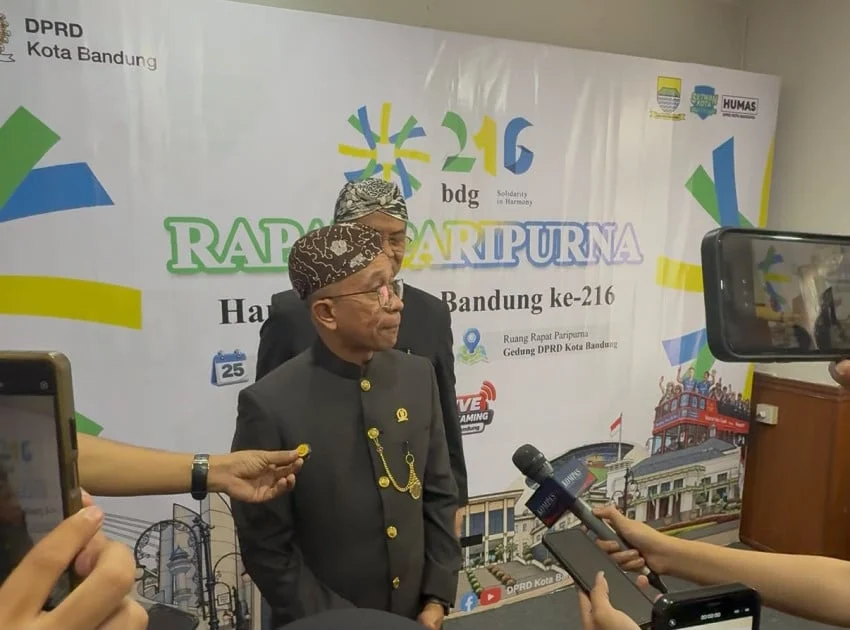
As the capital of West Java province celebrated its milestone anniversary, local legislative leadership called for a profound shift in how municipal governance addresses everyday civic grievances. Marking the 216th anniversary of Bandung, locally known as Hari Jadi Kota Bandung (HJKB) to the Sundanese community and the broader Indonesian public, the Chairman of the Bandung City Regional House of Representatives (D DPRD), Asep Mulyadi, delivered a stern yet constructive message to the executive branch. He emphasized that anniversary celebrations must transcend mere pageantry and symbolic festivities, evolving instead into an annual crucible for rigorous institutional self-reflection, administrative accountability, and the systemic enhancement of public service delivery.
The core of the legislative leader’s address centered on the eradication of bureaucratic sluggishness, particularly regarding citizen-reported infrastructure failures, environmental concerns, and administrative bottlenecks. In an era defined by instantaneous digital connectivity and heightened civic awareness, Mulyadi argued that the municipal government can no longer afford to operate at a reactive, sluggish pace. The expectation from the citizenry is clear: local governance must be agile, empathetic, and proactive.
Beyond Ceremonial Festivities: A Call for Administrative Evolution
The anniversary of Bandung serves as a historical anchor, commemorating the official establishment of the city in 1810 under the colonial administration of Governor-General Herman Willem Daendels, who famously struck his walking stick into the ground and declared, "Tentukan suatu tempat di sini kalau matahari terbit" (Find a place here when the sun rises), giving birth to the settlement that would eventually become the vibrant metropolis known as the Paris of Java. Over the past two centuries, Bandung has transformed from a quiet plantation hub and colonial hill station into a bustling economic powerhouse, a renowned center for higher education, a creative industry incubator, and a primary tourism destination in Southeast Asia.
However, rapid urbanization, population growth, and industrial expansion have introduced complex challenges that continually strain municipal resources. Traffic congestion, waste management complications, spatial planning violations, and infrastructure maintenance backlogs frequently plague daily life for the city’s millions of residents.
It is against this complex socio-historical backdrop that Mulyadi framed his critique. He asserted that while commemorating the city’s rich heritage is culturally and historically vital, leadership must prioritize the contemporary quality of life for its residents. The legislative chief argued that the true measure of a successful municipal administration lies not in the grandeur of its anniversary parades or cultural festivals, but in the efficiency and empathy with which it handles a broken streetlight, a clogged drainage system, an illegal dumping site, or a disrupted public utility.
The Phenomenon of Viral Advocacy and Bureaucratic Inertia
One of the most critical points raised by the DPRD Chairman was the concerning trend of bureaucratic responsiveness being dictated by social media amplification. In recent years, urban governance across Indonesia has witnessed a phenomenon where ordinary citizens resort to recording municipal failures—such as massive potholes, uncollected garbage, or flooded thoroughfares—and posting them on platforms like Instagram, TikTok, and X (formerly Twitter) in hopes that algorithmic virality will force authorities into action.
Mulyadi strongly criticized this reactive dynamic, labeling it an indictment of standard operating procedures within local government agencies.
"The Bandung City Government today is demanded to be capable of anticipating and responding to every community report and complaint. We must prevent a situation where citizens are forced to make their issues go viral first before any action is taken," Mulyadi stated firmly during the legislative evaluation session marking the anniversary.
He stressed that reliance on public outrage and social media pressure as catalysts for administrative action reveals a structural flaw in public service delivery. When municipal departments only mobilize after an issue captures public attention online, routine administrative duties are effectively outsourced to internet outrage. Mulyadi underscored that every department, from the top executive tier down to neighborhood and village authorities, must possess internal monitoring systems that capture citizen grievances before they escalate into public relations crises.
Comprehensive Chain of Command Accountability
To rectify the issue of sluggish bureaucratic response times, the legislative leadership laid out a clear framework for institutional accountability. Mulyadi insisted that swift action cannot rely on isolated, well-meaning civil servants; it must be embedded as an institutional mandate spanning the entire municipal hierarchy.
The chain of command identified in his directive includes the Mayor and Deputy Mayor, the Regional Secretary (Sekda), the heads of various specialized municipal agencies (Dinas), sub-district heads (Camat), and down to the grassroots community leaders at the sub-district and neighborhood levels (Lurah, RW, and RT).
"This must be a serious concern. The government must be present before a problem becomes major. Every community report must be followed up quickly, measurably, and completely," Mulyadi elaborated.
This holistic approach recognizes that local issues often slip through the cracks of inter-departmental jurisdiction. For instance, a collapsed drainage wall might sit on the boundary between the public works agency and a local housing developer’s jurisdiction, leading to protracted finger-pointing while residents suffer the consequences. Mulyadi’s directive demands that municipal apparatuses abandon jurisdictional siloes and adopt an integrated, cross-departmental problem-solving model. By establishing measurable key performance indicators (KPIs) for complaint resolution, the city aims to transition from a culture of administrative avoidance to one of proactive public stewardship.
Urban Aesthetics, Spatial Planning, and Environmental Cleanliness
Beyond administrative responsiveness, the commemorative evaluations also touched heavily upon pressing physical and spatial challenges confronting the city. Bandung has long prided itself on its unique architectural heritage, picturesque tree-lined boulevards, and vibrant public spaces. However, rapid commercialization and competing economic interests have frequently compromised the city’s aesthetic integrity and pedestrian safety.
Mulyadi specifically highlighted ongoing public criticisms regarding urban management, drawing explicit attention to the haphazard placement and delayed removal of promotional banners, commercial advertisements, and political paraphernalia across various corners of the city.
While municipal enforcement teams—particularly the Public Order Agency (Satpol PP)—frequently conduct sweeps to tear down unauthorized billboards, banners, and streamers, the legislative evaluation pointed out that current enforcement methodologies remain superficial and incomplete.
"According to him, enforcement is not sufficient merely by pulling down banners, but must also ensure that all remaining parts do not continue to disrupt aesthetics or citizen safety," the evaluation noted.
Often, when enforcement officers remove illegal banners attached to utility poles, trees, or street furniture, they leave behind jagged plastic ties, rusty metal staples, adhesive residues, or torn fragments of fabric and paper. These remnants not only degrade the visual cleanliness of the urban landscape but can also pose tangible hazards to pedestrians, cyclists, and motorists—such as exposed metal wire or sharp plastic remnants snagging clothing or skin. Mulyadi’s critique calls for a comprehensive enforcement protocol where structural removal includes post-removal cleanup and surface restoration.
Broader Economic, Social, and Infrastructural Implications
The intersection of responsive governance and rigorous urban management holds profound economic and social implications for Bandung. As a primary destination for domestic and international travelers, the city’s economic vitality is deeply intertwined with its tourism sector, creative industries, and higher education ecosystem. Millions of visitors travel to Bandung annually to experience its culinary scene, factory outlets, heritage architecture, and cool highland climate.
When urban infrastructure degrades, municipal services lag, or public spaces become cluttered with unmanaged promotional materials and waste, the overall tourist experience suffers. Furthermore, inefficient bureaucratic responses to localized flooding, traffic bottlenecks, and structural disrepair directly impact the daily productivity and well-being of the city’s permanent residents.
Economic analysts and urban planners suggest that cities which successfully integrate responsive e-government systems—such as optimized digital complaint portals linked directly to field-level operational units—experience higher levels of investor confidence, enhanced civic trust, and greater social cohesion. By heeding the warnings and directives issued by the DPRD Chairman during the 216th anniversary, the Bandung City Government faces a critical opportunity to modernize its administrative machinery.
Toward a Resilient Future for the Paris of Java
As Bandung moves past its 216th anniversary milestones, the path forward requires a delicate balance between honoring a storied historical legacy and confronting the gritty realities of contemporary urban administration. The critique delivered by Asep Mulyadi is not merely a political talking point, but a pragmatic roadmap for institutional reform.
The challenge now rests with the executive branch to operationalize these directives. Transforming municipal agencies from reactive, complaint-driven bureaucracies into proactive, data-informed public servants will require sustained political will, internal structural reorganization, and continuous digital modernization. If the Bandung City Government successfully bridges the gap between public expectation and administrative execution, the city can ensure that future anniversaries celebrate not just the passage of time, but a tangible, enduring improvement in the quality of urban life for every resident who calls the West Java capital home.