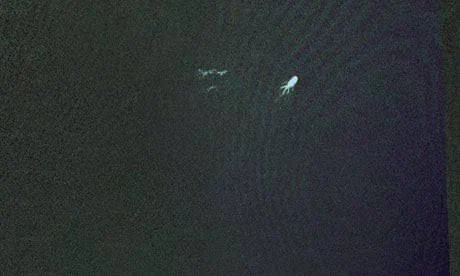
The enduring mystery of the Loch Ness Monster has resurfaced in the digital age, as a recent discovery on Google Earth has sparked renewed international interest in Scotland’s most famous cryptozoological legend. Julie Fraser, a tourist planning a trip to the Scottish Highlands, recently identified three anomalous shapes while scouring satellite imagery of Loch Ness. Her findings have since been submitted to the Official Loch Ness Monster Sightings Register, reigniting long-standing debates regarding the existence of the elusive creature known as "Nessie."
The Discovery and Initial Observations
The discovery occurred while Fraser was conducting virtual research for her upcoming travel itinerary to Inverness. While navigating the high-resolution satellite views of the 23-mile-long freshwater loch, she encountered three distinct, submerged shapes moving in tandem. Unlike typical maritime traffic, these objects appeared to possess biological characteristics that defied standard identification.
Fraser immediately cross-referenced the shapes with known vessel patterns in the area. Upon closer inspection of the satellite imagery, she noted that the objects did not produce the characteristic "V-shaped" wake typically associated with motorized boats. By comparing the anomalies to a nearby tour vessel clearly visible in the same frame—which was actively displacing water and creating a visible wake—Fraser concluded that the objects were moving through the water with minimal surface disturbance.
"After examining the imagery at higher magnification, it became evident that these were not watercraft," Fraser noted in her report to the registry. "The silhouettes are reminiscent of large marine mammals, such as whales, displaying curved backs that suggest a rhythmic movement through the depths."
Chronology of the Loch Ness Phenomenon
The legend of the Loch Ness Monster dates back to the 6th century, when Saint Columba is said to have encountered a "water beast" in the River Ness. However, the modern obsession with the creature began in 1933, when a road built along the north shore of the loch provided an unobstructed view of the water, leading to a surge in sightings.
The following timeline highlights the evolution of this cultural phenomenon:
- 1933: The first major modern sighting occurs, reported by George Spicer and his wife, who claimed to see a creature with a long neck crossing the road.
- 1934: The famous "Surgeon’s Photograph" is published in the Daily Mail, becoming the definitive—though later debunked—image of the monster.
- 1960: Aeronautical engineer Tim Dinsdale films a hump moving through the water, which remains one of the most credible pieces of evidence in the eyes of many enthusiasts.
- 1987: Operation Deepscan, the largest scientific sweep of the loch, utilizes sonar technology to survey the entire basin, resulting in "unexplained contacts."
- 2019: An environmental DNA (eDNA) study led by Professor Neil Gemmell of the University of Otago concludes there is no evidence of a large reptile, but suggests the possibility of large eels inhabiting the loch.
- 2024: Julie Fraser’s submission marks the 17th potential sighting of the year, underscoring the persistent nature of the legend despite modern technological advancements.
Scientific Analysis and Skepticism
The Official Loch Ness Monster Sightings Register, which catalogs reports, maintains a rigorous vetting process. Each submission is evaluated based on the witness’s description, environmental conditions, and the presence of photographic or video evidence. While the register provides a platform for enthusiasts, it operates with a degree of academic caution.
The scientific community generally views reports like the one submitted by Fraser with significant skepticism. Oceanographers and limnologists often point to natural phenomena that can mimic large animals. These include:
- Seiches: Large-scale standing waves in the loch caused by wind or changes in atmospheric pressure, which can create the illusion of movement.
- Boat Wakes: Even when a wake is not immediately visible, the reflection of light on the water surface can create "phantom" shapes that disappear upon movement.
- Floating Debris: Trees or peat bogs rising to the surface can occasionally create shapes that, when viewed from a satellite or a distance, resemble biological organisms.
- Biological Misidentification: Large eels, seals, or otters swimming in a line can create a visual effect that the human brain interprets as a single, large entity.
The Role of Satellite Technology in Cryptozoology
The use of Google Earth as a tool for "armchair cryptozoology" has grown significantly over the last decade. Satellite imagery offers a perspective previously unavailable to researchers, allowing for the scanning of vast areas in seconds. However, experts in image analysis warn against the limitations of these tools.
Satellite imagery is often a composite of several images taken at different times and stitched together by software. This process can sometimes create "artifacts"—visual glitches or distortions—that appear as coherent shapes when they are merely data errors. Furthermore, the resolution of public-access satellite imagery is often insufficient to definitively identify small, moving objects in a fluid environment like a deep, dark lake.
"While the technology is impressive, we must distinguish between pixels and reality," noted a representative from a Scottish geological survey group. "The data provided by satellite imagery is a starting point for inquiry, not a substitute for peer-reviewed field research."
Official Responses and the Future of the Register
The Official Loch Ness Monster Sightings Register has confirmed that it is currently reviewing Fraser’s submission. If accepted, it would join a small but consistent stream of reports that keep the legend relevant. The registry serves not only as a record for enthusiasts but also as a cultural archive that tracks how human perception of the loch has changed over the last century.
Tourism in the Highlands remains intrinsically linked to the legend. The "Nessie" industry contributes millions of pounds annually to the local economy, supporting hotels, boat tours, and museums. Consequently, the local government and tourism boards maintain a delicate balance between fostering the mystery that draws visitors and upholding the scientific reputation of the region.
Implications of the Ongoing Mystery
The case of the Google Earth images highlights a broader psychological trend: the human desire for discovery in an increasingly mapped world. Despite the fact that the loch has been surveyed by sonar, underwater cameras, and eDNA sampling, the ambiguity of the water—deep, peaty, and dark—leaves just enough room for the imagination to thrive.
The implications of this incident are primarily cultural rather than scientific. It demonstrates that as technology advances, so too do the methods by which we search for the unknown. Whether these shapes are merely a trick of the light, a software artifact, or something more remains to be seen. However, the fact that an individual in Scotland can prompt a global conversation about a centuries-old mystery simply by using a smartphone application speaks to the enduring power of the Loch Ness legend.
As the scientific community continues to move toward more comprehensive environmental monitoring, the hope is that high-resolution underwater drones and AI-enhanced sonar will eventually resolve the mystery once and for all. Until then, the "monster" remains a staple of Scottish folklore, protected by the very depth and darkness of the water it is said to inhabit.
For now, the three shapes identified by Julie Fraser remain in the pending pile of the register, serving as a reminder that even in the age of high-speed internet and global satellite surveillance, the world still holds pockets of uncertainty that invite us to look a little closer at what lies beneath the surface.