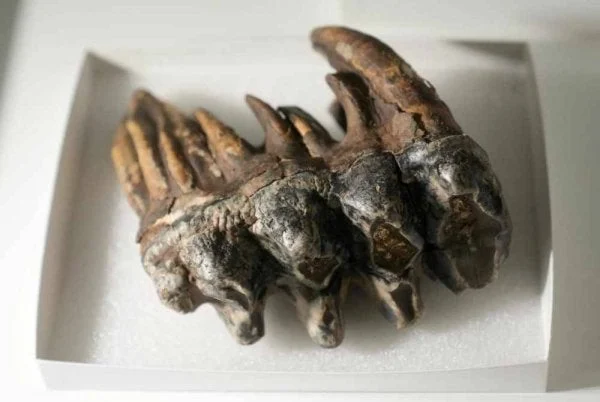
SAN MATEO, CALIFORNIA – A routine environmental survey in the rugged terrain of San Mateo County has resulted in a significant paleontological discovery. Brigid Lynch, a professional geomorphologist, unearthed a fossilized molar belonging to a Pacific mastodon, a massive prehistoric mammal that roamed North America during the Pleistocene epoch. The artifact, which initial estimates suggest is at least 10,000 years old, was found embedded in a riverbed, masquerading as an unremarkable rock until closer inspection revealed its biological origin.
The discovery occurred while Lynch was conducting field assessments for a habitat restoration project aimed at protecting the California red-legged frog, a species currently listed as threatened under the U.S. Endangered Species Act. The finding highlights the unexpected intersections between contemporary conservation efforts and the study of deep-time biological history.
The Chronology of Discovery
The sequence of events leading to the recovery of the fossil began during a standard site survey. As a geomorphologist tasked with restoring the riparian ecosystem, Lynch was navigating the creek bed when a peculiar shape caught her attention. In an environment dominated by sedimentary rocks and alluvial deposits, the object appeared at first glance to be a strangely weathered stone.
Upon closer physical examination, however, the texture, density, and distinct morphological features—specifically the complex ridges characteristic of proboscidean dentition—indicated that the object was organic in nature. Following the discovery, Lynch initiated standard reporting protocols, ensuring the site remained undisturbed while local experts were consulted. Subsequent analysis by paleontologists confirmed the object was indeed a molar from a Pacific mastodon (Mammut pacificus), an extinct relative of the modern elephant that inhabited the coastal regions of the Western United States.
Anatomical Significance of the Specimen
The fossilized molar is a remarkably well-preserved specimen, measuring approximately 23 centimeters (roughly 9 inches) in length. Paleontologists noted that both the crown and the root systems remain largely intact, a rarity for fossils found in high-energy stream environments where erosion and transport often degrade organic remains.
The Pacific mastodon is distinguished from the more widely known woolly mammoth by its dental morphology. While mammoths were primarily grazers with flat, ridged teeth adapted for grinding grasses, mastodons possessed cone-shaped, high-cusped molars designed for browsing on woody vegetation, leaves, and twigs. The presence of clear root canals and the preservation of the crown structure provide researchers with a high-fidelity window into the diet and health of the animal at the time of its death.
Data obtained from the tooth’s enamel could potentially yield isotopic signatures, allowing scientists to reconstruct the environmental conditions of San Mateo County during the terminal Pleistocene. By analyzing the carbon and oxygen isotopes trapped within the enamel, researchers can determine the types of vegetation the mastodon consumed and the climatic conditions of the region 10,000 years ago.
The Pleistocene Context in California
The Pacific mastodon was a staple of the Pleistocene megafauna that inhabited North America until roughly 10,000 to 11,000 years ago. During this period, the California landscape was characterized by a mosaic of grasslands and coniferous forests, providing an ideal habitat for these massive herbivores.
The extinction of the mastodon at the end of the last Ice Age remains a subject of intense scientific debate. Theories primarily center on a combination of climate change—specifically the rapid warming at the transition to the Holocene epoch—and the arrival of human hunters in the Americas. The discovery of this tooth in San Mateo County serves as a poignant reminder that the suburban landscapes of modern California were once dominated by colossal creatures that vanished in the blink of an evolutionary eye.
This find is not an isolated incident in the region. California’s geological history, particularly its alluvial fans and river systems, has frequently yielded remains of Pleistocene megafauna. However, the discovery of such a complete molar in a current, active stream bed is rare, as most fossils are typically recovered from asphalt seeps (like the La Brea Tar Pits) or deep sedimentary strata.
Expert Perspectives and Official Response
While local environmental agencies have yet to issue a formal press release regarding the future of the site, the paleontological community has expressed significant interest in the find. Experts in the field of quaternary science suggest that the discovery validates the importance of environmental impact surveys. Often viewed by developers as bureaucratic hurdles, these surveys have proven to be essential for the preservation of archaeological and paleontological heritage.
"Every time we step into the field to protect modern biodiversity, we are literally standing on top of the history of the planet," noted a regional researcher familiar with the site. "This discovery underscores why survey work is vital. Had this project not been initiated to protect the red-legged frog, this specimen might have remained buried, eventually eroding into dust or being washed away by seasonal flooding."
The specimen is expected to be transferred to a regional museum or university for permanent curation and further study. Its potential inclusion in a broader study of coastal mastodon populations could offer insights into how these populations moved along the Pacific coast during the fluctuating climate of the late Pleistocene.
Broader Implications and Scientific Value
The preservation of the molar has implications beyond mere curiosity. By identifying the exact strata in which the tooth was found, geologists can better date the surrounding sediments, which assists in mapping the geological evolution of the San Mateo creek systems.
Furthermore, the discovery provides a unique educational opportunity. The contrast between the fragile, threatened California red-legged frog and the massive, extinct mastodon serves as a powerful narrative for conservationists. It illustrates that ecosystems are fluid and that the species we protect today are merely the current inhabitants of a landscape that has undergone radical transformations.
For the scientific community, the primary focus now shifts to whether the site contains additional skeletal remains. While a single tooth is a significant find, it often suggests the presence of a larger deposit. Paleontologists may seek permits to conduct a controlled excavation of the surrounding riverbank to determine if a partial skeleton remains buried in the mud. Such a find would be a major event for California paleontology, potentially offering a more complete picture of the mastodon’s life and the specific ecological conditions of the region at the close of the last glacial period.
Future Preservation Efforts
As discussions continue regarding the future of the fossil, there is a consensus among local authorities that the site must be handled with sensitivity. The goal is to balance the ongoing habitat restoration for the red-legged frog with the need to extract potentially valuable paleontological data.
The project remains an example of how multidisciplinary teams—comprising biologists, geomorphologists, and paleontologists—can work in tandem. The integration of these fields is increasingly necessary as human development continues to encroach on previously undisturbed lands. By formalizing the reporting process for such discoveries, local government bodies in California have ensured that items of historical significance are not lost to private collection or accidental destruction.
In the coming months, the results of the initial isotope analysis and further stratigraphic testing will be published, providing the public and the scientific community with a clearer understanding of the mastodon that once roamed the hills of San Mateo. This artifact stands as a silent witness to a time when California was defined by the presence of giants, and its recovery ensures that this chapter of natural history will continue to inform our understanding of the earth’s past for generations to come.
As the scientific community awaits the detailed report on the molar, the discovery serves as a reminder of the hidden records preserved beneath our feet. Whether it is the restoration of a tiny frog’s habitat or the uncovering of a prehistoric titan, the efforts of field researchers continue to bridge the gap between our current world and the ancient history that shaped it. The San Mateo tooth is more than a fossil; it is a piece of a complex, long-standing puzzle that links the environmental stewardship of today with the natural legacy of the Pleistocene.