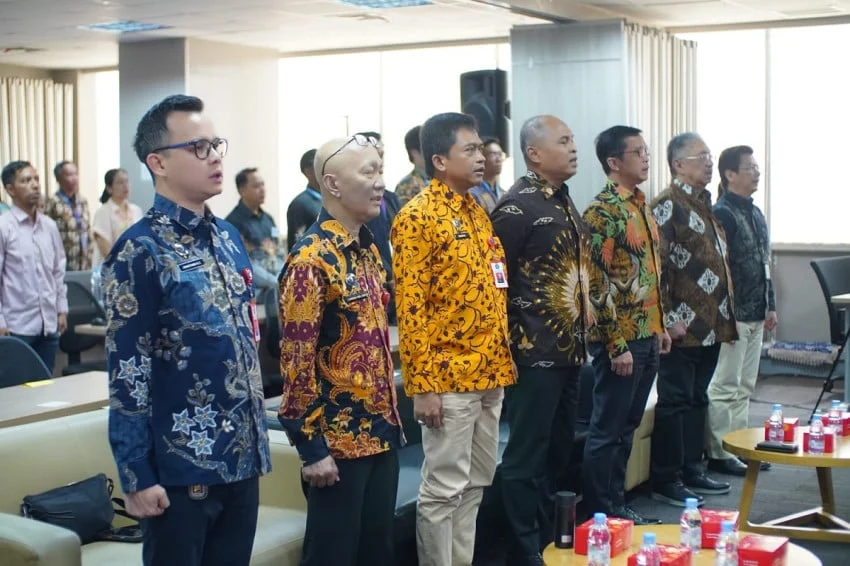
JAKARTA — Demonstrating its ongoing commitment to delivering world-class postgraduate education closely aligned with modern technological shifts, dynamic industrial demands, and the evolving needs of the professional landscape, Swiss German University (SGU) officially inaugurated its latest academic term through the SGU Master Orientation Day 2026. The prestigious hybrid event, held on Saturday, September 12, 2026, successfully combined on-campus engagement at the university’s modern facilities with seamless virtual participation, accommodating incoming master’s degree students, esteemed faculty members, and notable institutional guests.
The centerpiece of the orientation festivities was an intensive Public Seminar designed to bridge the gap between rigorous academic theory and urgent, real-world strategic challenges. To provide students with unparalleled industry and governmental insights, SGU invited the Head of the National Cyber and Crypto Agency (BSSN), Lieutenant General TNI (Ret.) Nugroho S Budi, to deliver a keynote address. His presentation served as an intellectual catalyst, framing the foundational mindset required for professionals navigating an increasingly digitized and interconnected global economy.
The inclusion of high-ranking state officials and security leaders in an academic orientation underscores SGU’s strategic vision: ensuring that future leaders, technologists, and business administrators possess not only technical competency but also a profound understanding of national security, institutional resilience, and ethical digital governance.
Chronology and Background of the SGU Master Orientation Day 2026
The planning for SGU Master Orientation Day 2026 began months prior, coinciding with the culmination of the university’s comprehensive admissions cycle for the academic year. As global industries face unprecedented disruptions driven by artificial intelligence, automation, and complex supply chain vulnerabilities, SGU’s academic senate resolved to pivot its orientation model away from traditional administrative briefings. Instead, the institution curated an immersive intellectual experience focused on the intersections of technology, leadership, and security.
On the morning of Saturday, September 12, 2026, the event commenced with official opening remarks from the SGU Rectorate, welcoming the incoming cohort of postgraduate students across various specialized master’s programs. Following the initial welcoming formalities, the academic program transitioned directly into the highly anticipated Public Seminar featuring Lieutenant General Nugroho S Budi.
Utilizing a hybrid format, the seminar allowed dozens of students to engage directly with the BSSN chief in person while hundreds of others participated via interactive digital streaming platforms. The session was structured as an engaging talk show and interactive dialogue, moving away from rigid lecturing to foster active intellectual exchange between the speaker and the newly enrolled professionals.
Core Themes Addressed: Cybersecurity, Emerging Threats, and National Resilience
The dialogue led by the BSSN head tackled some of the most critical and complex subjects facing modern enterprises and nation-states alike. Among the primary focus areas were cybersecurity frameworks, the exponential rise of emerging digital threats, the complexities of comprehensive digital transformation, and the absolute necessity of human capital readiness.
Lieutenant General Nugroho S Budi emphasized that as organizations accelerate their digital transformation initiatives, their exposure to sophisticated cyber threats expands exponentially. In a contemporary global ecosystem defined by asymmetric warfare, malicious actors no longer rely solely on conventional physical force. Instead, critical infrastructure, financial institutions, government networks, and corporate intellectual property are increasingly targeted through coordinated cyber campaigns designed to destabilize economies and compromise national sovereignty.
Furthermore, the discussion delved deeply into the paradigm-shifting impacts of emerging technologies. The seminar explored the rapid commercialization and integration of Artificial Intelligence (AI), the looming computational paradigm of Quantum Computing, and the urgent necessity for Post-Quantum Cryptography (PQC). As quantum computing approaches commercial viability, traditional encryption methods risk becoming obsolete overnight. Consequently, the BSSN head stressed that current and future technology leaders must proactively integrate future-proof cryptographic protocols into their organizational infrastructures to safeguard sensitive data against tomorrow’s computational threats.
Broader Industry Context and Supporting Data on Cybersecurity Imperatives
The insights shared during the SGU Master Orientation Day 2026 arrive at a critical juncture for Indonesia’s digital economy and security landscape. According to recent data compiled by national cybersecurity watchdogs and international technology research firms, Southeast Asia remains one of the fastest-growing digital economies globally, yet it simultaneously ranks among the most targeted regions for cyberattacks, ransomware deployment, and data breaches.
In Indonesia alone, millions of cyber threats and anomalies are detected annually, targeting critical sectors such as banking, telecommunications, healthcare, and public administration. This surge in digital vulnerability highlights a persistent structural challenge: the acute shortage of qualified cybersecurity professionals and digitally literate organizational leaders. Industry assessments indicate a global shortfall of millions of skilled cybersecurity practitioners, a gap that academic institutions like Swiss German University are uniquely positioned to address through specialized postgraduate curricula, advanced research initiatives, and strategic partnerships with government agencies and industry leaders.
By integrating security awareness, risk management, and technological foresight into master’s programs spanning business administration, information technology, and engineering, SGU actively contributes to narrowing this critical human capital deficit. The alignment between BSSN’s national strategic priorities and SGU’s educational framework ensures that graduates emerge not merely as managers or technicians, but as resilient, forward-thinking catalysts for organizational security and innovation.
Institutional Reactions and Stakeholder Perspectives
While the event served primarily as an educational orientation, the implications of the discussions resonated deeply across the academic community and the broader professional sector. Representatives from SGU’s academic leadership noted that inviting high-profile figures like the head of BSSN reinforces the university’s commitment to experiential, industry-relevant learning.
"Postgraduate education in the modern era cannot exist in an ivory tower," remarked a senior SGU faculty member following the seminar. "Our students are industry practitioners, corporate leaders, and tech innovators who face complex, real-world challenges every single day. By hosting leaders from vital national institutions like BSSN, we provide our students with direct access to strategic state-level perspectives, ensuring they understand that technological innovation and security are two sides of the same coin."
Incoming master’s students similarly expressed enthusiasm regarding the orientation format. Many noted that the interactive dialogue on AI, quantum computing, and asymmetric warfare broadened their understanding of how their respective disciplines—whether in IT management, engineering, or business strategy—intersect with national security and macroeconomic stability. The ability to question a high-ranking state official directly regarding digital transformation strategies offered a rare and valuable perspective that transcended standard classroom learning.
Implications for the Future of Indonesian Professional Education
The success of the SGU Master Orientation Day 2026 establishes a benchmark for how higher education institutions in Indonesia can effectively prepare their postgraduate students for the complexities of the Industry 4.0 and Society 5.0 eras. As emerging technologies evolve at a breakneck pace, the traditional boundaries separating IT governance, corporate leadership, public policy, and national security are increasingly dissolving.
The comprehensive insights provided by Lieutenant General Nugroho S Budi serve as a timely reminder that digital resilience is a shared responsibility. It requires active collaboration between government regulatory bodies, national security agencies, academic institutions, and the private sector. Through initiatives like the Master Orientation Day 2026, Swiss German University continues to solidify its role as a premier educational hub dedicated to producing agile, highly competent, and security-conscious professionals equipped to navigate and shape Indonesia’s digital future.