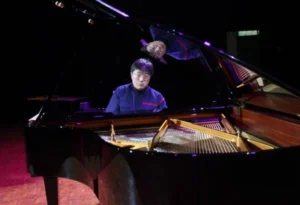
The Indonesian arts and cultural landscape entered a period of profound mourning following the passing of legendary composer, choreographer, and multi-disciplinary artist Mohammad Guruh Irianto Soekarnoputra. The esteemed cultural figure died on Saturday at the age of 73, passing away at 04:16 Western Indonesia Time (WIB) at MRCCC Siloam Hospitals Semanggi in Jakarta.
The announcement of his death was formally communicated to the public via a written statement released early Saturday morning by Hasto Kristiyanto, Secretary-General of the Indonesian Democratic Party of Struggle (PDI-P). As the youngest son of Indonesia’s founding father and first President, Soekarno, and former First Lady Fatmawati, Guruh occupied a unique space at the intersection of national history, political lineage, and artistic innovation. Yet, throughout a career spanning more than five decades, he deliberately carved out a distinct identity not as a political figure, but as an uncompromising visionary who fundamentally reshaped the architecture of modern Indonesian music, theater, and dance.
His departure leaves an irreplaceable void in the nation’s creative ecosystem. Guruh’s career was defined by an intellectual and artistic rigor that sought to bridge the gap between contemporary Western musical idioms and the ancient, intricate wealth of Indonesian traditional arts. From his groundbreaking experiments with progressive rock and gamelan in the 1970s to his grand, colossal stage productions that captured the imagination of multiple generations, his artistic output served as an ongoing meditation on national identity, cultural preservation, and modernity.
Early Foundations and Formative Years in Art
Long before he became a household name as a composer and cultural producer, Guruh’s immersion in the arts began in early childhood. Archival records from the National Archives of Indonesia (ANRI) indicate that he received rigorous early training in traditional dance forms from Java, Sunda, Bali, and Minangkabau. This exposure was not merely superficial; it instilled in him a deep, structural understanding of regional aesthetics that would inform every major project he undertook later in life.
By the time he was in elementary school, his prodigious talent was already evident as he performed regularly on state broadcaster TVRI alongside musical ensembles he had assembled himself. His adolescence marked a shift toward contemporary sounds; in 1965, he formed the musical group The Beat-G, followed in 1970 by The Flower Poetman. Concurrently, he maintained a rigorous dedication to traditional disciplines, participating in Balinese gamelan circles, theatrical training, and organizing angklung and Javanese gamelan groups within the Perguruan Cikini educational environment.
In the early 1970s, Guruh traveled to the Netherlands to pursue higher education at the Universiteit van Amsterdam. Far from distancing himself from his roots, his time in Europe deepened his engagement with Indonesian culture. He embedded himself within the Javanese and Balinese gamelan circles at the Tropen Museum in Amsterdam, eventually taking on the role of an instructor teaching Balinese dance and gamelan. This international exposure proved pivotal, shaping a cosmopolitan worldview that posited that modern music and traditional heritage were not mutually exclusive, but rather complementary forces waiting to be unified.
Guruh Gipsy and the Radical Fusion of East and West
The defining milestone of Guruh’s early professional career arrived upon his return to Indonesia in 1975, with the conceptualization and execution of the Guruh Gipsy project. Driven by a desire to synthesize the complex polyrhythms of Balinese gamelan with the harmonic and structural sensibilities of Western progressive rock, Guruh spearheaded an unprecedented sonic experiment.
Teaming up with the legendary band Gipsy—featuring Keenan Nasution on drums and vocals, Chrisye on bass and vocals, Roni Harahap on piano and keyboards, Oding Nasution on guitar, and Abadi Soesman on the synthesizer—Guruh took on the roles of lyricist, pianist, and gamelan instrumentalist. The ensuing production sessions, spanning from 1975 to 1976, resulted in the self-titled album Guruh Gipsy, released in 1976.
Featuring compositions such as "Geger Gelgel," "Barong Gundah," "Smaradhana," "Indonesia Maharddhika," "Janger 1897 Saka," and "Chopin Larung," the album is widely recognized by music historians and critics as a watershed moment in Indonesian music history. It did not merely graft traditional sounds onto a rock framework; rather, it interrogated themes of cultural identity, nationalism, and societal transformation. Tracks like "Indonesia Maharddhika" became enduring anthems of progressive national pride, while "Smaradhana" achieved mainstream immortality through the soaring vocals of the late Chrisye.
The enduring resonance of this project was vividly demonstrated when Guruh Gipsy—featuring surviving members Keenan Nasution and Abadi Soesman—reunited to perform at Synchronize Fest 2025. Backed by a new generation of musicians, the performance served as both a triumphant revival and a poignant tribute to departed bandmates such as Chrisye, Roni Harahap, and Oding Nasution, proving that Guruh’s avant-garde vision had lost none of its potency across the decades.
Charting the Course of Indonesian Pop and the Birth of Colossal Stagecraft
Guruh’s creative output extended far beyond progressive rock experiments. In 1976, his composition "Renjana" triumphed at the National Popular Song Festival, earning him a ticket to represent Indonesia at the prestigious World Popular Song Festival in Tokyo, Japan. This success opened the floodgates for a torrent of commercially and critically acclaimed songs that define the golden era of Indonesian pop music, including "Galih dan Ratna," "Gita Cinta," "Anak Jalanan," "Lenggang Puspita," "Sendiri," and "Marlina."
His penchant for cross-cultural synthesis resurfaced in the track "Kembalikan Baliku," performed by Jopie Latul. By fusing traditional Balinese instrumentation with disco and rock elements, Guruh cemented a signature formula: fiercely rooted in Indonesian identity yet relentlessly modern in execution.
In 1977, Guruh expanded his artistic canvas from the recording studio to the physical stage by founding Swara Maharddhika. Conceived as a creative sanctuary and training ground for Indonesian youth, the organization became the incubator for Guruh’s grandest theatrical ambitions. Here, he pioneered the integration of traditional Indonesian choreography with modern Western dance forms, packaging them into accessible, high-production spectacles.
This vision materialized in a landmark series of colossal stage productions:
- Pergelaran Karya Cipta Guruh Soekarno Putra I (1979)
- Untukmu Indonesiaku (1980)
- Cinta Indonesia (1984)
- Gilang Indonesia Gemilang (1986)
These productions were holistic masterclasses in multi-disciplinary art, seamlessly blending original music, intricate choreography, avant-garde costume design, elaborate stage architecture, and deep theatrical narratives. Guruh frequently wore multiple hats as composer, choreographer, and director. His colossal format soon became the blueprint for major national events, including the opening ceremonies of the 10th National Games (PON) in Jakarta in 1981, the Jakarta Fair in 1982, Gempita Swara Maharddhika in 1987, and the massive urban spectacle JakJakJakJak Jakarta in 1989.
Institutionalization, International Outreach, and Mentorship
To ensure the longevity of his vision, Swara Maharddhika transitioned into the Swara Maharddhika Foundation in 1988. Concurrently, Guruh established GSP Productions (PT Gencar Semarak Perkasa) to professionalize the business of large-scale performing arts. Under his leadership, these troupes transcended national borders, taking Indonesian traditional-contemporary fusion to audiences in Singapore, Morocco, Tunisia, Jordan, Germany, Belgium, Denmark, Sweden, Switzerland, and Australia.
Beyond his direct artistic output, Guruh’s most enduring institutional legacy may well be the talent he nurtured. The Swara Maharddhika ecosystem served as the launchpad for a generation of performers who would go on to dominate the Indonesian entertainment industry, including Titi DJ, Deni Malik, Dewi Gita, Memes, Irianti Erningpraja, Euis Dahlia, and Rico Tampatty. Through these artists, Guruh’s pedagogical and artistic ethos permeated mainstream Indonesian culture for decades.
Film, Dance, and Multi-Disciplinary Mastery
Guruh’s footprint was equally visible in the Indonesian film industry. He contributed memorable musical scores and arrangements for iconic cinematic works such as Ali Topan Anak Jalanan, Gita Cinta dari SMA, and Puspa Indah Taman Hati. His work on cinematic soundscapes earned him the Best Musical Illustration award at the Indonesian Film Festival (FFI) in 1977. On-screen, he demonstrated his versatility as an actor, portraying Sunan Muria in the 1985 historical epic Wali Songo.
As a choreographer, his foundational studies under Balinese dance and gamelan luminaries—including I Wayan Diya, I Wayan Rindi, Anak Agung Ayu Oka, Ni Ketut Reneng, I Nyoman Kakul, and I Gusti Kompyang Raka, alongside musical mentors like Mochtar Embut and Ismail Marzuki—allowed him to speak fluently across multiple artistic dialects. Reducing Guruh Soekarnoputra to a mere songwriter or pop composer fundamentally misunderstands an artist whose canvas encompassed music, choreography, theater, film, fashion, and mass pageantry.
Cross-Generational Resonance and Lasting Legacy
The enduring relevance of Guruh’s catalog is best illustrated by its continuous reinvention across generations. In 2014, the "Salute to Guruh Soekarno Putra" concert brought together a diverse roster of contemporary musicians to reinterpret 25 of his classic compositions, including "Zamrud Khatulistiwa," "Kembalikan Baliku," "Galih dan Ratna," and "Gita Cinta dari SMA."
This intergenerational dialogue continued in 2020 when Musica Studios released the compilation album Puspa Ragam Karya Guruh Sukarno Putra 2020. Featuring contemporary heavyweights such as Noah, Iwan Fals, D’MASIV, Kahitna, Afgan, Geisha, Sheryl Sheinafia, and Vidi Aldiano, the album proved that Guruh’s songwriting possessed a timeless structural integrity capable of transcending fleeting radio trends. Hits like "Kala Cinta Menggoda," "Aji Mumpung," "Sendiri," and "Kala Sang Surya Tenggelam" found new life, acquiring fresh emotional resonance through modern arrangements.
Even in his later years, Guruh remained an active and vocal advocate for the cultural arts. As recently as January 2026, he appeared at a media gathering for the musical Bukan Cinta Galih/Ratna, using the platform to reiterate his lifelong thesis: that art is not merely entertainment, but an essential medium for transmitting civic values and shaping the character of the younger generation.
The overarching narrative of Guruh Soekarnoputra’s life work is defined by a refusal to dichotomize tradition and modernity. Throughout his journey—from the avant-garde shockwaves of Guruh Gipsy in the 1970s and the breathtaking pageantry of Swara Maharddhika to timeless pop standards and late-career festival returns—he maintained that Indonesia’s rich cultural heritage was not a museum artifact to be preserved behind glass, but a living, breathing vocabulary with which to converse with the modern world.
As Indonesia bids farewell to one of its most idiosyncratic and brilliant cultural architects, his tangible legacy survives in every chord progression that marries the gamelan to the synthesizer, in every stage production that marries traditional choreography with modern theatricality, and in the collective consciousness of a nation that continues to sing his songs. Guruh Soekarnoputra leaves behind more than a catalog of hits; he leaves a blueprint for how a nation can look unflinchingly toward the future while honoring the ancient echoes of its past.