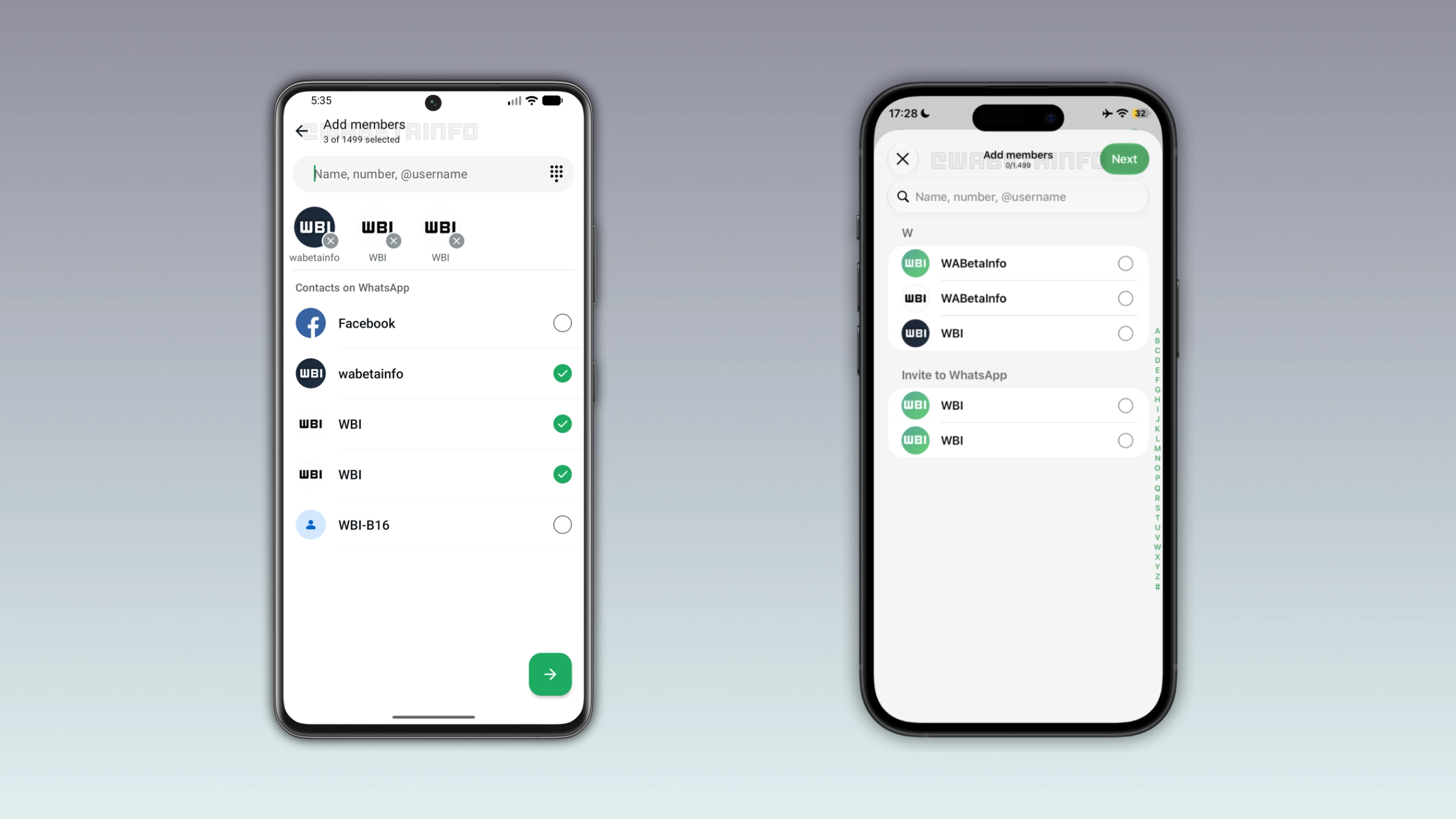
Meta-owned messaging giant WhatsApp has officially begun rolling out a major update that significantly expands the maximum participant capacity for its group chats. Moving forward, individual WhatsApp groups will be able to accommodate up to 1,500 members, a substantial increase from the previous ceiling of 1,024 participants. This new threshold represents an additional 476 slots per group, providing unprecedented scaling opportunities for large communities, corporate teams, educational institutions, and social networks relying on the platform for mass communication.
The feature is currently being deployed gradually across both Android and iOS operating systems. As the rollout progresses in phases globally, users and administrators are advised to ensure their applications are updated to the latest available version through the Google Play Store or Apple App Store to take advantage of the expanded infrastructure as soon as it hits their respective accounts.
Unveiling the Update: Discovery and Implementation
The expansion was first brought to light by WABetaInfo, a well-known industry publication recognized for tracking beta features and backend developments within the messaging application. According to their reports, the feature has entered the deployment phase, targeting select user accounts worldwide.
Crucially, group administrators will not need to perform any complex manual configurations, reconfigure existing chat settings, or migrate members into newly created groups to benefit from the upgrade. Existing group chats will automatically adopt the new 1,500-member limit the moment the server-side update and client-side patch synchronize with the administrator’s account.
However, because the deployment follows a phased rollout strategy, availability will vary. Users whose applications still restrict group creation or member additions to the older 1,024 ceiling are simply awaiting the arrival of the update in their geographic region or account tier. Patience is required as Meta scales server capacity to support the increased database load globally.
A Chronological History of WhatsApp Group Expansion
To fully understand the significance of this milestone, it is helpful to examine the historical trajectory of WhatsApp’s group capacity scaling over the past decade. When the platform was rapidly scaling its global user base, group limits were intentionally kept conservative to manage server loads, conserve mobile bandwidth, and curb the rapid viral spread of misinformation.
- Early Years to 2016: In the foundational years of the platform, group chat capacities were strictly capped at a modest 100 participants. This reflected a design philosophy centered primarily on close-knit groups of family and friends. In 2016, recognizing the growing utility of the platform for larger communities and professional networks, WhatsApp increased this threshold to 256 members.
- The 2022 Milestone: For nearly six years, the 256-member limit remained the standard. However, as hybrid work models, online education, and global digital communities surged during the post-pandemic era, demand for larger communication pools intensified. In mid-2022, WhatsApp doubled the limit to 512 participants before rapidly accelerating capabilities later that same year, pushing the maximum boundary to 1,024 members. This rapid succession of upgrades signaled a strategic shift by Meta to transform WhatsApp from a simple peer-to-peer messenger into a robust community collaboration platform.
- The 2026 Shift to 1,500: Continuing this evolutionary curve, the introduction of the 1,500-member threshold further cements WhatsApp’s ambition to cater to institutional, organizational, and massive public communities that previously had to rely on alternative applications for large-scale coordination.
Competitive Landscape: WhatsApp Versus Telegram
Despite the substantial leap to 1,500 members, market analysts and industry observers immediately note the stark contrast between WhatsApp’s scaling metrics and those of its primary market competitor, Telegram.
Telegram has long held a dominant position in the realm of massive digital communities, famously allowing standard group chats to scale up to 200,000 members. Furthermore, Telegram’s broadcast-style channels support an unlimited number of subscribers, positioning the platform as a hybrid between a messaging app and social media.
While WhatsApp’s encrypted architecture and end-to-end security protocols demand significantly higher computing power and device resource management—making massive group sizes technically more challenging to maintain without degrading user experience—the platform’s latest update closes a portion of that competitive gap. For many enterprise users, local community organizers, and civic groups, 1,500 members strikes a pragmatic balance between massive broadcast capability and manageable conversational oversight.

Technical Implications and Moderation Challenges
Expanding group chat sizes from 1,024 to 1,500 participants introduces both opportunities and administrative challenges. From an infrastructure perspective, Meta’s engineering teams must optimize message delivery queues, database synchronization, and encryption key distribution across larger arrays of active devices to prevent battery drain, high data usage, and message delivery latency.
For group administrators, however, the human element of moderation becomes exponentially more complex. Managing a community of 1,500 individuals requires robust administrative tools to maintain discourse quality, prevent spam, and enforce group guidelines. Fortunately, WhatsApp has concurrently invested in developer tools aimed at administrators, including stronger permission controls, pending member approval systems, and advanced moderation features that allow admins to delete inappropriate messages for all participants.
Broader Economic and Social Impact
The ability to aggregate up to 1,500 individuals in a single encrypted space carries profound implications for several key sectors:
- Corporate and Enterprise Communication: Multinational corporations, decentralized startups, and large franchise networks frequently utilize WhatsApp for rapid internal communications. The expanded limit allows entire operational departments, regional branch offices, or company-wide announcements to be housed within a single unified chat, reducing fragmentation across multiple smaller groups.
- Education and Academia: Universities, student unions, and large academic cohorts often struggle with fragmented communication channels. A 1,500-member ceiling enables entire academic departments, graduating classes, or massive lecture cohorts to receive real-time administrative updates instantly.
- Customer Support and Community Building: E-commerce brands, software developers, and creator economies leverage WhatsApp communities to foster customer loyalty and provide direct peer support. Higher caps allow brands to scale their customer engagement initiatives directly within the world’s most popular messaging ecosystem without forcing users to migrate to third-party forums.
Future Outlook for Messaging Infrastructure
As WhatsApp continues to refine its ecosystem—recently evidenced by experiments with innovative communication features such as view-once text messaging and enhanced media sharing controls—the platform remains dedicated to evolving alongside modern digital communication demands.
Whether the new 1,500-member limit will satisfy the demands of the platform’s most ambitious community leaders, or if user feedback will eventually drive Meta to push the boundary even closer to the tens of thousands seen elsewhere in the industry, remains to be seen. For now, the rollout marks a major technical achievement in balancing high-density connectivity with the platform’s signature privacy and encryption standards.