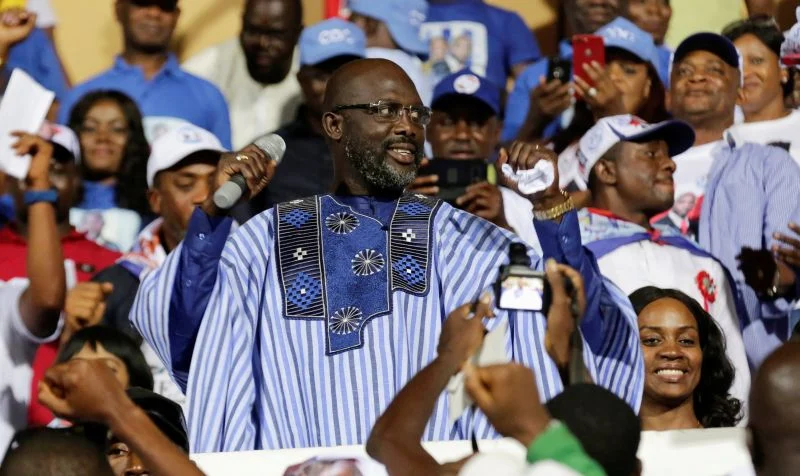
The transition of George Tawlon Manneh Oppong Ousman Weah from the hallowed turf of Europe’s elite football stadiums to the presidency of Liberia stands as one of the most remarkable career trajectories in modern history. Following his official election as the President of Liberia in December 2017, Weah achieved a feat matched by no other former professional athlete, bridging the gap between global sports stardom and high-stakes national governance. Long before he traded football boots for presidential suits—having previously graced the pitches of AC Milan, Paris Saint-Germain, Chelsea, and Manchester City—Weah was globally celebrated as a trailblazing athlete. His journey from the sandy pitches of Monrovia to the pinnacle of world football and ultimately to the highest political office of his homeland reflects a life defined by resilience, unmatched athletic brilliance, and a persistent commitment to public service.
Early Life and the Genesis of a Football Prodigy
Born on October 1, 1966, in the densely populated Clara Town district of Monrovia, Liberia, George Weah grew up in an environment defined by economic hardship. Raised primarily by his grandmother, Emma Klonh Wleh, in a patriarchal household with numerous siblings, Weah’s formative years were far removed from the luxury of modern football academies. Football was not just a pastime; it was an escape and a universal language in the streets of the Liberian capital.
Weah’s raw natural talent quickly distinguished him from his peers. He spent countless hours refining his technique on improvised pitches, playing barefoot on hard, uneven, and sandy surfaces. These humble beginnings forged his exceptional balance, close ball control, and physical resilience. His early exploits on the local scene caught the attention of domestic clubs, leading to stints with several Liberian teams, including Invincible Eleven, Mighty Barolle, Bongrange Bonguine, and Young Survivors of Claretown.
During his teenage years, Weah demonstrated not only athletic prowess but also natural leadership capabilities. Most notably, he captained and managed Young Survivors—a team that operated remarkably without a formal coach. Under his guidance, the squad achieved a historic promotion, climbing into Liberia’s top-flight division. This early success served as the springboard for his professional career, catching the eye of scouts looking beyond the domestic borders for untapped African talent.
The African Launchpad and European Discovery
In 1987, Weah’s career took a significant leap forward when he crossed international borders to sign a three-year contract with Tonnerre Yaoundé, one of Cameroon’s most prominent football clubs. The transition to the Cameroonian top division tested his professional mettle, but Weah adapted seamlessly. In his debut season, he played an instrumental role in leading Tonnerre Yaoundé to the Cameroonian championship title. His imposing physical stature, combined with astonishing acceleration, blistering pace, and a clinical eye for goal, made him an immediate sensation in Central African football.
It did not take long for European scouts to recognize the extraordinary potential possessed by the young Liberian striker. Arsène Wenger, then the manager of French club AS Monaco, spotted Weah’s talent through a VHS cassette and orchestrated his transfer to France in 1987. Relocating to Europe at the age of 21 presented cultural and competitive challenges, but Wenger’s mentorship proved pivotal in refining Weah’s tactical understanding and positioning.
Over five seasons with AS Monaco, spanning from 1987 to 1992, Weah established himself as one of the most lethal and dynamic forwards in the French Division 1. During his tenure in the Principality, he netted 57 goals across all competitions, terrorizing opposing defenses with his trademark surging runs from the halfway line. His stellar performances culminated in 1991 when he helped AS Monaco capture the Coupe de France, marking his first major silverware on European soil and solidifying his reputation as an emerging global superstar.
Conquering European Football: PSG, AC Milan, and the Ballon d’Or
Weah’s rising stock earned him a high-profile transfer to Paris Saint-Germain (PSG) in 1992. In the French capital, Weah elevated his game to an even higher echelon. During his three seasons with PSG, he became a central figure in the club’s domestic dominance and European ambitions. He captured another Coupe de France title, a French Division 1 championship, and famously finished as the top scorer in the UEFA Champions League during the 1994–1995 campaign, leading PSG to a memorable appearance in the tournament’s semi-finals. Across 123 appearances for the Parisian club, Weah registered 37 goals and numerous assists, leaving an indelible mark on French football history.
The pinnacle of his club career, however, awaited him in Italy. In the summer of 1995, Italian powerhouse AC Milan secured Weah’s services for a substantial transfer fee. In the grueling and tactically rigorous environment of Serie A, Weah thrived under the management of seasoned tacticians. Wearing the famous red and black jersey, he formed lethal attacking partnerships and played a decisive role in capturing two Scudetto titles (in the 1995–1996 and 1998–1999 seasons).
During his five-year spell at San Siro (1995–2000), Weah scored 51 goals in 114 league appearances. It was during this golden era that he achieved individual immortality. In 1995, he was awarded the FIFA World Player of the Year, the Ballon d’Or, and the Onze d’Or, becoming the first and, to date, only African player to win these prestigious global accolades. His historic achievement was further underscored by winning the African Footballer of the Year award three times (1989, 1994, and 1995).
Later in his career, Weah experienced brief stints in the English Premier League with Chelsea and Manchester City, where he added an FA Cup to his trophy cabinet, before concluding his playing days with spells in the United Arab Emirates and France.
Transition from Pitch to Politics: A New Mission for Liberia
As his football career wound down in the early 2000s, Liberia was emerging from a devastating fourteen-year civil conflict (1989–2003) that left the nation’s infrastructure shattered, its economy in ruins, and hundreds of thousands of citizens displaced. Having achieved immense wealth and global fame, Weah could have easily chosen a life of retirement in Europe or the United States. Instead, he chose to return home, compelled by a deep sense of patriotism and a desire to heal his war-torn nation.
Weah initially engaged in humanitarian work, serving as a UNICEF Goodwill Ambassador, using his immense global platform to campaign against child soldiers, promote education, and advocate for public health initiatives in West Africa. However, he quickly realized that sustainable, systemic change required direct political engagement.
In 2005, just two years after the official end of the Second Liberian Civil War, Weah announced his candidacy for the presidency of Liberia. Running under the banner of the Congress for Democratic Change (CDC), his announcement was met with mixed reactions. Critics pointed to his lack of formal higher education and political experience, while his massive base of youthful supporters viewed him as a unifying figure untainted by the decades of political corruption that had plagued the country.
Although Weah won the initial round of the 2005 presidential election, he was defeated in the subsequent runoff by Ellen Johnson Sirleaf, a veteran economist and Harvard-educated politician who would go on to become Africa’s first elected female head of state. Rather than retreating from politics, Weah committed himself to long-term nation-building. He returned to formal education, earning a high school diploma and subsequently acquiring a bachelor’s degree in business administration from DeVry University in Miami, followed by a master’s degree in public administration from Keller Graduate School of Management.
The Road to the Presidency: 2017 Election and Chronology
Weah’s patient, calculated approach to political integration bore fruit over the next decade. He served as a Senator for Montserrado County from 2014 to 2018, using his legislative seat to address local concerns, advocate for youth employment, and build a formidable political coalition.
The political chronology of Weah’s ascent culminated in the watershed general elections of October and December 2017. With President Ellen Johnson Sirleaf constitutionally barred from seeking a third term, the political landscape was wide open. Weah formed the Coalition for Democratic Change (CDC), uniting several opposition factions, and selected Jewel Howard-Taylor—the former wife of imprisoned former president Charles Taylor—as his vice-presidential running mate, a strategic move that consolidated significant regional support.
In the first round of voting held on October 10, 2017, Weah secured a plurality of the votes, finishing ahead of his primary rival, Vice President Joseph Boakai. Because no candidate achieved the mandatory 50% plus one vote required for an outright victory, a runoff election was scheduled. Following legal delays and logistical challenges, the historic runoff took place on December 26, 2017.
On December 29, 2017, the National Elections Commission (NEC) of Liberia officially announced the final results. George Weah secured a landslide victory, capturing over 61% of the total vote across the country’s 15 counties. The peaceful conclusion of the electoral process marked the first democratic transfer of power in Liberia from one elected president to another in more than 70 years, representing a monumental milestone for the nation’s fragile democratic institutions.
Implications, Challenges, and Global Reception
Weah’s inauguration on January 22, 2018, at the Samuel Kanyon Doe Sports Complex—ironically, the same stadium where he had once dazzled football fans as a player—was attended by thousands of ecstatic citizens and several regional heads of state. International observers, including the European Union, the Carter Center, and the Economic Community of West African States (ECOWAS), praised the peaceful conduct of the elections, signaling a new chapter of stability for Liberia.
However, the political implications of Weah’s presidency brought immediate and profound challenges. Analysts and economists noted that transitioning from a sports icon to a head of state required navigating immense socioeconomic hurdles. Liberia faced severe fiscal deficits, high inflation, widespread youth unemployment, and the lingering scars of systemic corruption. International financial institutions, including the International Monetary Fund (IMF) and the World Bank, closely monitored the new administration’s early economic policies, emphasizing the critical need for fiscal discipline, transparency, and infrastructural development.
Supporters argued that Weah’s humble origins, international network, and immense popularity uniquely positioned him to connect with the impoverished majority and attract foreign investment. Conversely, critics frequently scrutinized his governance style, cabinet appointments, and the administration’s early handling of economic pressures, highlighting the stark contrast between the adulation of the football pitch and the unforgiving realities of executive governance.
Conclusion
The journey of George Weah remains a singular narrative in modern history. From a barefoot boy chasing a makeshift ball in the dusty alleyways of Monrovia to a global football icon draped in gold and showered with international accolades, and finally to the constitutional leader of a sovereign nation, his life trajectory defies conventional paradigms. Whether viewed through the lens of sports history or political science, Weah’s ascent to the presidency of Liberia illustrates the transformative power of ambition, resilience, and an unwavering connection to one’s roots. As his administration continues to script the modern history of Liberia, Weah’s legacy extends far beyond the confines of athletic greatness, firmly embedding his name in the annals of African political evolution.