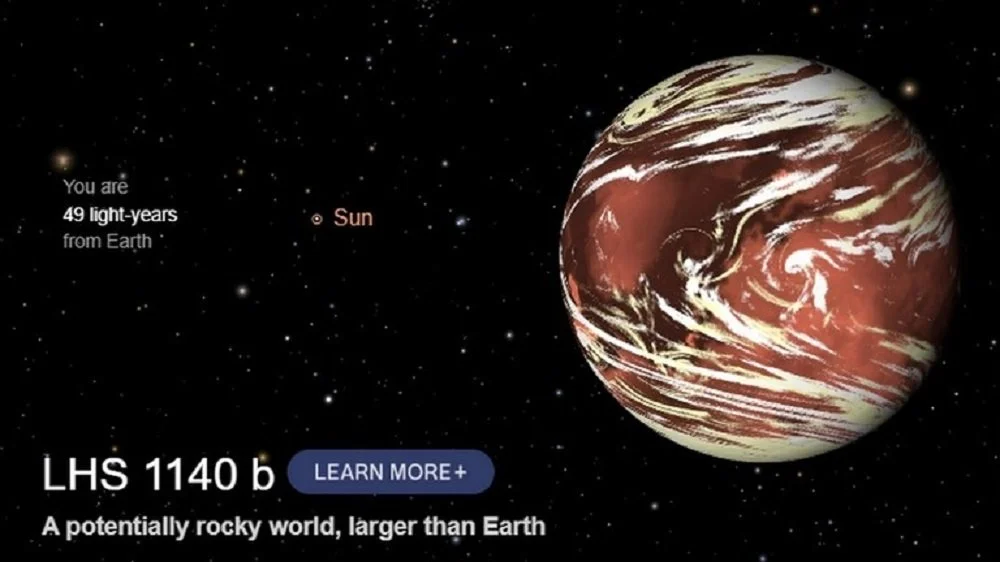
In a groundbreaking discovery that propels the search for life beyond Earth into a new era, astronomers have for the first time detected an atmosphere surrounding a rocky planet situated within the potentially habitable zone of its star. This monumental finding, detailed in a new report from a Harvard-led scientific team, signifies a pivotal moment in exoplanetary science, offering unprecedented insights into the conditions that might foster life on worlds far beyond our solar system.
The discovery centers on LHS 1140b, a super-Earth exoplanet located approximately 49 light-years away from Earth. This celestial body orbits a red dwarf star within a temperature range theoretically conducive to the presence of liquid water, a fundamental ingredient for life as we understand it. The research, published on Thursday, July 16, 2026, in the esteemed journal Science, is based on the detection of helium escaping from the planet’s atmosphere.
"An atmosphere is crucial for a planet to support life as we know it," stated Collin Cherubim, the lead author of the study and a planetary scientist affiliated with the University of Chicago, as reported by RT. "This is the first time anyone has found an atmosphere on a rocky planet in the habitable zone of another star." Cherubim’s assertion underscores the significance of this achievement, moving beyond theoretical models and into empirical observation of potentially life-supporting conditions on distant worlds.
A Glimpse into the Past: The Genesis of the Discovery
The initial hints of LHS 1140b’s atmospheric presence emerged in 2024. Astronomers, utilizing the sophisticated WINERED spectrograph mounted on the Magellan Clay Telescope in Chile, were observing the exoplanet when they detected a peculiar signal. The instrument captured a depletion of helium at high altitudes, a clear indication that this gas was actively leaking from the planet’s upper atmosphere. This leakage, rather than being a sign of depletion, provided the crucial evidence of an existing atmospheric envelope.
The WINERED spectrograph, a cutting-edge instrument designed for high-resolution spectroscopy, played a critical role. Its ability to meticulously analyze the light passing through or reflected by an exoplanet’s atmosphere allows scientists to identify the chemical composition of these distant envelopes. The detection of helium, a light and noble gas, is particularly interesting because its escape rate can provide clues about the planet’s atmospheric pressure, temperature, and the rate at which it is losing its gaseous shield to space.
LHS 1140b: A Promising Candidate
LHS 1140b itself has been a subject of intense scientific interest since its discovery. Classified as a super-Earth, it is larger and more massive than our own planet, with an estimated mass of 6.6 times that of Earth and a radius about 1.4 times larger. Its orbit around the red dwarf star LHS 1140 places it squarely within the star’s habitable zone. Red dwarf stars, while cooler and dimmer than Sun-like stars, are the most common type of star in the Milky Way galaxy, making planets around them prime targets in the search for exoplanetary life.
The theoretical possibility of liquid water on LHS 1140b stems from its orbital distance, which allows for surface temperatures that are neither too hot nor too cold. However, the presence of an atmosphere significantly enhances this possibility. An atmosphere can regulate a planet’s temperature through the greenhouse effect, shield its surface from harmful stellar radiation, and provide the necessary pressure to maintain liquid water.
A Cautious Optimism: The Road Ahead
While the detection of an atmosphere is a monumental step, lead scientist Cherubim urged a measured approach to interpreting its implications for habitability and the existence of life. "At this point, we have absolutely no evidence of life on the planet," he cautioned. However, he immediately followed this with a hopeful observation: "We think all the essential and critical ingredients are there."
This statement reflects the rigorous scientific methodology employed in astrobiology. The presence of an atmosphere, particularly one containing gases like helium which can be part of a larger atmospheric composition, suggests that the planet possesses the fundamental building blocks for life. The next steps in research will undoubtedly focus on identifying other atmospheric constituents, such as water vapor, carbon dioxide, or oxygen, which could further bolster the case for habitability.
A Prime Laboratory for Astrobiology
Despite the need for caution, Cherubim enthusiastically described the discovery as "incredibly exciting." He elaborated, "This truly places LHS 1140b at the forefront as the best, most promising, and most exciting laboratory for studying astrobiology and habitability beyond our solar system." This declaration highlights the transformative potential of this finding for the field of astrobiology.
LHS 1140b presents a unique opportunity to study the processes that govern planetary atmospheres and their potential to sustain life in a context different from Earth. While it shares some similarities with our planet, such as its overall composition and temperature range, it also exhibits significant differences. One notable difference is the phenomenon of tidal locking. Planets orbiting close to red dwarf stars are often tidally locked, meaning one side perpetually faces the star, leading to extreme temperature variations between the day and night sides. This characteristic poses challenges for habitability but also presents fascinating avenues for scientific inquiry.
Furthermore, the possibility of deeper water reserves on LHS 1140b, as suggested by some models, could offer protection from stellar flares and radiation, common occurrences from red dwarf stars. The presence of a robust atmosphere could further mitigate these effects.
Chronology of Discovery and Observation
The journey to this remarkable discovery can be traced through a series of critical observations and analyses:
- 2010s: Initial discovery of LHS 1140b through transit photometry, revealing its size and orbital period. This period also saw significant advancements in exoplanet detection technologies and the development of instruments like WINERED.
- 2024: The WINERED spectrograph on the Magellan Clay Telescope begins targeted observations of LHS 1140b. During these observations, astronomers first detect subtle anomalies in the light spectrum, indicative of atmospheric gas interactions.
- 2024-2025: Intensive data analysis by the Harvard-led team. Scientists meticulously examine the spectral data, ruling out instrumental errors and other astrophysical phenomena, to confirm the signal as originating from helium escaping LHS 1140b’s atmosphere.
- Early 2026: The research paper is drafted and submitted to Science, undergoing peer review by leading experts in the field.
- July 16, 2026: The groundbreaking study is officially published in Science, announcing the first detection of an atmosphere on a rocky exoplanet in a habitable zone.
Supporting Data and Future Research
The detection of helium leakage implies a number of crucial factors about LHS 1140b:
- Presence of an Atmosphere: The primary data point is the confirmation that LHS 1140b is not a bare rock but possesses an envelope of gases.
- Atmospheric Dynamics: The observed leakage suggests ongoing atmospheric processes, including outgassing from the planet’s interior or interactions with the stellar wind.
- Potential for Atmospheric Retention: While helium is a light gas and prone to escape, its continued presence, even in leaking form, suggests that the planet has a mechanism for replenishment or a substantial initial atmospheric mass.
- Mass and Gravity: The fact that helium can be detected escaping indicates that the planet’s gravity is sufficient to hold onto a significant portion of its atmosphere.
Future research will likely involve:
- Extended Observations: Utilizing more powerful telescopes, such as the James Webb Space Telescope (JWST) or future ground-based observatories, to perform more detailed spectroscopic analysis.
- Search for Other Gases: Identifying the presence of water vapor, carbon dioxide, methane, oxygen, and other biosignatures.
- Atmospheric Modeling: Developing sophisticated computer models to simulate the planet’s atmospheric behavior, temperature profiles, and potential for liquid water on its surface.
- Comparison with Other Exoplanets: Placing LHS 1140b’s atmospheric characteristics in the context of other known exoplanets to understand commonalities and divergences in planetary formation and evolution.
Broader Impact and Implications for the Search for Life
This discovery has profound implications for humanity’s understanding of its place in the universe and the potential for life beyond Earth.
- Validation of Habitable Zone Concepts: It provides empirical evidence that rocky planets in habitable zones can indeed possess atmospheres, a key prerequisite for life.
- Shift in Exoplanet Research Focus: The success of this detection will likely spur increased efforts to characterize the atmospheres of other rocky exoplanets, particularly those within habitable zones.
- Technological Advancement: The success of instruments like WINERED highlights the rapid progress in astronomical instrumentation, enabling ever more sensitive and precise observations.
- Philosophical and Societal Impact: The confirmed presence of an atmosphere on a potentially habitable world fuels the age-old human curiosity about whether we are alone in the cosmos. It brings the possibility of discovering extraterrestrial life closer to reality.
The detection of an atmosphere on LHS 1140b is not just a scientific paper; it is a beacon of hope and a testament to human ingenuity and perseverance in unraveling the mysteries of the universe. It signifies that the universe may be far more replete with the ingredients for life than previously imagined, and that the quest to find it has just entered its most exciting chapter.