The ongoing battle against narcotics distribution in the Greater Jakarta area has long faced complex socio-economic hurdles, particularly in notorious enclaves historically associated with widespread drug rings. In a significant strategic pivot, the Jakarta Metropolitan Police (Polda Metro Jaya) has announced a paradigm shift in how law enforcement agencies will tackle the persistent narcotics trade in Kampung Ambon, located in the Cengkareng sub-district of West Jakarta. Moving beyond traditional, raid-heavy tactics that have defined anti-narcotics operations for decades, the leadership of Polda Metro Jaya has articulated a comprehensive approach that intertwines stringent criminal enforcement with targeted community welfare initiatives, urban revitalization, and social engineering.
This strategic evolution was formally highlighted by top police officials during a high-profile joint ministerial and regional inspection of social development projects within the neighborhood. The initiative aims to address the root socio-economic vulnerabilities that often make impoverished urban communities fertile ground for illicit drug syndicates. By integrating urban renewal projects—such as government-backed housing renovations—with aggressive police oversight, authorities hope to dismantle the structural foundations that allow drug networks to persist and recruit within vulnerable populations.
Background Context of Kampung Ambon and Urban Narcotics Networks
Kampung Ambon has historically earned a reputation as one of Jakarta’s most persistent open-air narcotics markets. For generations, law enforcement agencies have conducted periodic sweeps, high-profile raids, and targeted arrests in the neighborhood, seizing quantities of methamphetamine, marijuana, and illicit paraphernalia. Despite these regular police interventions, the underground drug economy has repeatedly regenerated, driven by a complex web of local distribution rings, interconnected familial ties, and deep-seated economic desperation.
Criminologists and urban sociologists have long pointed out that enforcement-only paradigms in areas like Kampung Ambon, as well as its neighboring high-risk zone Kampung Boncos, yield limited long-term results. When law enforcement agencies rely exclusively on punitive measures without addressing infrastructural decay, high unemployment, and substandard living conditions, individuals caught in the periphery of the drug trade—often serving as low-level couriers, lookouts, or consumers—frequently return to illicit activities out of sheer economic survival. Furthermore, substandard housing and poorly lit, labyrinthine alleyways have historically provided ideal physical cover for narcotics transactions and a tactical advantage for suspects evading police pursuit.
Recognizing these structural limitations, modern policing strategies in Indonesia have increasingly looked toward holistic crime prevention models. These frameworks emphasize that sustainable eradication of organized drug syndicates requires transforming the physical and social landscape of high-risk neighborhoods, thereby denying criminal networks the social camouflage and economic desperation they exploit.
Chronology of the Joint Ministerial Visit and Recent Developments
The articulation of this new welfare-centric approach coincided with a collaborative field inspection conducted on Saturday, October 24, 2026. The inspection brought together key figures from both security and civil governance sectors, underscoring a cross-ministerial commitment to urban reform in high-crime zones.
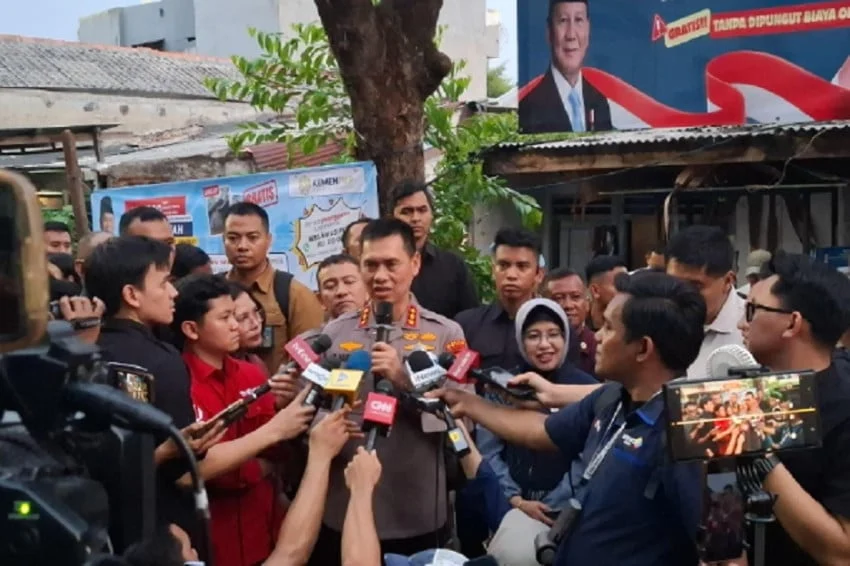
The delegation was led by the Chief of Polda Metro Jaya, Commissioner General Dadang Hartanto, alongside Minister of Housing and Settlement Areas (PKP) Maruarar Sirait and Minister of Home Affairs Tito Karnavian. The high-ranking officials visited the heart of Kampung Ambon to personally review the implementation of government-sponsored social welfare initiatives, most notably the national housing renovation program, locally known as bedah rumah.
During the visit, the officials interacted directly with local residents who have recently benefited from the housing revitalization scheme. Among them was Ester Yacoba Sumakul, a 64-year-old resident of Kampung Ambon, Cengkareng, West Jakarta, whose substandard dwelling was selected for comprehensive rehabilitation. The program aims to systematically target and transform homes that are deemed unfit for habitation, replacing structurally compromised buildings with safer, more sanitary living spaces.
The timing of this welfare push closely follows continuous law enforcement operations in the area. Just weeks prior, regional police units executed fresh raids in Kampung Ambon, resulting in the apprehension of primary suspects and the seizure of local narcotics stashes. By pairing these tactical interventions with immediate infrastructural investments, the government is attempting to demonstrate a dual-track strategy: decisive action against major drug suppliers coupled with tangible improvements in the daily lives of law-abiding citizens residing in the neighborhood.
Official Statements and Institutional Vision
Addressing the media and local stakeholders on location during the October 24 inspection, Commissioner General Dadang Hartanto emphasized that traditional law enforcement methodologies must evolve to achieve permanent security outcomes. He noted that the complexity of modern narcotics distribution networks demands an equally sophisticated, multi-agency response.
"Therefore, I see and am optimistic that if we resolve this in a comprehensive manner, this will become an extraordinary advancement for the Kampung Ambon area," stated Commissioner General Dadang Hartanto.
The Polda Metro Jaya Chief elaborated that the eradication of drug cartels and localized trafficking rings cannot rely solely on the criminal justice system. While investigations, targeted raids, and the apprehension of major suppliers remain non-negotiable pillars of police duty, Dadang stressed that social rehabilitation and structural neighborhood improvements must run parallel to police operations.
Minister of Housing and Settlement Areas Maruarar Sirait, echoing these sentiments during the tour, highlighted the critical role of secure physical infrastructure in fostering community resilience against criminal elements. Meanwhile, Minister of Home Affairs Tito Karnavian pointed to the necessity of inter-ministerial coordination—bridging security forces, local government administration, and social welfare agencies—to ensure that revitalized communities do not regress into urban decay.
The core philosophy underpinning this strategy is the disruption of the psychological and economic dependency that vulnerable residents may have on the underground economy. By upgrading living standards, providing legitimate economic pathways, and increasing state presence through social services rather than purely punitive measures, authorities aim to foster a community culture that actively rejects narcotics activity.
Fact-Based Analysis of Implications for Urban Security
The integration of welfare programs into counter-narcotics law enforcement carries profound implications for the future of urban policing in Indonesia, particularly within densely populated metropolitan centers like Jakarta.
From a tactical perspective, improving the physical layout of neighborhoods such as Kampung Ambon—widening access roads, improving illumination, and replacing dilapidated shophouses with standardized housing—inherently reduces the operational advantages long enjoyed by drug syndicates. Labyrinthine alleys that once facilitated rapid escapes and hidden stashes become more transparent and accessible to both municipal services and routine police patrols.
Economically, the bedah rumah initiative and concurrent social assistance programs address the financial precarity that often drives marginalized individuals to participate in petty drug distribution. When families are relieved of the burden of hazardous living conditions and supported through community development grants, their resilience against the coercive recruitment tactics of major drug syndicates is significantly enhanced.
However, security analysts also point out potential challenges in executing this long-term vision. Transitioning a historically entrenched narcotics hub requires sustained political will, consistent budgetary allocation, and long-term administrative follow-through that extends well beyond short-term political cycles. Furthermore, law enforcement agencies must maintain rigorous internal oversight to ensure that revitalization efforts are not undermined by corrupt local actors or resilient syndicates attempting to re-establish their networks in adjacent areas.
Broader Impact on West Jakarta’s Anti-Narcotics Campaign
The shift in Kampung Ambon is widely viewed as a test case for broader anti-narcotics campaigns across West Jakarta and the wider Jabodetabek (Jakarta, Bogor, Depok, Tangerang, Bekasi) agglomeration. Neighboring districts facing similar structural challenges, such as Kampung Boncos, are closely watching the outcomes of the Cengkareng initiative.
By framing urban development not merely as a matter of municipal beautification, but as an essential component of national security and crime prevention, the Indonesian government is signaling a maturation in its approach to the war on drugs. The collaboration between Polda Metro Jaya, the Ministry of Housing and Settlement Areas, and the Ministry of Home Affairs sets a collaborative benchmark for future public safety campaigns.
Ultimately, the success of the Kampung Ambon intervention will be measured not only by the volume of narcotics seized or the number of high-profile arrests made by Polda Metro Jaya, but by the sustainable transformation of the neighborhood’s social fabric. If families like Ester Yacoba Sumakul’s can live in secure, dignified environments free from the daily coercion of drug traffickers, the joint strategy of welfare-integrated policing may well redefine the blueprint for urban crime eradication in modern Indonesia.