The 2026 Formula 1 Belgian Grand Prix at the iconic Circuit de Spa-Francorchamps was marred by a dramatic lap one incident involving championship rivals Lewis Hamilton of Ferrari and George Russell of Mercedes. Hamilton received a five-second time penalty from the race stewards for his role in the collision, which effectively ended Russell’s race and dealt a significant blow to his title aspirations. In contrast, Ferrari teammate Charles Leclerc navigated a separate lap one incident with McLaren’s Oscar Piastri without incurring any penalty, highlighting the stewards’ nuanced approach to on-track incidents.
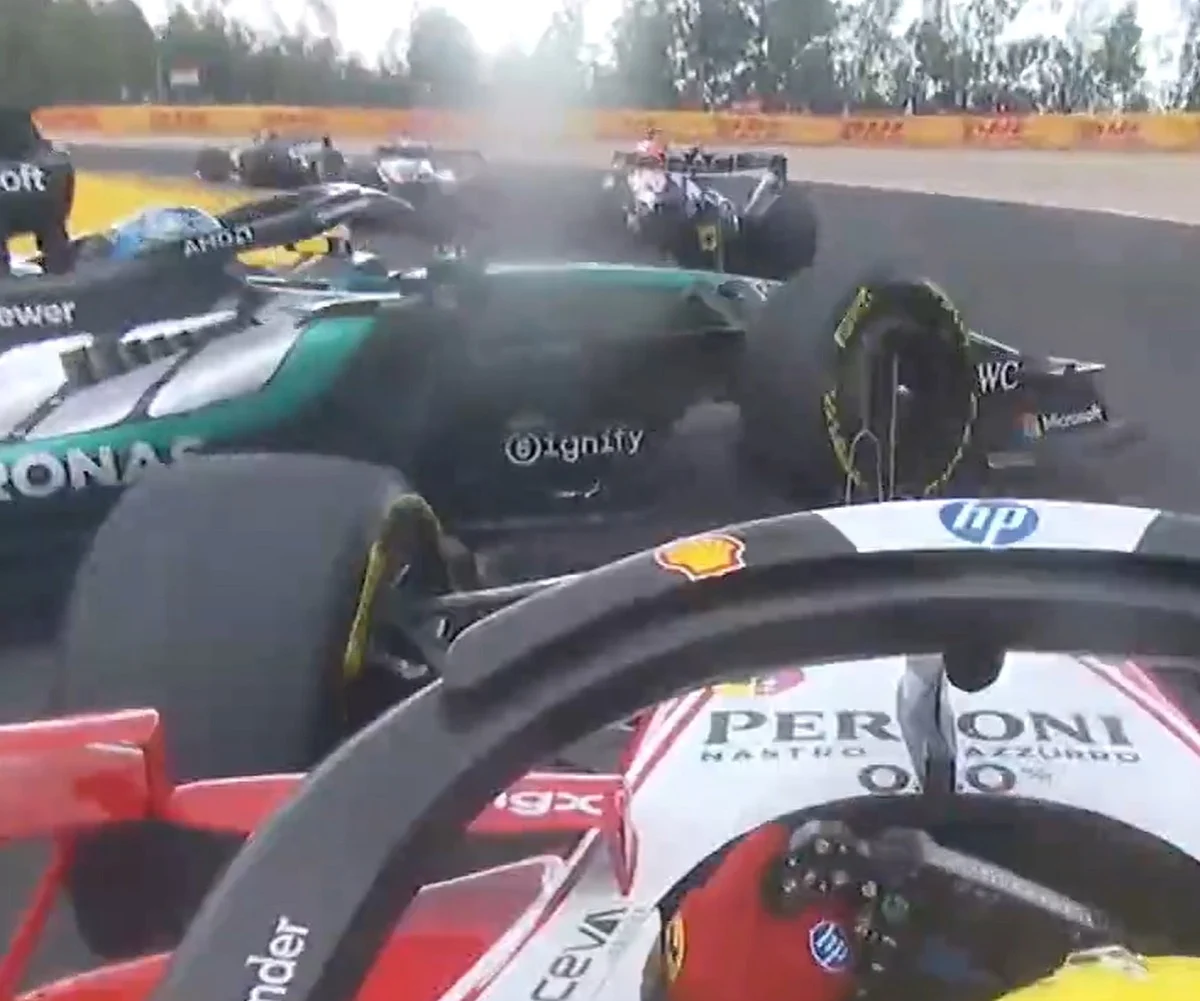
The collision between Hamilton and Russell occurred on the opening lap as the field navigated the challenging Kemmel Straight and the subsequent Les Combes chicane. Both drivers, former teammates at Mercedes, were vying for position in the early stages of the race. Reports from the stewards’ investigation indicate that the contact transpired as Russell attempted to make a move around the outside of Hamilton into Turn 5.
Hamilton Penalized for Collision with Russell
The stewards’ official decision meticulously detailed the sequence of events leading to the crash. Approaching Turn 5 on the first lap, Car 63 (Russell) was attempting to overtake Car 44 (Hamilton) on the outside. According to the report, Russell had established sufficient proximity to warrant racing room. Hamilton, meanwhile, maintained his line on the inside.
During the cornering phase, Car 44 (Hamilton) experienced a moment of understeer. Despite attempting to correct the steering input and avoid contact with Car 63 (Russell), Hamilton’s front-left wheel made contact with the right-hand side of Russell’s Mercedes. The impact sent Russell’s car spinning into the gravel trap, forcing him to retire from the race. This outcome was particularly disheartening for Russell, who was a strong contender in the 2026 championship battle.
Russell himself described the incident as a "racing incident," expressing his view that Hamilton should not have been penalized. The decision by the stewards to impose a five-second time penalty on Hamilton surprised many observers, given the often-forgiving nature of lap one incidents. However, the detailed explanation provided by the stewards offered insight into their reasoning.
The stewards concluded that Russell had maintained his position within the available racing line. The collision, they determined, was a direct consequence of Hamilton’s inability to leave sufficient space, a situation exacerbated by his understeer. The report explicitly stated, "The contact occurred due to a loss of front grip, not as a result of an aggressive or intentional manoeuvre."
Mitigating Circumstances and Penalty Justification
While finding Hamilton at fault, the stewards also acknowledged several mitigating circumstances that influenced the severity of the penalty. The report noted that Hamilton appeared to be aware of Russell’s presence and made a genuine effort to leave adequate racing room. Furthermore, the understeer experienced by Hamilton was identified as a contributing factor rather than a deliberate act of aggression.
This recognition of mitigating factors led to the imposition of a five-second time penalty, rather than the more common ten-second penalty often applied for causing a collision. This meant that Hamilton’s race was not entirely derailed, but his chances of a strong points finish were significantly diminished. The penalty would be added to his race time at the conclusion of the Grand Prix, impacting his final finishing position.

Leclerc’s Incident and Steward’s Discretion
In stark contrast to Hamilton’s situation, Ferrari’s Charles Leclerc was involved in a separate on-track incident with McLaren driver Oscar Piastri during the opening lap. Details of this incident are less extensively publicized, but it is understood that contact was made between the two cars. However, the race stewards opted not to penalize Leclerc, signifying a different assessment of fault or circumstance compared to the Hamilton-Russell collision.
This disparity in decisions underscores the complex and often subjective nature of stewarding in Formula 1. While clear-cut infractions are typically penalized, incidents involving multiple cars, varying speeds, and driver reactions can lead to differing interpretations. The stewards’ primary mandate is to ensure fair racing and driver safety, and their decisions are informed by extensive video analysis and input from experienced officials.
Background Context: The 2026 Championship Landscape
The 2026 Formula 1 season has been characterized by a fierce championship battle, with several drivers and teams vying for supremacy. Both Lewis Hamilton and George Russell have been central figures in this intense competition. Russell, in particular, has shown remarkable pace and consistency throughout the season, positioning himself as a genuine title contender. His retirement from the Belgian Grand Prix due to the collision was therefore a significant setback, potentially altering the championship trajectory.
The Belgian Grand Prix at Spa-Francorchamps is renowned as one of the most demanding circuits on the Formula 1 calendar. Its combination of high-speed straights, challenging corners, and variable weather conditions often leads to unpredictable racing and dramatic incidents. The opening lap of any Grand Prix at Spa is particularly fraught with danger, as drivers jostle for position in a condensed pack, amplifying the risk of contact.
Broader Implications for the Championship
The penalty handed to Lewis Hamilton, while not completely eliminating him from contention, undoubtedly impacts his championship aspirations. Every point is crucial in a closely fought season, and the loss of potential points due to a time penalty can be a significant disadvantage. For George Russell, the DNF (Did Not Finish) at Spa represents a missed opportunity to capitalize on his strong performance and close the gap on his rivals. The incident could also have psychological implications, potentially fueling animosity between the two drivers.
The contrasting decisions regarding Hamilton and Leclerc also raise questions about consistency in stewarding. While each incident is reviewed on its own merits, fans and teams often seek clear and predictable application of the rules. The stewards’ role is to interpret these rules in the context of each specific event, a task that can be challenging and subject to scrutiny.
The 2026 Belgian Grand Prix will be remembered not only for its thrilling racing but also for the controversy surrounding the lap one collisions. The stewards’ decisions highlight the delicate balance between promoting aggressive racing and ensuring driver safety and fair competition. As the season progresses, the repercussions of this incident, both on and off the track, will undoubtedly continue to unfold. The focus now shifts to the upcoming races, where drivers will be looking to regroup and continue their pursuit of the coveted Formula 1 World Championship. The championship narrative has certainly been spiced up by this dramatic turn of events at one of motorsport’s most historic venues.