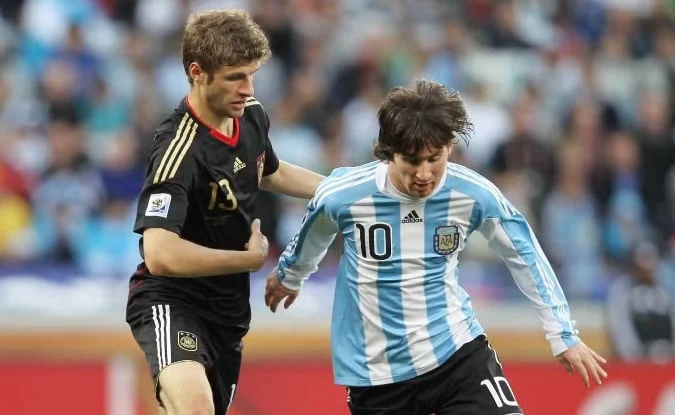
Thomas Muller, the decorated German football legend, has reignited a long-standing controversy by making pointed remarks about Lionel Messi and the officiating in the wake of Argentina’s 0-1 defeat to Spain in the 2026 FIFA World Cup final. Muller’s comments, surfacing amidst widespread criticism of several questionable refereeing decisions that allegedly favored Argentina throughout the tournament, have sparked renewed debate regarding the perceived influence of the Argentine superstar on match officials.
The controversy centers on an incident from the 2010 FIFA World Cup quarter-final, where Germany decisively defeated Argentina 4-0. Muller was shown a yellow card for a handball offense, a booking that ultimately ruled him out of Germany’s subsequent semi-final clash against Spain. He has now publicly expressed his belief that the referee’s decision in that pivotal match was not solely based on the handball itself, but was influenced by Messi’s proximity and, implicitly, his perceived plea to the official.
Recounting the 2010 Incident
Muller, speaking in the aftermath of the 2026 World Cup final, recalled the specific moment from the 2010 encounter. "We were already leading against Argentina, and Lionel Messi was standing right next to me," Muller stated, as quoted in various media reports and social media snippets. "The ball bounced off the ground and then hit my hand, which was in this position," he elaborated, likely gesturing to a hand held close to his body, a position often considered less deliberate.
The German forward then delivered the crux of his controversial statement: "The referee immediately showed me a yellow card. I felt the reason was simple, because Messi was standing next to me. I felt Messi was looking at the referee as if to say, ‘we are trailing, please help us a little.’"
This recollection, shared years after the event, carries significant weight given the context of the 2026 World Cup. Argentina’s path to the final, though ultimately unsuccessful, was indeed marked by several contentious refereeing decisions. These included penalty awards, card revocations, and seemingly lenient judgments in crucial moments, all of which fueled speculation and debate among fans, pundits, and opposing teams about whether the officials were subtly swayed by the narrative surrounding Messi’s potential final World Cup triumph.
The 2026 World Cup: A Tournament Marred by Refereeing Controversies
The 2026 FIFA World Cup, held in North America, will likely be remembered not only for its thrilling matches and dramatic upsets but also for the persistent undercurrent of refereeing controversies. From the group stages to the knockout rounds, numerous incidents drew the ire of players, coaches, and supporters alike.
- Group Stage Irregularities: Early in the tournament, Argentina benefited from a penalty decision that many observers deemed soft, which helped them secure a crucial victory. Another instance involved a seemingly clear handball offense being overlooked in a match where Argentina was under pressure.
- Knockout Stage Debates: As Argentina progressed, the scrutiny intensified. In their quarter-final match, a crucial foul committed by an Argentine player, which could have resulted in a red card, was instead punished with a yellow, allowing the player to remain on the field. Later, in the semi-final, a seemingly legitimate goal by the opposing team was disallowed for a marginal offside call, a decision that dramatically altered the course of the game.
- The Final Incident: While the final itself was a relatively clean affair in terms of overt refereeing errors, the lingering perceptions from earlier matches cast a long shadow. Spain’s solitary goal came from a moment of individual brilliance, but the narrative of Argentina’s ‘lucky’ journey to the final was already firmly established.
These cumulative incidents created an environment where any comment alluding to preferential treatment for Argentina, and by extension Messi, was bound to resonate powerfully. Muller’s statement, therefore, tapped into a pre-existing vein of skepticism and frustration.
Historical Context: Argentina vs. Germany Encounters
The rivalry between Argentina and Germany in the World Cup has a rich and often dramatic history. The 2010 quarter-final, where Muller’s contentious yellow card occurred, was a particularly significant chapter. Germany, under Joachim Löw, displayed a dominant performance, dismantling an Argentine side that boasted players like Messi, Gonzalo Higuaín, and Carlos Tevez. The 4-0 scoreline was emphatic, and the early goal from Müller, followed by his subsequent booking, was a turning point for the German team, forcing them to adapt their strategy for the next match.
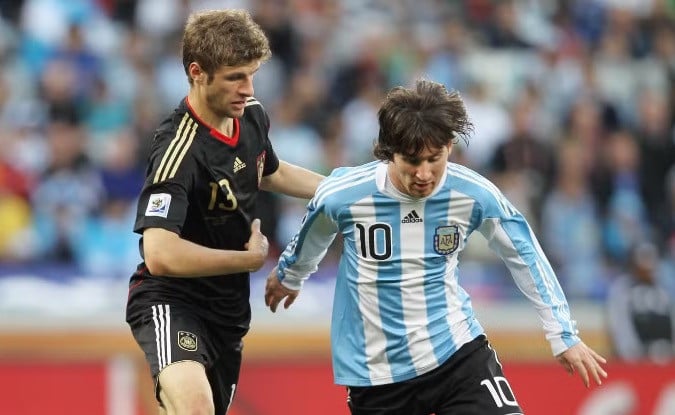
Muller’s absence in the semi-final against Spain was a significant blow. The match itself was a tactical masterclass by Spain, who eventually won 1-0 thanks to Carles Puyol’s header. Had Muller been available, it is a hypothetical scenario that has been debated by football historians and fans for years: could Germany have challenged Spain more effectively? Muller’s current remarks suggest he believes the referee’s decision in 2010, influenced by the presence of Messi, directly impacted his and potentially Germany’s chances in that tournament.
Analysis of Muller’s Implication
Muller’s statement is carefully worded, avoiding direct accusations of corruption or explicit bribery. Instead, he uses phrases like "I felt the reason was simple" and "I felt Messi was looking at the referee as if to say, ‘please help us a little.’" This nuanced approach allows him to voice his suspicion without making unsubstantiated claims that could lead to severe repercussions.
The implication, however, is clear: that a referee might be subconsciously (or perhaps consciously) influenced by the presence of a globally recognized superstar like Messi, especially when that player’s team is in a precarious situation. This phenomenon, often referred to as "star power" or "aura" in sports, is a subject of ongoing discussion. Referees, like all humans, can be susceptible to psychological influences. The pressure of officiating a match involving a player of Messi’s stature, coupled with the high stakes of a World Cup, could theoretically lead to split-second decisions that are not purely objective.
Reactions and Broader Implications
Muller’s comments quickly went viral on social media platforms, reigniting debates among football fans worldwide. While some have defended Muller, echoing his sentiments and pointing to other instances where they believe Messi has benefited from favorable calls, others have vehemently criticized him. These critics argue that Muller is attempting to retroactively justify Germany’s loss and is unfairly tarnishing Messi’s legacy.
- Fan Reactions: Social media was flooded with clips of the 2010 incident and discussions about other controversial calls involving Messi. Hashtags like #MessiBias and #MullerWasRight trended in various regions.
- Pundit Commentary: Football analysts have offered a range of opinions. Some acknowledge the potential for subconscious bias in officiating, while others emphasize the need for concrete evidence and decry such accusations as unsubstantiated.
- Official Silence: As of now, there have been no official statements from FIFA, the Argentinian Football Association (AFA), or Lionel Messi himself regarding Muller’s remarks. This silence is typical in such situations, as governing bodies often avoid engaging with speculative controversies. However, the lack of a denial from Messi or the AFA could be interpreted by some as tacit acknowledgment or simply a strategic decision to not dignify the claims with a response.
The broader implications of Muller’s statement extend beyond a simple historical grievance. They touch upon fundamental questions about fairness, integrity, and the perception of bias in professional sports. In an era where VAR (Video Assistant Referee) technology aims to minimize human error, such comments highlight that subjective interpretations and potential psychological influences remain factors in the game.
The Legacy of Messi and Refereeing in the World Cup
Lionel Messi’s career is undeniably one of the greatest in football history. His extraordinary talent and achievements have earned him legions of admirers and a unique place in the sport’s pantheon. However, like any player who reaches such stratospheric heights, his career has also been subject to intense scrutiny, with every decision, every performance, and every perceived advantage being dissected.
The World Cup, as the pinnacle of international football, amplifies these narratives. The desire to see iconic players like Messi finally lift the coveted trophy can create immense pressure, not only on the players but also on the officials tasked with ensuring fair play. Muller’s comments, while retrospective, serve as a reminder that the perception of fairness is as crucial as fairness itself in maintaining the integrity and appeal of the sport.
As football continues to evolve, discussions surrounding refereeing standards, the influence of star players, and the psychological aspects of officiating will undoubtedly persist. Thomas Muller’s resurfacing of this decades-old controversy ensures that the debate over Messi’s impact on refereeing decisions, both perceived and real, will continue to be a talking point in the annals of World Cup history. The incident from 2010, amplified by the context of the 2026 World Cup and the surrounding controversies, has cemented its place as a significant, albeit contentious, moment in the careers of both Muller and Messi, and in the broader narrative of the FIFA World Cup.