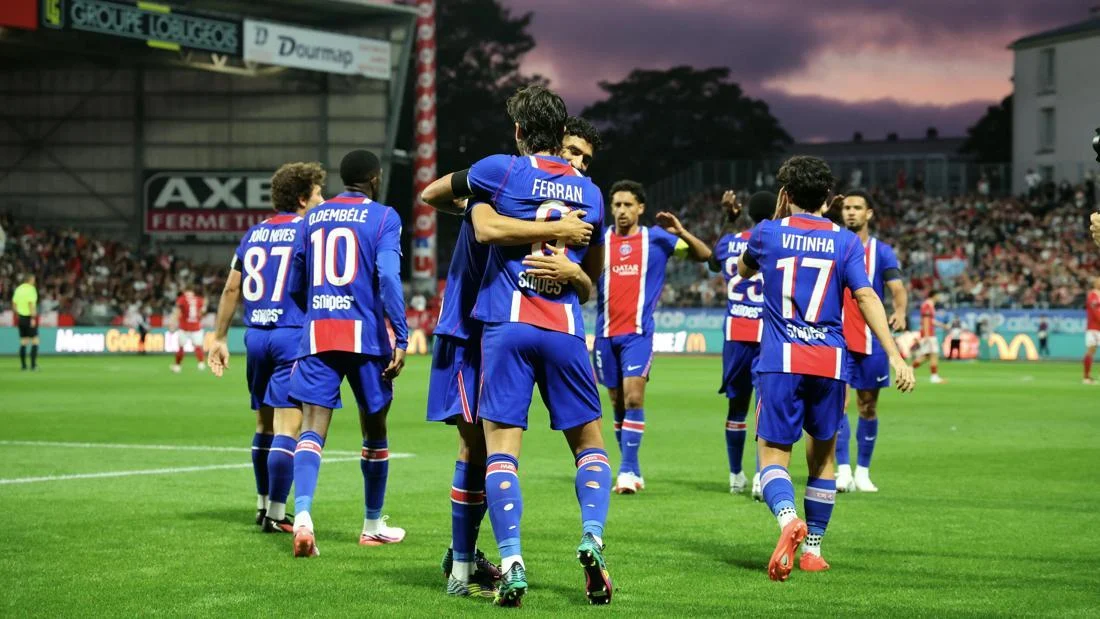
Paris Saint-Germain finally secured their first victory of the 2024-2025 Ligue 1 season, navigating a challenging away fixture at the Stade Francis-Le Ble to defeat Brest 1-0 on Monday morning. The result serves as a significant relief for manager Luis Enrique, whose side had struggled to find their rhythm in the opening stages of the domestic campaign. The decisive moment arrived early in the match, courtesy of new signing Ferran Torres, whose clinical finish in the fifth minute proved to be the difference-maker in a contest defined by tactical intensity and defensive resilience.
A Rapid Breakthrough and Tactical Stalemate
The match began with high energy, as PSG looked to assert dominance immediately following a lackluster start to their league season. The deadlock was broken just five minutes into the encounter. A fluid transition play saw the PSG attack slice through the Brest defensive line, allowing Ferran Torres to capitalize on the early defensive lapse. His goal, a composed strike that found the bottom corner, marked a significant personal milestone and injected immediate confidence into a PSG squad that had been under immense scrutiny following three winless matches.
Despite the early lead, the remainder of the first half evolved into a tactical chess match. PSG dominated possession, maneuvering the ball with precision through the midfield trio of João Neves, Vitinha, and Warren Zaïre-Emery. However, the visitors found it increasingly difficult to penetrate a disciplined Brest low block. While Ousmane Dembélé and Khvicha Kvaratskhelia provided consistent width and tested the Brest backline with intricate dribbling, the final pass often went astray, or was intercepted by the vigilant Egil Selvik in the Brest goal. As the referee signaled for halftime, PSG maintained their narrow 1-0 lead, though the fragility of the margin remained a concern for the traveling faithful.
Second-Half Resilience and Defensive Discipline
The complexion of the game shifted in the second half. Brest, fueled by the vocal home crowd, began to press higher up the pitch, forcing PSG into defensive transitions. The hosts, led by the physical presence of Ludovic Ajorque in the attack, tested the resolve of the PSG backline on multiple occasions.
Matvey Safonov, occupying the PSG goal, was forced into several crucial interventions as Brest searched for an equalizer. The pressure from the hosts was sustained, with Kenny Lala and Bradley Locko frequently overlapping to provide crosses into the danger zone. PSG’s defensive unit, anchored by Marquinhos and Willian Pacho, stood firm under the mounting pressure. The tactical adjustments made by Luis Enrique—focusing on maintaining shape and managing the tempo—allowed PSG to survive the onslaught. While the Parisians launched dangerous counter-attacks through Dembélé, they were unable to add a second goal, leaving the game on a knife-edge until the final whistle.
Contextualizing the Struggle: A Slow Start for the Champions
The victory against Brest is not merely three points; it is a vital psychological hurdle cleared for a team in transition. Entering this match, PSG occupied an unfamiliar position in the standings, having recorded two draws and one defeat in their opening three league fixtures. This uncharacteristic lack of form had invited questions regarding the team’s cohesion following the departures of several high-profile players during the summer transfer window and the subsequent arrival of fresh talent.
With only two points from their first three matches, the pressure on Luis Enrique had been mounting. The draw against local rivals and the unexpected loss had signaled a potential power vacuum in Ligue 1, a league PSG has historically dominated. By securing this 1-0 win, the club has stabilized its trajectory. PSG now sits with five points, sharing the total with Brest and several other clubs in a congested middle section of the table. While they remain outside the top four, the win provides a platform to build consistency as the grueling schedule of the UEFA Champions League looms on the horizon.
Statistical Breakdown and Player Performances
The data from the match highlights the controlled nature of PSG’s victory. PSG commanded approximately 62% of the possession, emphasizing their intent to dictate the tempo of the game. Despite the dominance, they were limited to five shots on target, a testament to the stubborn defensive structure employed by Brest.
Ferran Torres’s goal was the highlight of his early PSG tenure, showcasing his ability to find space in high-pressure situations. Defensively, the pairing of Willian Pacho and Marquinhos proved vital, winning a combined 12 duels and contributing to the clean sheet—a rarity for the team in the early weeks of the season. For Brest, the performance of goalkeeper Egil Selvik was commendable; he recorded four crucial saves that kept his side in contention until the final minute, illustrating the quality present in the mid-table tiers of French football.
Official Reactions and Managerial Perspective
In the post-match press conference, PSG manager Luis Enrique struck a tone of measured satisfaction. "It is never easy to come to a stadium like this and secure a result," he noted. "We saw the character of the team today. After a difficult start to the season, the players showed maturity. We know we must be more clinical in the final third to kill off games, but the defensive discipline shown today is the foundation upon which we will build our campaign."
Conversely, the Brest camp expressed disappointment but remained optimistic about their long-term prospects. The consensus within their dressing room was that the early goal conceded forced a tactical deviation that ultimately cost them points. "We conceded early, which changed our entire game plan," a spokesperson for the club stated. "However, the way we responded in the second half proves that we can compete with the league leaders. We take the positives from the second-half performance and look toward the next round of fixtures."
Broader Implications for Ligue 1
The result at the Stade Francis-Le Ble serves as a microcosm of the current state of Ligue 1. The gap between the traditional giants and the rest of the league appears to be narrowing, as smaller clubs become increasingly adept at executing compact, counter-attacking defensive systems.
For PSG, the implications of this match are twofold. First, it arrests the slide and prevents a crisis of confidence from taking hold in the early autumn. Second, it allows for the integration of new signings like Kvaratskhelia and Torres to continue without the suffocating atmosphere of a winless run. However, the lack of a second goal remains a point of concern for analysts. PSG’s reliance on a single goal to beat a mid-table side suggests that while the defensive transition is improving, the attacking fluidity is still a work in progress.
As the season progresses, PSG will face more rigorous tests, particularly away from home. The victory over Brest is an essential first step, but the upcoming fixtures will determine if this result represents a true turning point or merely a fleeting recovery. For now, the Parisian side can breathe a sigh of relief, having successfully navigated a challenging evening in Brittany to secure their first win of the season. The focus now shifts to the training ground, where Enrique will look to refine the attacking chemistry of his squad, ensuring that when the Champions League begins, the team is operating at the peak of its powers.
The league table remains tight, with the five-point mark placing PSG in a position to strike as the top clubs begin to separate themselves in the coming weeks. For the neutral observer, the competitive nature of this fixture confirms that the 2024-2025 Ligue 1 season promises to be one of the most unpredictable in recent memory.