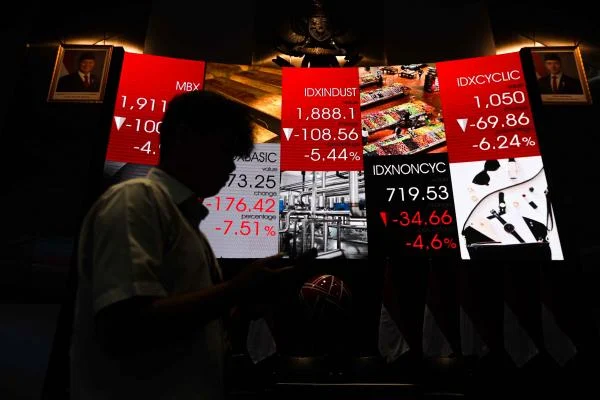
The Indeks Harga Saham Gabungan, or the Jakarta Composite Index (JCI), closed in negative territory during the trading session on Monday, September 14, 2026, pressured by widespread sectoral corrections despite a late afternoon recovery sparked by significant political developments. The benchmark index slipped 0.1 percent to settle at 6,534, halting just above its intraday lows as investors digested a major high-level cabinet shakeup orchestrated by the administration.
Throughout the Monday trading session, the composite index experienced notable volatility, charting a wide trajectory. The market opened under persistent downward pressure, dragging the index down to an intraday low of 6,371. However, market sentiment experienced a modest upward adjustment toward the latter half of the trading day. This slight recovery coincided with official breaking news from the State Palace regarding a high-profile leadership change at the Ministry of Finance, where President Prabowo Subianto officially inaugurated Suahasil Nazara as the new Minister of Finance, replacing his predecessor, Purbaya. Despite this late-session momentum, the broader market failed to sustain an overall positive trajectory, leaving the headline index to close the day with a fractional loss.
Market Breadth and Broad-Based Selling Pressure
While the headline index only suffered a marginal decline of 0.1 percent, the underlying market breadth revealed a far more subdued picture across the board. Data compiled from the Indonesia Stock Exchange (IDX) indicated that selling pressure dominated the floor, with the vast majority of listed equities finishing in the red.
Specifically, 455 stocks suffered corrections, dwarfing the count of advancing equities. Meanwhile, only 229 stocks managed to post gains, and 279 stocks remained unchanged from their previous closing prices. This disparity between the headline index and individual stock movements highlights how heavy-weight constituents or selective buying cushioned the benchmark from a steeper fall, even as the broader market endured broad-based liquidations.
Trading Activity and Liquidity Metrics
Despite the cautious sentiment and negative close, market liquidity remained robust throughout the session. Total transaction value reached a substantial Rp17.7 trillion, reflecting active portfolio balancing and institutional reallocations in response to the sudden fiscal leadership transition.
Trading volume totaled 33.38 billion shares changing hands across approximately 2.055 million individual transactions. Concurrently, the overall market capitalization of the Indonesia Stock Exchange stood resiliently at approximately Rp11.371 trillion, demonstrating the underlying depth and scale of Southeast Asia’s largest capital market even during periods of domestic political and economic recalibration.
Sectoral Performance Breakdown
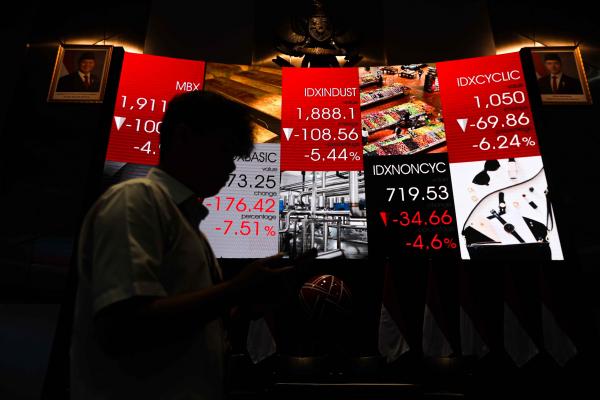
An analysis of sectoral indices shows that the downward pressure on Monday was widespread, affecting defensive and cyclical sectors alike. The healthcare sector bore the brunt of the sell-off, plunging 2.95 percent to lead the sectoral losses. Analysts noted that pharmaceutical and healthcare providers faced profit-taking and sentiment-driven adjustments following recent regulatory updates.
The energy sector followed closely behind, recording a 1.66 percent decline as global commodity prices and domestic resource equities faced downward revisions. Infrastructure stocks also lost ground, dropping 1.45 percent, while the basic materials sector fell 1.41 percent due to softening demand expectations in regional industrial supply chains. Additionally, the non-cyclical consumer goods sector—frequently viewed as a defensive stronghold—could not escape the broader market downturn, shedding 1.19 percent by the closing bell.

Chronology and Background of the Ministerial Transition
The centerpiece of Monday’s domestic news cycle was the unexpected and high-profile cabinet reshuffle announced by President Prabowo Subianto. The President formally relieved Purbaya of his duties as Minister of Finance and appointed Suahasil Nazara to helm the critical economic ministry. The swearing-in ceremony took place late Monday afternoon at the State Palace in Jakarta.
The sudden transition introduces a familiar yet pivotal figure back into the top echelons of fiscal management. Suahasil Nazara brings extensive macroeconomic experience to the role, having previously served in key economic advisory and structural capacities within the government. The leadership change comes at a delicate juncture for the Indonesian economy, characterized by global economic uncertainties, currency fluctuations, and the ongoing challenge of balancing national development ambitions with strict fiscal discipline.
Presidential Directives and the Mandate for Fiscal Health
Immediately following the swearing-in ceremony, President Prabowo Subianto issued a direct and unambiguous mandate to the newly appointed Finance Minister. The head of state placed paramount emphasis on safeguarding the structural integrity and sustainability of the state budget, commonly known as the Anggaran Pendapatan dan Belanja Negara (APBN).
The president underscored that maintaining the "health" of the APBN is non-negotiable. This directive serves as a clear signal to both domestic and international financial markets that the administration remains firmly committed to fiscal prudence, deficit containment, and disciplined debt management. Amid growing pressures to fund ambitious national infrastructure and social programs, the new Finance Minister faces the intricate task of optimizing state revenues while preventing fiscal expansion from destabilizing macroeconomic stability.

Implications for Investor Sentiment and the Capital Markets
The simultaneous occurrence of a cabinet reshuffle and a subdued trading session on the IDX has prompted extensive commentary from market analysts and institutional strategists. The initial market reaction—reflected in the late-day stabilization of the IHSG—suggests that investors are cautiously optimistic about Suahasil Nazara’s administrative capabilities and his deep institutional familiarity with Indonesia’s fiscal framework.
However, the prevailing red numbers across the broader sectoral indices indicate that market participants are adopting a wait-and-see approach. Investors are eager to see how the new Ministry of Finance leadership team will navigate upcoming fiscal targets, manage sovereign bond yields, and coordinate monetary-fiscal policies with Bank Indonesia. The transition is viewed as a crucial juncture for policy continuity and regulatory predictability, both of which are vital for attracting foreign portfolio investments back into Indonesian equities.
Outlook and Future Trajectory for the IHSG
Looking ahead, market observers anticipate that trading on the Indonesia Stock Exchange will remain sensitive to both domestic political implementation and global macroeconomic cues, including anticipated interest rate decisions by major central banks and fluctuating commodity trends.
As the dust settles on the executive transition, institutional focus will shift toward upcoming corporate earnings reports, monthly macroeconomic indicators, and early policy announcements from the newly appointed Minister of Finance. While short-term volatility is expected to persist as portfolios adjust to the new fiscal leadership, the robust liquidity recorded on Monday demonstrates that capital remains deeply engaged in the Indonesian market, awaiting clearer signals of sustainable economic momentum.