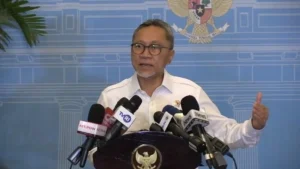
The Indonesian Financial Services Authority (OJK) has intensified its oversight of the capital market, issuing a series of administrative sanctions against 23 publicly listed companies as of August 31, 2026. Among the entities cited in the latest enforcement actions are PT Nippon Indosari Corpindo Tbk. (ROTI), the producer of the well-known Sari Roti brand affiliated with the Salim Group, and PT Bakrie & Brothers Tbk. (BNBR), a prominent holding company within the Bakrie Group. These enforcement actions underscore the regulator’s commitment to enforcing strict corporate governance, particularly regarding transparency in material transactions and the procedural integrity of appointing independent auditors.
Hasan Fawzi, the Chief Executive of Capital Markets, Derivatives, and Carbon Exchange Supervision at OJK, confirmed that the penalties were issued following thorough investigations into non-compliance with the Financial Services Authority Regulations (POJK). The sanctions highlight a broad spectrum of regulatory requirements that listed companies must navigate, ranging from the appointment of Public Accountants (AP) and Public Accounting Firms (KAP) to the disclosure and approval requirements for material financial transactions.
The Case of PT Nippon Indosari Corpindo Tbk. (ROTI)
PT Nippon Indosari Corpindo Tbk. (ROTI), a market leader in the mass-produced bread industry, was hit with an administrative fine of Rp150 million. The sanction stems from a procedural breach regarding the appointment of its external auditor for the 2023 and 2024 financial years.
According to OJK’s findings, the company’s Board of Directors appointed and approved the KAP prior to the holding of the Annual General Meeting of Shareholders (RUPST) for the respective financial years. Under the provisions of POJK No. 9/2023, the appointment of an external auditor is a mandate reserved for the shareholders via a resolution in the General Meeting of Shareholders (RUPS). By bypassing this stage, ROTI failed to adhere to the governance protocols designed to ensure the independence of the auditing process.
While the fine itself is relatively modest compared to the company’s market capitalization, the incident serves as a significant reminder to the corporate sector regarding the hierarchy of decision-making. Proper governance requires that the oversight body—the shareholders—maintain control over the selection of the parties responsible for verifying the company’s financial statements.
The Case of PT Bakrie & Brothers Tbk. (BNBR)
The sanction against PT Bakrie & Brothers Tbk. (BNBR) is substantially heavier, totaling Rp1.2 billion. The OJK’s investigation revealed a complex failure to comply with disclosure and approval requirements regarding a major loan transaction.
The core of the violation involves a loan secured by a controlled entity of BNBR, amounting to Rp4.81 trillion—a figure equivalent to 115.87% of the company’s equity. Under POJK No. 17/2020, which governs material transactions, such a high-value transaction necessitates rigorous disclosure and, crucially, explicit approval from the shareholders.
OJK identified several layers of failure in this transaction:
- Change of Counterparty: The actual lender was different from the one originally presented to and approved by shareholders during the RUPS.
- Lack of Independent Valuation: The company failed to utilize an independent appraiser to assess the transaction, a requirement meant to protect minority shareholders from potential conflicts of interest or unfavorable terms.
- Disclosure Failures: BNBR did not perform the mandatory public disclosure nor did it notify the OJK regarding the actual identity of the lender, thereby keeping the market and regulators in the dark about the true nature of the material transaction.
The severity of the fine reflects the systemic nature of the breach, as it involved not just a failure to follow meeting procedures, but an avoidance of the checks and balances required for transactions that fundamentally alter the company’s risk profile.
Regulatory Context and OJK Enforcement Trends
The sanctions against ROTI and BNBR are part of a broader, more aggressive enforcement posture adopted by the OJK throughout 2026. Data up to August 31, 2026, reveals that the OJK has issued a total of 1,277 administrative sanctions, warnings, and written orders to market participants.
Of this total, 93 were formal administrative sanctions specifically targeting violations of capital market regulations. The composition of these enforcement actions is as follows:
- Financial Fines: Totaling Rp73.99 billion.
- Written Warnings: Eight instances.
- Written Orders: Five instances.
- Prohibitions: Ten instances.
- License Suspensions: Six instances.
These figures illustrate a regulatory environment where the OJK is increasingly utilizing its authority to penalize both minor procedural lapses and major governance failures. The objective is to cultivate a "culture of compliance" that aligns with international standards, particularly as the Indonesian capital market seeks to attract more foreign institutional investment.
Chronology of Enforcement
The OJK’s oversight process involves a continuous audit cycle. Throughout the first eight months of 2026, the regulator conducted a series of "thematic inspections" focused on transparency in financial reporting and the conduct of General Meetings of Shareholders.
Following the discovery of discrepancies in the 2023-2024 audit cycles and the review of material transactions filed in the public disclosure system, the OJK issued Requests for Information (RFI) to the companies involved. Upon review of the responses, the OJK determined that the actions of ROTI and BNBR constituted clear violations of existing POJK statutes. Formal notification of the fines was finalized in the late summer of 2026, culminating in the public announcement released this September.
Implications for Market Governance
The imposition of these fines carries significant implications for the Indonesian stock exchange. Firstly, it signals to listed companies that the OJK is utilizing advanced data analytics to cross-reference shareholder resolutions with actual corporate actions. The days of "rubber-stamping" auditor appointments or obscuring the true nature of material loans are increasingly coming to an end.
For investors, these sanctions are a double-edged sword. While the fines indicate that regulatory enforcement is working, they also highlight governance risks inherent in large holding companies. Investors are advised to pay closer attention to the "Notes to Financial Statements" and the specific terms of material transactions disclosed on the Indonesia Stock Exchange (IDX) website.
Furthermore, the BNBR case highlights the risks associated with "Company Controlled Entities." Often, large conglomerates utilize subsidiaries to undertake debt, which may not always be immediately visible to the retail investor. The OJK’s move to penalize BNBR for the lack of transparency in its subsidiary’s loan is a positive step toward ensuring that the true debt burden of a group is properly represented to the public.
Expert Perspectives and Future Outlook
While neither the Salim Group nor the Bakrie Group has issued a comprehensive formal defense beyond their initial responses to the OJK, market analysts suggest that these fines will lead to a stricter internal compliance regime for both companies.
"The OJK is signaling a shift from a reactive regulator to a proactive, risk-based supervisor," said a senior analyst at a Jakarta-based brokerage. "Companies that fail to recognize that the rules of the game have changed regarding material transactions and auditor independence will find themselves facing not just financial penalties, but also reputational damage that could impact their cost of capital."
As the market progresses toward the end of 2026, the OJK is expected to maintain its enforcement intensity. For listed companies, the message is clear: compliance with POJK No. 9/2023 and POJK No. 17/2020 is not merely a box-ticking exercise, but a fundamental prerequisite for operating within the Indonesian capital market. The regulator’s focus on these specific statutes suggests that future audits will continue to scrutinize the interplay between board decisions, shareholder approvals, and independent financial verification.
Ultimately, the goal of these interventions is to bolster investor confidence. By holding large, influential groups accountable to the same regulations as smaller entities, the OJK is fostering a more equitable playing field, which is essential for the long-term health and growth of the Indonesian financial ecosystem. As of mid-September 2026, the market remains expectant of further disclosures from the OJK regarding the remaining 21 entities currently under investigation, suggesting that the regulatory cleanup initiated earlier this year is far from over.