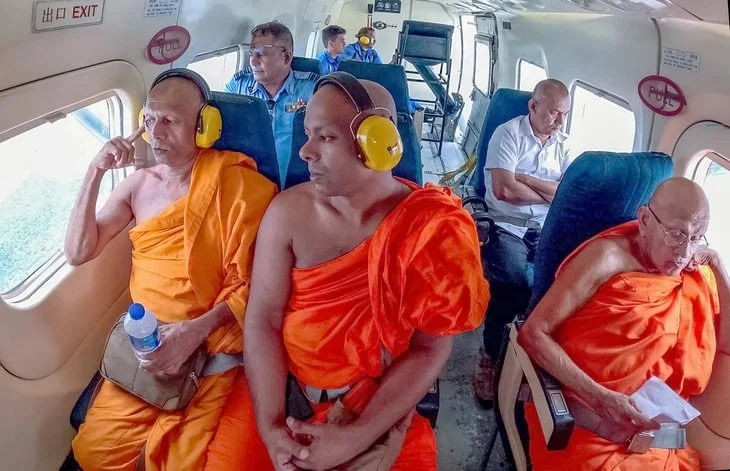
In an unusual intersection of state-sanctioned military logistical support and traditional religious practice, the Sri Lanka Air Force (SLAF) conducted a unique aerial operation on September 19, transporting three Buddhist monks aboard a Y-12 transport aircraft to perform a ritual intended to invoke rainfall over drought-stricken regions of the nation. The mission, which saw the clergy chanting prayers and sprinkling "blessed water" from high altitudes, represents a desperate response to the escalating climate crisis currently gripping the island nation and broader South Asia.
The Aerial Ritual: A Convergence of Faith and Military Logistics
The operation took place under the cover of evening on September 19, as the SLAF deployed a Harbin Y-12 light utility aircraft to traverse the skies above areas suffering from acute moisture deficits. Inside the aircraft, three monks draped in traditional saffron robes chanted ancient prayers, a practice rooted in Buddhist tradition often employed during times of environmental catastrophe or social distress.
Accompanied by military personnel, the monks utilized plastic containers filled with water that had been consecrated through religious rites. As the aircraft navigated the flight path over parched agricultural zones, the contents were ceremonially dispersed into the atmosphere. The SLAF characterized the mission as a "symbolic act of solidarity" with the citizens and farmers who have been severely impacted by the lack of precipitation.
Chronology of the Drought and Response
The decision to initiate this aerial prayer mission follows months of deteriorating meteorological conditions in Sri Lanka. The following timeline outlines the progression of the crisis and the state’s multi-pronged response:
- Early 2023: Initial signs of below-average rainfall were recorded in the north-central and eastern provinces, the traditional "dry zone" of Sri Lanka.
- May–July 2023: The Department of Meteorology in Sri Lanka noted a significant decrease in precipitation during the Yala cropping season, leading to water shortages in major reservoirs used for irrigation and hydroelectric power generation.
- August 2023: The Ministry of Agriculture reported substantial crop failure in paddy fields, prompting discussions about national food security.
- Mid-September 2023: With reservoir levels dipping below critical thresholds, local communities began intensifying traditional religious appeals for rain.
- September 19, 2023: The Sri Lanka Air Force officially confirms the execution of the "rain-praying" flight, garnering international attention.
Meteorological Context: The Shadow of El Niño
The drought in Sri Lanka is not an isolated event but rather part of a regional and global climate pattern heavily influenced by the El Niño Southern Oscillation (ENSO). Scientists have identified the current cycle as a significant El Niño event, which typically results in suppressed rainfall across much of South and Southeast Asia.
According to meteorological data, El Niño conditions frequently lead to "super" events where temperature anomalies deviate significantly from historical averages. In Sri Lanka, this manifests as prolonged heatwaves and a reduction in the southwest monsoon’s efficacy. The implications for the region are severe; as reservoirs dry up, the country faces a double crisis: the loss of agricultural output and a looming energy shortage, given that a significant portion of Sri Lanka’s electricity grid relies on hydropower.
The phenomenon is also affecting neighboring regions. In Vietnam, for instance, central and southern provinces have reported similar conditions, with authorities bracing for a sequence of extreme weather events—including intense heatwaves and saltwater intrusion—as the El Niño cycle is expected to intensify through October and potentially into the following year.
Official Responses and Public Sentiment
The involvement of the Sri Lanka Air Force in a religious ceremony has sparked a nuanced debate regarding the role of state institutions in secular governance versus traditional cultural expression. An official spokesperson for the SLAF stated on social media that the mission was an attempt to provide moral support to the populace during a period of immense suffering.
"When the country is facing a drought, the takeoff of this aircraft is a symbolic act of solidarity with those in need," the statement read.
For many in the rural population, the act was received with gratitude. In Buddhist-majority Sri Lanka, the integration of religious ritual into state affairs is not entirely unprecedented, as the government often relies on traditional cultural practices to maintain social morale during times of crisis. Conversely, secular observers and environmental scientists have pointed out that while the ritual provides a sense of psychological comfort, it does not address the underlying infrastructural and systemic issues that exacerbate the impact of the drought.
Broader Implications: Food Security and Energy
The current drought serves as a stark reminder of the vulnerability of island nations to climate change. Beyond the immediate symbolic gesture of the prayer flight, the economic data presents a grim reality. The decline in agricultural production has triggered a rise in domestic food prices, placing an additional burden on a population already navigating a complex economic recovery.
Furthermore, the water levels in reservoirs such as the Mahaweli complex are closely monitored. If these levels remain low, the government may be forced to implement scheduled power cuts, as seen in previous years when hydroelectric capacity was compromised. The reliance on rain-fed agriculture means that any significant deviation in the monsoon cycle ripples through the entire economy, from subsistence farmers to large-scale export operations.
Analysis: Climate Adaptation vs. Traditional Ritual
From a journalistic and analytical perspective, the event highlights the gap between environmental reality and human response. While modern climate science suggests that adaptation strategies—such as drought-resistant crop varieties, improved water management systems, and investment in solar or wind energy to offset hydro-dependence—are the only viable long-term solutions, the human element remains deeply connected to spiritual traditions.
Sociologists note that in times of extreme uncertainty, societies often revert to rituals that provide a sense of agency. Even if the ritual does not produce a meteorological change, its function as a tool for social cohesion cannot be dismissed. The SLAF’s decision to assist the monks acknowledges the importance of this cultural fabric, even as the government continues to grapple with the scientific and logistical aspects of the drought.
Environmental Outlook and Future Preparedness
As the global community enters a period of heightened climate volatility, the experiences of Sri Lanka, Vietnam, and other nations in the path of the current El Niño will likely become more frequent. The "super" El Niño forecast for the coming months necessitates a shift in how nations prepare for weather-related catastrophes.
Governments across the region are now faced with the challenge of balancing immediate disaster relief with long-term climate adaptation. This includes:
- Investment in Smart Irrigation: Moving away from flood irrigation toward drip and sprinkler systems to maximize water efficiency.
- Crop Diversification: Encouraging farmers to plant drought-resistant crops that require less water than traditional rice varieties.
- Infrastructure Resilience: Strengthening the grid to handle a mix of energy sources so that the nation is not solely dependent on hydropower during dry spells.
- International Cooperation: Sharing meteorological data and climate modeling to improve early warning systems.
Conclusion
The sight of a military transport aircraft carrying Buddhist monks into the clouds to petition for rain is a poignant image of a nation grappling with forces far beyond its control. While the operation was symbolic, it underscores the intensity of the drought and the profound anxiety it has generated across all levels of society.
As Sri Lanka moves forward, the challenge will be to integrate such cultural expressions of hope with rigorous, evidence-based climate policy. The mission of September 19 remains a unique chapter in the country’s efforts to manage the crisis, reflecting a culture that, while looking toward the heavens for salvation, is increasingly cognizant of the earthly transformations forced by a changing global climate. Whether the prayers are answered by the clouds or the nation must rely on its capacity for industrial and agricultural adaptation, the events of this month remain a testament to the resilience of a people confronting the harsh realities of the 21st-century climate landscape.