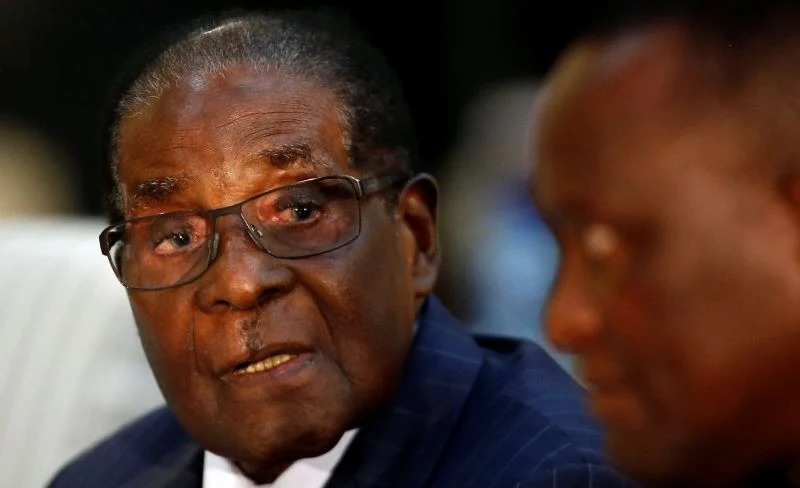
The political landscape of Southern Africa underwent a historic transformation on Wednesday, November 22, 2017, when Robert Gabriel Mugabe officially stepped down as the President of Zimbabwe. At the age of 93, the world’s oldest sitting head of state at the time relinquished the power he had held for nearly forty years. His resignation brought a dramatic end to a tumultuous week defined by a military takeover, mass street protests, and impending impeachment proceedings in parliament.
Mugabe’s departure marked the closure of a complex chapter in modern African history—transitioning from a celebrated anti-colonial liberation hero to an authoritarian ruler whose policies ultimately crippled a once-prosperous nation. Across the capital city of Harare and throughout the country, the news of his resignation triggered spontaneous celebrations. Thousands of citizens flooded the streets, dancing, singing, and waving Zimbabwean flags, expressing an overwhelming sense of liberation and hope for a democratic future.
The Chronology of the Crisis: From Military Intervention to Resignation
The events leading to Robert Mugabe’s resignation unfolded rapidly over a tense eight-day period in November 2017. The catalyst for the crisis was an intensifying succession battle within the ruling Zimbabwe African National Union-Patriotic Front (ZANU-PF) party. For months, a faction loyal to Mugabe’s wife, Grace Mugabe, had been locked in a bitter power struggle with veterans of the liberation struggle, most notably Emmerson Mnangagwa, the country’s long-serving Vice President.
On November 6, 2017, Mugabe dismissed Mnangagwa, accusing him of disloyalty and plotting to seize power through unorthodox means, including witchcraft. Mnangagwa fled the country, warning of retribution against the ruling elite. Sensing that Grace Mugabe—who was widely unpopular and viewed as an extravagant figure disconnected from the daily struggles of ordinary citizens—was poised to succeed her aging husband, the military stepped in.
In the early hours of November 15, 2017, the Zimbabwe National Army, led by General Constantino Chiwenga, launched a bloodless military intervention. Tanks rolled into Harare, seizing control of the state broadcaster, ZBC, and placing Robert and Grace Mugabe under house arrest. While military leaders vehemently denied staging a coup, insisting they were merely targeting the "criminals" surrounding the president who were steering the country toward economic and social ruin, the international community recognized the action as a de facto regime change.
Despite the military takeover, Mugabe initially resisted pressure to step down. He insisted on maintaining his constitutional legitimacy during negotiations brokered by military generals and southern African envoys. However, the political ground shifted dramatically on November 19, when ZANU-PF stripped Mugabe of his role as party leader and expelled his wife, replacing him with the newly returned Mnangagwa.
On November 21, as the Zimbabwean Parliament formally convened to initiate impeachment proceedings against the embattled leader, a letter of resignation from Mugabe was read aloud by the speaker of parliament, Jacob Mudenda. The legislative chamber erupted in rapturous applause, mirroring the jubilation taking place on the streets outside.
Early Life, Education, and the Rise of a Revolutionary
To understand the immense gravity of Robert Mugabe’s fall, it is essential to examine his rise to power. Born on February 21, 1924, in Kutama, located in the northeastern district of Salisbury (now Harare) in what was then the British colony of Southern Rhodesia, Mugabe grew up in a deeply religious, mission-educated household.
Displaying an exceptional intellect from a young age, Mugabe pursued education with relentless dedication. Before entering the political arena, he worked as a schoolteacher, a vocation that took him to various parts of Southern Rhodesia and neighboring Ghana. Over the course of his lifetime, Mugabe accumulated as many as seven academic degrees, earning qualifications in education, law, economics, and administration through distance learning while imprisoned or in office.
Mugabe’s political awakening occurred during a period of entrenched racial segregation and white minority rule under Prime Minister Ian Smith. In 1960, Mugabe joined the National Democratic Party, which was later banned by the colonial government. Implicated in delivering what the colonial authorities deemed "subversive speeches," Mugabe was arrested in 1964 and sentenced to a decade of imprisonment without trial.
The decade behind bars transformed Mugabe into a hardened revolutionary strategist. Following his release in 1974, he crossed the border into Mozambique, where he assumed leadership of the Zimbabwe African National Liberation Army (ZANLA), the military wing of ZANU. From exile, Mugabe orchestrated a protracted and bloody guerrilla war against the white-minority government.
The armed struggle, combined with international economic sanctions against Rhodesia, ultimately forced the Ian Smith regime to negotiate. The landmark Lancaster House Agreement of 1979 paved the way for democratic elections and internationally recognized independence. In April 1980, the independent nation of Zimbabwe was born, and Robert Mugabe assumed office as its first Prime Minister, hailed locally and globally as a visionary statesman committed to racial reconciliation and national development.
From Liberator to Authoritarian: The Decades of Decline
The early years of Mugabe’s administration were characterized by significant advancements in public education and healthcare, earning international acclaim. However, the promise of a prosperous, multiracial democracy gradually eroded as Mugabe centralized power and systematically dismantled institutional checks and balances.
A dark stain on his early tenure was the Gukurahundi massacres between 1983 and 1987, during which a North Korean-trained military brigade slaughtered an estimated 20,000 civilians in the Matabeleland region, predominantly targeting members of the minority Ndebele ethnic group who supported Mugabe’s political rival, Joshua Nkomo. Mugabe never formally apologized for the atrocities, framing the operation as a necessary measure to suppress dissidents.
In 1987, following constitutional amendments that abolished the post of Prime Minister, Mugabe transitioned from head of government to executive President. His personal life also underwent changes; his first wife, the Ghanaian-born Sally Hayfron, whom he married in 1961, passed away from kidney failure in 1992. In 1996, he married Grace Marufu, a former presidential secretary, in a lavish ceremony that drew criticism amid rising economic hardships.
By the late 1990s, mounting political opposition led by the Movement for Democratic Change (MDC), founded by trade unionist Morgan Tsvangirai, posed a genuine electoral threat to ZANU-PF. In response, Mugabe’s government initiated the controversial Fast Track Land Reform Program in 2000. Under the guise of addressing colonial land imbalances, the state seized productive commercial farms owned by white minorities and redistributed them to ruling-party loyalists, many of whom lacked agricultural expertise.
The chaotic land seizures crippled Zimbabwe’s agricultural sector, historically the backbone of the national economy. Foreign exchange reserves evaporated, leading to catastrophic hyperinflation in the late 2000s. At its peak in 2008, Zimbabwe’s inflation rate reached an astronomical 79.6 billion percent, rendering the local currency entirely worthless, wiping out the life savings of millions, and plunging the population into severe poverty, food insecurity, and widespread unemployment.
To maintain power, Mugabe increasingly relied on state-sponsored violence, judicial manipulation, and widespread electoral fraud during national polls in 2002, 2008, and 2013. Human rights organizations regularly documented arbitrary arrests, torture of political opponents, and the suppression of independent media.
Reactions from National and International Stakeholders
Mugabe’s resignation elicited a complex array of responses from the international community and domestic stakeholders. Western governments, which had imposed targeted sanctions on Mugabe and his inner circle due to human rights abuses and election rigging, cautiously welcomed his departure while emphasizing the need for democratic reforms and credible future elections.
African regional bodies, including the Southern African Development Community (SADC) and the African Union (AU), praised the peaceful manner in which the transition was handled, avoiding the large-scale civil conflict that many analysts had feared. However, critics noted that African leaders had long turned a blind eye to Mugabe’s authoritarian excesses, largely due to his status as a revered veteran of the continent’s anti-colonial struggles.
Domestically, civil society organizations and opposition figures expressed profound relief tempered by realistic caution. While citizens celebrated the end of the Mugabe era, many voiced concerns that the military intervention and the ascension of Emmerson Mnangagwa—a close confidant of Mugabe and a key figure in past state security apparatuses—represented a change of personnel rather than a fundamental shift in governance.
Implications and the Future of Post-Mugabe Zimbabwe
The removal of Robert Mugabe left profound political and economic implications for Zimbabwe. The immediate challenge facing the new administration under President Emmerson Mnangagwa was the stabilization of the collapsing economy. Rebuilding investor confidence, securing international financial bailouts from institutions like the International Monetary Fund and the World Bank, and addressing severe liquidity shortages required urgent structural reforms.
Politically, the transition tested the resilience of Zimbabwe’s democratic institutions. Analysts emphasized that true reform necessitated dismantling the entrenched patronage networks built by ZANU-PF over nearly four decades. Ensuring the independence of the judiciary, protecting freedom of the press, and guaranteeing free and fair elections became the primary benchmarks by which the post-Mugabe government would be judged by its citizens and the global community.
Ultimately, the fall of Robert Mugabe serves as a watershed moment in modern African political history. It demonstrated the limits of authoritarian endurance in the face of deep economic despair and public mobilization, while underscoring the enduring aspirations of ordinary citizens for accountable, democratic governance after decades of misrule.