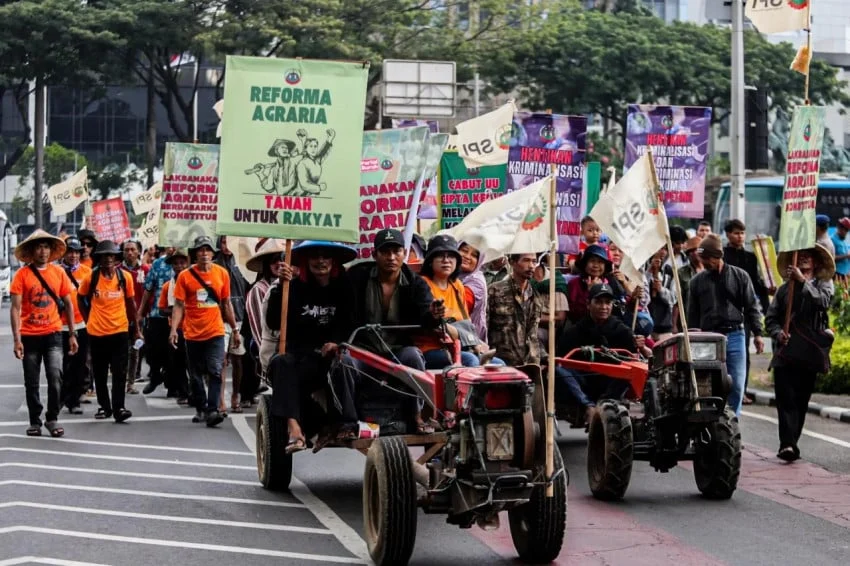
JAKARTA — The National Commission on Human Rights (Komnas HAM) has officially welcomed the enactment of the Agrarian Reform Regulation Law (UU PRA) by the House of Representatives (DPR RI). While acknowledging the legislative milestone achieved on Tuesday, September 22, 2026, the commission has issued a stern cautionary reminder. Komnas HAM emphasized that the subsequent implementing regulations must be formulated through a participatory approach, ensuring robust legal safeguards for indigenous communities and other vulnerable social groups who have historically been disproportionately affected by land disputes.
The endorsement by Komnas HAM aligns directly with a series of strategic policy recommendations previously compiled by the institution. These include the Human Rights-Based Roadmap for Agrarian Conflict Resolution, as well as an exhaustive study on the handling of agrarian conflicts within the operational duties and functions of the Indonesian National Police (Polri). For years, the commission has monitored systemic vulnerabilities in how land disputes are arbitrated across the archipelago, noting a persistent structural imbalance that frequently disadvantages local communities, smallholder farmers, and customary populations.
Shifting Agrarian Disputes from Criminal Courts to Rights-Based Resolutions
Uli Parulian Sihombing, the Commissioner for Research and Investigation at Komnas HAM, highlighted a critical flaw in the historical handling of land disputes in Indonesia. According to Uli, state apparatuses and corporate entities have routinely transformed civil and administrative land disputes into premature criminal cases, prosecuting community members under various penal codes for simply occupying or utilizing ancestral and traditional lands.
"Based on Komnas HAM’s comprehensive research and ongoing monitoring data, the handling of agrarian conflicts has consistently suffered from a premature shift—moving away from the core issues of land tenure, ownership, and utilization rights, and directly into the criminal domain," Uli stated in an official written statement released on Sunday, September 27, 2026.
This criminalization trend has historically resulted in the unnecessary detention of farmers, indigenous leaders, and local activists. Komnas HAM hopes that the newly minted Agrarian Reform Regulation Law will serve as a legal watershed, fundamentally altering how law enforcement agencies and judicial bodies approach land-related grievances by prioritizing human rights standards and restorative justice over punitive incarceration.
Legislative Milestones and the Path to Enactment
The road to the passage of the Agrarian Reform Regulation Law has been long, marked by decades of civil society advocacy, intense parliamentary debates, and frequent nationwide demonstrations led by agrarian reform movements, student organizations, and indigenous coalitions. Land rights groups have long argued that colonial-era legal frameworks, combined with overlapping sectoral regulations in forestry, mining, and plantation sectors, have severely compromised the welfare of rural populations.
Proponents of the legislation within the legislature have praised the bill as a tangible testament to the government’s commitment to addressing structural inequality. Lawmakers maintain that the enactment proves the DPR’s responsiveness to the socio-economic demands of the broader populace, particularly concerning the redistribution of land and the formalization of customary rights (hak ulayat).
However, civil society organizations and human rights watchdogs remain cautiously optimistic. While the overarching legislative framework has been established, the ultimate efficacy of the law will depend entirely on the drafting of its technical implementing regulations—specifically government regulations (PP) and ministerial decrees—which will dictate enforcement mechanisms on the ground.
Historical Context and Chronology of Agrarian Conflicts in Indonesia
To understand the weight of Komnas HAM’s recent statement, one must examine the broader historical landscape of land administration in Indonesia. Since the enactment of the landmark Basic Agrarian Law (UUPA) of 1960, the nation has struggled to achieve its promise of social justice and equitable land distribution.
Over the past two decades, rapid economic development, driven largely by large-scale extractive industries, palm oil plantations, and infrastructure expansion, has exponentially increased the frequency and severity of land conflicts. Data compiled by various agrarian NGOs and national human rights bodies consistently highlight hundreds of active land disputes spanning millions of hectares across Sumatra, Kalimantan, Sulawesi, and Papua.
Chronologically, the momentum leading up to the September 2026 legislative breakthrough can be broken down into several key phases:
- 2014–2019: The executive branch introduces the National Agrarian Reform Program (Pora), aimed at legalizing millions of hectares of land and redistributing assets, though implementation faces bureaucratic hurdles and localized resistance.
- 2020–2023: Escalation of agrarian conflicts during post-pandemic economic recovery initiatives, prompting Komnas HAM to intensify its institutional research and draft the Human Rights-Based Roadmap for Agrarian Conflict Resolution.
- 2024–2025: Heightened legislative lobbying by civil society coalitions, indigenous alliances (such as AMAN), and farmer unions urging the DPR to prioritize a comprehensive regulatory framework rather than piecemeal administrative fixes.
- September 22, 2026: The DPR RI officially passes the Agrarian Reform Regulation Law (UU PRA) amid continued public demonstrations and civil society monitoring.
- September 27, 2026: Komnas HAM issues its formal response, welcoming the law while demanding inclusive implementation and an end to the criminalization of land rights defenders.
Implications for Indigenous Peoples and Vulnerable Groups
The core apprehension voiced by Komnas HAM centers on the protection of indigenous populations (masyarakat adat) and local communities whose livelihoods are inextricably linked to customary territories. Under previous legal regimes, the lack of formal recognition for customary forests and communal lands often left indigenous groups vulnerable to eviction when state-issued concession permits overlapped with ancestral domains.
Legal experts note that for the Agrarian Reform Regulation Law to succeed, it must harmonize existing, conflicting statutory provisions across the Ministry of Agrarian Affairs and Spatial Planning/National Land Agency (BATR/BPN), the Ministry of Environment and Forestry, and local regional governments. Without seamless inter-agency coordination, overlapping legal mandates will continue to create loopholes that disadvantage grassroots communities.
Furthermore, the demand for a "participatory" drafting process for the implementing regulations implies that the government must actively consult indigenous representatives, academic experts, human rights organizations, and local community leaders. Top-down regulatory drafting has historically alienated the very populations the law is designed to protect, leading to implementation paralysis at the village level.
Broader Economic and Social Impacts
Beyond human rights considerations, the successful implementation of the Agrarian Reform Regulation Law carries profound macroeconomic implications. Secure land tenure is widely recognized by economists as a vital prerequisite for sustainable rural development, poverty alleviation, and investment certainty.
When smallholders and indigenous communities possess legal security over their plots, they are more inclined to invest in sustainable land management practices, enhance agricultural productivity, and access formal financial credit systems without predatory intermediaries. Conversely, unresolved land disputes depress local economies, trigger prolonged social friction, and expose corporations to reputational and operational risks.
As Indonesia navigates the post-enactment phase of the UU PRA, all eyes will be on the executive branch and relevant ministries as they begin drafting the technical rules of engagement. Komnas HAM has signaled that it will maintain an active oversight role, monitoring whether the state can successfully bridge the gap between legislative idealism and equitable ground-level reality, thereby ending the cycle of criminalizing citizens who seek justice over their ancestral lands.